Before the Business Model Canvas: the Market Opportunity Navigator
This article was machine-translated from Japanese by AI (Claude). It may contain errors. Read the original Japanese article.
While reading a paper on the Lean Startup, I came across a framework listed among the "frequently used frameworks" called the Market Opportunity Navigator, which has not been introduced much in Japan, so I'm introducing it here.
The Market Opportunity Navigator is proposed in the book Where to Play as a tool for looking at market opportunities more broadly, before zooming in on each business with something like the Business Model Canvas.
The Market Opportunity Navigator consists of three processes: (1) choose candidate markets, (2) consider how attractive the markets are, and (3) think through strategy. The steps are also available on Slideshare and elsewhere.
Market Opportunity Navigator, Lesson 1: Overview (slideshare.net)
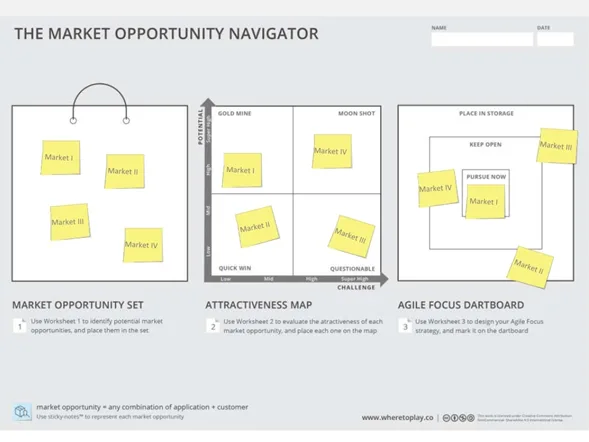
It seems to have originated in the paper "Look Before You Leap: Market Opportunity Identification in Emerging Technology Firms", which pointed out the thinking style of serial entrepreneurs (doing a lot of market identification before entering), and it was created to connect that to practice. Incidentally, the same authors appear on both the book and the paper above.
The order in which to use them
The Lean Startup Framework: Closing the Academic–Practitioner Divide - Dean A. Shepherd, Marc Gruber, 2021 suggests using them in this order:
- Market Opportunity Navigator
- Business Model Canvas
- Customer development / agile product development
Steve Blank's article, which also introduces the Market Opportunity Navigator, seems to say the same.
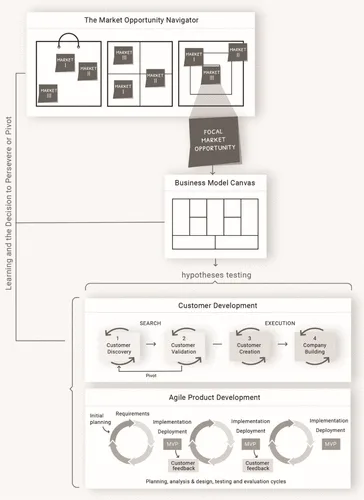
On the other hand, the Market Opportunity Navigator's own manual seems to recommend this order:
- Market Opportunity Navigator
- Business Model Canvas
- Empathy map
Personally, I think this order feels more natural:
- Market Opportunity Navigator
- Business Model Canvas
- Empathy map
- Customer development / product development (hypothesis testing)
And my impression is that rather than a strict order, you probably examine a business by going back and forth between each of them.
Personal thoughts
Compared with the past, the importance of choosing market opportunities and entry points seems to have risen relatively for startups, and my impression is that serial entrepreneurs choose their markets quite carefully. So I thought that first-time entrepreneurs, too, might try a tool like this when they get a little stuck.
// An article titled "Serial entrepreneurs take on fintech, spurred by deregulation" also came out recently.