A Design Support Tool for Entrepreneurship Education Courses (Using the Japanese Edition of the EntreComp v1 Guide)
This article was machine-translated from Japanese by AI (Claude). It may contain errors. Read the original Japanese article.
On Saturday, December 6 and Sunday, December 7, 2025, I led the FD (Faculty Development) program of the 2025 National Entrepreneurship Talent Development Program, hosted by the Ministry of Education, Culture, Sports, Science and Technology.
We have been running this for about three years, to respond to voices saying "I don't know how to design a course," and from the perspective of assuring the quality of courses as entrepreneurship education spreads.
This year, about 60 instructors took part, double the number last year, and over two days, about 14 hours in total, we shared our own know-how on entrepreneurship education.
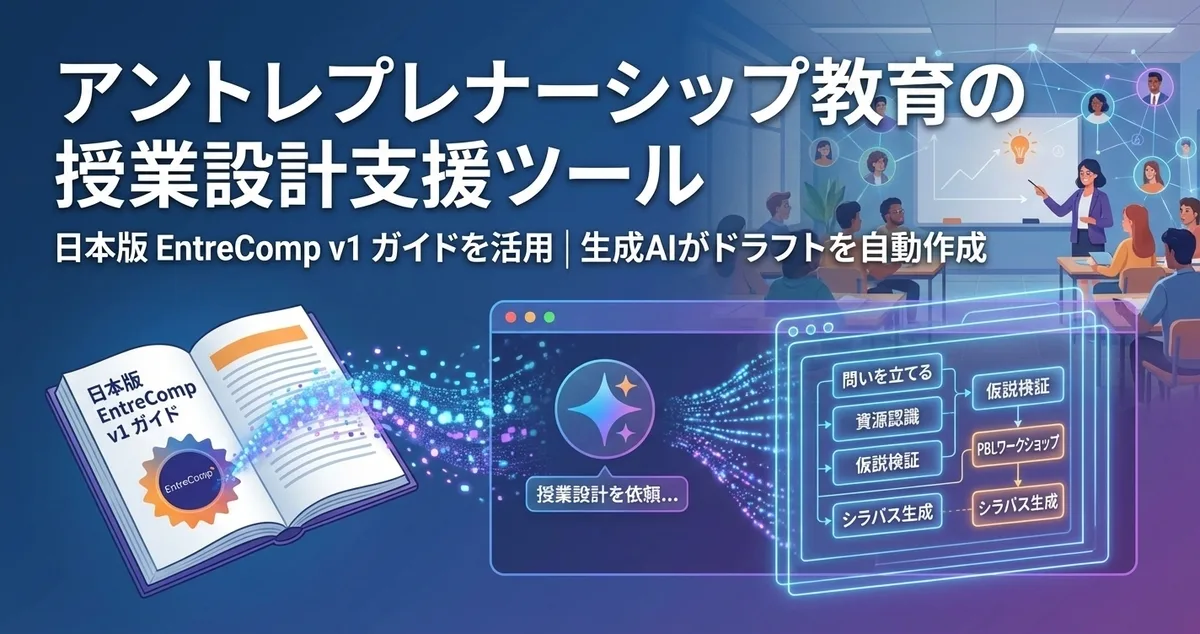
In this year's FD, I introduced a method (draft) for course design based on the Japanese edition of EntreComp v1, which was released in March this year, and we also tried using generative AI for course design for the first time this year. I thought instructors who did not attend might also find the generative-AI part of the course design useful, so I am making it public here.
Overview of the tool
This tool is a Google Gemini Gem that has the guide loaded into it.
Just type into the chat box what kind of course you want to teach, and it will produce a draft outline of the course design.
I think it is quicker to try it yourself, so please copy and paste the sample prompts below and give it a go.
Sample (1): A 90-minute, 15-session course
Copy and paste this into the chat box above.
## 授業タイトル
アントレプレナーシップ概論(1)

## 授業の概要
1コマ90分
全15コマ
宿題あり
履修人数は50人
大学1年生
選択科目
ビジネスの前提知識はなし
階段教室で実施する
TAはいない
オフィスアワーを毎週1時間実施予定

## 学生に学んでほしいこと
自ら問いを立てて、その問いを解決するような仮説を考え、仮説検証をすることの重要性を体験すること。

## 押さえてほしいポイント
講義だけではなくワークショップを行いたい。ゲストは呼べないけれど、動機づけは多少したい。

## 重視したい EntreComp
① 問いを立てる
④ 今ある資源を認識する
⑧ 試してみる
Sample (2): A 90-minute extracurricular activity
## 授業タイトル
地域の課題解決を通してアントレプレナーシップを体験してみよう

## 授業の概要
90分の課外授業1回
参加人数は30人
中学3年生中心
公民の授業の延長

## 学生に学んでほしいこと
インタビューして課題を見つけたり、検証するという基本動作。外に出て、協力者を探すことの大切さ。

## 押さえてほしいポイント
学校と地域との結びつきを強めたい。学生に課題解決の喜びを知ってもらいたい。

## 重視したい EntreComp
② 情報を探索する
⑥ 足りない資源を獲得する
Sample (3): Critique and improvement of an existing course
So far we have assumed designing a course from scratch, but you can also use this Gem to improve an existing course.
For example, attach lecture materials and send a prompt like the one below, and it will offer suggestions for improving the course.
以下の情報や添付の資料は50分の小学生向けのアントレプレナーシップの授業です。EntreComp v1ガイドに沿って、この授業の良い点と悪い点、改善点を教えてください。With additional prompts, you can go all the way to detailed design
If you get a good result as a course design, adding follow-up prompts such as "Please design session X in detail" or "Based on this course structure, create a syllabus with the following items" should get you more detailed course design support.
I am also preparing a separate Gem for designing assessment, which is often a problem.
Reference information
For reference, the ten competences of the Japanese edition of EntreComp v1 are as follows.
① Ask questions
② Explore information
③ Generate ideas
④ Recognize the resources you already have
⑤ Make use of the resources you already have
⑥ Acquire the resources you lack
⑦ Assess uncertainty, ambiguity, and risk
⑧ Try things out
⑨ Make decisions
⑩ Learn from the experience
Also, when creating a syllabus, I think it would be good to include items like the following.
Copy
#### 1. 基本・事務情報
* **科目名:** [科目名を入力]
* **担当教員名:** [教員名を入力]
* **対象学年・開講期:** [例:1年生・前期]
* **単位数:** [例:2単位]
* **授業形態:** [例:講義、演習、実習]
* **使用言語:** [例:日本語]
* **オフィスアワー:** [学生からの相談を受け付ける時間帯]

#### 2. 授業の核心(コンテンツ)
* **授業の概要 (Course Description):**
    * 授業のテーマ、背景、全体像を要約して記述する。
* **到達目標 (Learning Objectives):**
    * 主語を学生にし、「〜を理解する」だけでなく「〜ができる(行動変容)」という形式で3〜5点挙げる。
* **授業計画 (Course Schedule):**
    * 全15回(または指定回数)の各回のテーマと内容。
* **テキスト・参考文献:**
    * メインの教科書と、参考となる図書や資料。

#### 3. 教育学的要件(質の保証・実質化)
* **詳細な学習成果 (Specific Learning Outcomes):**
    * ブルームのタキソノミー(知識・理解・応用・分析・評価・創造)を意識し、具体的なコンピテンシーとして記述する。
* **予習・復習の指示と目安時間 (Out-of-class Study):**
    * 各回の授業に対して、具体的に何を読むか(予習)、終わった後に何をするか(復習)を記述する。
    * 時間目安(例:予習90分、復習90分)を明記する。
* **成績評価基準と方法 (Grading Policy & Criteria):**
    * 評価の内訳(試験〇%、レポート〇%など)。
    * 各項目の評価基準(何ができればA評価か)やルーブリックの有無を明記する。
* **ディプロマ・ポリシーとの関連 (Relation to DP):**
    * 学部・学科の人材育成方針(DP)のどの項目に寄与するか。
* **フィードバック方法 (Feedback Method):**
    * 課題提出後、どのように学生へフィードバックを行うか(個別添削、全体講評など)。
* **アクティブ・ラーニングの内容 (Active Learning):**
    * 一方的な講義以外に、どのような能動的学習(議論、グループワーク、PBL等)が含まれるか。
Summary
I wrote the Japanese edition of the EntreComp v1 guide at considerable length, so I was a little worried about whether anyone would read it. But rather than having instructors read it directly, handing it to an AI as knowledge seems to let the AI support them well. (Because it is so thick, it seems to work well.)
AI is still a little unreliable in places, but over the past year it has become far more practical. Even with Gemini 3.0 Pro (Thinking) as of 2025, my impression is that it produces course designs that are good enough to use as drafts.
I hope you will make good use of this tool together with EntreComp v1 when you teach entrepreneurship education courses.