The Limits of Entrepreneurship Classes and the Role They Should Play
This article was machine-translated from Japanese by AI (Claude). It may contain errors. Read the original Japanese article.
Not many people say that "a class changed my life" or that "I changed careers because I took a class."
Take entrepreneurship, for example. Even Stanford University's famous entrepreneurship class has not been confirmed to increase the number of entrepreneurs.
Moreover, it almost never happens that a business idea gets better simply because someone takes a class. At least, I have hardly ever seen such a case around me. Of course, a class may give you knowledge that serves as a hint for your thinking, but finding a good idea often requires trial and error through practice.
Classes on entrepreneurship education are expected to change careers and raise abilities, but it is extremely difficult to do that through classes alone.
Of course, for classes whose purpose is to transmit knowledge, as is often the case with general education and specialized subjects, there is probably much that the class format can do. But a class on entrepreneurship should not be one whose central purpose is the transmission of knowledge.
If so, what are entrepreneurship classes for in the first place? Classes also have time constraints. Given that what can be done is limited, what should be done?
I think that in education such as entrepreneurship education, we need to think carefully about the role and value that classes should have, after recognizing the limits of what classes can do.
The Role of School Classes on Entrepreneurship
For many people, classes are a way to gain knowledge, but I think they have several other effects as well.
First, there must be a fair number of people who, prompted by a class or its homework, learned about something they hadn't known before, became slightly interested in it, and took a step forward from there.
Some people will also have been able to correct misconceptions through a class. Especially in a highly uncertain context like startups, "act and move forward while learning" is often more appropriate than the conventionally accepted "plan thoroughly before starting." In such a context, one needs to unlearn the conventional notion once, and in a class involving practice in particular, one can learn this with a real sense of it.
I also hear fairly often of people who found companions through a class. This is limited to classes involving practice rather than lecture-style classes, but I think it has an effect: people click with fellow students who took the same class, go to events or communities that would have been hard to enter alone, or form new connections through that person's introductions.
However, in many cases, isn't it through activities in a community involving practice that abilities ultimately grow greatly? I have summarized the importance of such communities in the following article.
Integrating these several perspectives, my current thinking is that classes on entrepreneurship held at schools can fulfill four roles:
- A function as a trigger for joining a practical community
- A function of correcting misconceptions in the context of entrepreneurship
- A function of acquiring the minimum knowledge and skills needed to join a community
- An opportunity to find companions
In other words, a class is only a trigger, and the flow that follows from it is what matters.
I also believe that the scope of what education should cover ought to be limited to some extent. The following figure illustrates that flow.
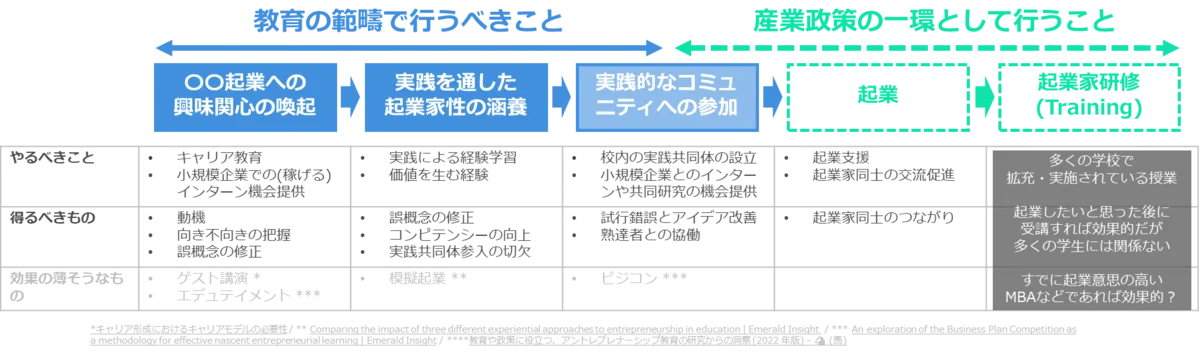
The flow is as follows.
- Start with career education to spark interest.
- In classes involving practice, cultivate entrepreneurial qualities and abilities while making companions.
- Provide a community involving practice, and a trigger for joining it.
The scope that education should cover ends here, and it is shown in blue.
On the other hand, I think training and the like that are useful after starting a business should rather be carried out as part of industrial policy. I have shown that in green, and I think educational institutions do not need to strengthen the green part much (unless they are professional business schools such as MBA programs).
A Concrete Example
So how should the blue part be designed?
Applying this flow to our activities at The University of Tokyo, it is structured as follows:
- In the first semester of the entrepreneurship classes (Entrepreneur Dojo), we mainly hold classes with a strong career-education flavor.
- In the second semester, we hold practice-based classes aimed at cultivating qualities and abilities.
- Beyond that, we introduce and connect students to communities such as Hongo Tech Garage, Todai to Texas, 100 Program, Entrepreneurship Challenge, and FoundX.
I think it is designed so that students progress step by step and arrive at a community suited to their situation.
The key point here is how well we can connect students to a community involving practice through classes.
Example: Research Labs
I think the way researchers go out into the world is close to this flow.
First, there is the research lab, a practical community for conducting research, and in the lab one can cultivate research ability while striving alongside fellow members. Hardly anyone could do research before entering a lab.
Moreover, once in a lab, there are many people around who are becoming independent as researchers, so more people probably come to feel that they too can become researchers (or that they are not suited to it).
However, if the lab had to teach basic knowledge, nothing would get done. So people need to acquire the minimum knowledge before entering a lab. In that case, acquiring knowledge through classes is useful.
The main place for developing ability is the lab, a practical community for conducting research, but preparing beforehand is also important.
Likewise, for ability development and career impact related to starting a business and entrepreneurship, I believe it would be more effective to think centered on such practical communities and to design classes with connection to them in mind.
Designing Classes from the Perspective of Their Role
Once classes are positioned in this way, I think what classes should do becomes clear.
First is creating a trigger. This is close to career education, and one aim is to present the career option of becoming an entrepreneur and make people aware of it.
Another is a class for thinking about what the minimum knowledge and skills are and acquiring them. In doing so, by creating group-based, practice-oriented classes rather than knowledge transmission, one can also aim for the secondary effect of making companions.
On that basis, the next step is to build practical communities in advance and connect students to them.
In this way, I think that recognizing the limits of classes and setting an appropriate scope of coverage will keep classes from being saddled with unnecessary burdens (designing a class to improve ideas or to raise the success rate is extremely difficult).
More Attention to Building Communities Involving Practice
Above all, it is important to have multiple practical communities in each region, and I think entrepreneurship education classes come alive only when such a foundation exists.
Conversely, I think that simply increasing the number of one-off classes probably cannot be expected to have much effect1.
Classes are, of course, important. But real learning about entrepreneurship comes through activities in which a person is actively involved. How to create environments and communities where such real learning can take place seems to me to be the main issue that each educational institution should consider when it comes to entrepreneurship.
Footnotes
-
Note: That said, I believe classes such as marketing are effective for people who have already started businesses. ↩