Entrepreneurship Education Above All Needs to Shift from "Teaching" to "Learning"
This article was machine-translated from Japanese by AI (Claude). It may contain errors. Read the original Japanese article.
It has been about 30 years since people began talking about moving "from the instruction paradigm to the learning paradigm."
Below I quote a passage that briefly explains the two.
The instruction paradigm is characterized by "from teacher to student" and "knowledge is transmitted from the teacher," while the learning paradigm is characterized by "learning is student-centered," "producing learning," and "knowledge is constructed, created, and acquired."
(Theory) The Shift from the Instruction Paradigm to the Learning Paradigm
Yet it seems to me that much of what is called entrepreneurship education or entrepreneur education is still conducted mostly within the instruction paradigm. Many such classes are knowledge-transmission type: a teacher or practitioner stands on a platform and teaches how to raise funds or draft a business plan, or talks about their own experiences.
I suspect the background is that these entrepreneurship and business-related classes are often taught by practitioners or by teachers whose field is not education, and as a result, without consulting insights from pedagogy, they repeat the methods by which they were taught themselves or by which they teach their own specialty subjects. Behind that, there also seems to be a hidden belief: "if you teach people about starting a business, there will be more entrepreneurs."
But when it is put into words like this, I think many people would consider it unlikely that "if you teach people about starting a business, there will be more entrepreneurs."
Fortunately, practice-oriented classes seem to be increasing recently, but I think future entrepreneurship education classes need to be designed more centrally around the learning paradigm.
Creating Situations in Which Learning Arises
In the instruction paradigm, teachers tend to concentrate on "how to convey correct knowledge correctly." As a result, they refine their teaching methods, look for easy-to-understand examples, and explain things over and over. Or they may bring in an entrepreneur. In this case, both what is said and how it is said are entirely under the teacher's control.
In the learning paradigm, however, the necessary way of thinking is "how to create situations in which students' learning arises." Whether learning arises may require motivation, and perhaps also a sense of accomplishment. Even after setting all that up, learning is not guaranteed to arise.
In other words, in the learning paradigm there are many parts that teachers find hard to control, so they lose the sense of omnipotence and tend to end up in an uncomfortable position. And in general, "how to produce students' learning" is harder than "how to convey correct knowledge."
Perhaps because of these differences, those who are steeped in the instruction paradigm seem inclined to hesitate to shift to the learning paradigm.
But when you think about it carefully, thinking about "how can learning arise within students" is, precisely because it is difficult, enjoyable, I think. And I suspect that class design based on the learning paradigm also gives us more frequent opportunities to see students grow.
If so, even though it is difficult, or rather precisely because it is difficult, wouldn't it be better to design classes with the learning paradigm in mind?
We Should Think Carefully About "What Learning" We Are Trying to Produce
Note that it is not enough simply to move from the instruction paradigm to the learning paradigm. At that point, we need to design while thinking carefully not only about "how to produce learning" but also about "what kind of learning to produce."
In entrepreneurship education in particular, unlike other subjects, there is not that much correct knowledge. Also, in many cases the goal of the class is not the efficient acquisition of knowledge in the first place.
Without thinking about what learning we want to produce, we cannot devise a mechanism for producing learning. So we need to clearly define the entrepreneurial qualities and competencies that we want to cultivate through the class.
Focusing on learning means not only that it is enough to change the method from instruction to learning, but also that we must think carefully about what students should learn.
We are probably required to design entrepreneurship education by setting such learning goals properly, thinking about what is needed to produce that learning, deciding what kind of environment and situation to arrange around the students, and considering what activities they should do through classes and homework.
I have summarized the qualities and competencies that I think should be cultivated in entrepreneurship education in the article below, but it is only one example. I think it would be better for people involved in entrepreneurship education to consider such qualities and competencies themselves and set their own goals.
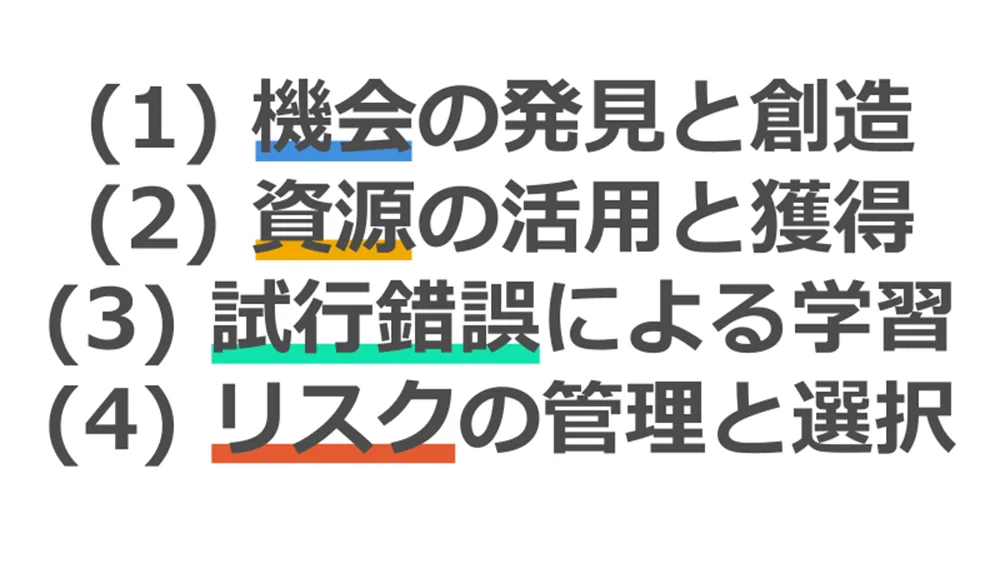
Entrepreneurship Education, of All Things, Should Break Away from Knowledge Transmission and Lecture-Style Classes
Traditional subjects such as arithmetic and Japanese language are also shifting from "teaching" to "learning." However, in these subjects the perspective of acquiring correct knowledge is fairly strong, and since knowledge is also needed in order to think, teachers have no choice but to spend a considerable amount of time on instruction in knowledge.
Entrepreneurship education, on the other hand, as stated above, has no correct answers, and is not centered on the acquisition of knowledge either. Precisely because it is a class in which students acquire skills and attitudes, it seems to me to be a subject that should be designed with a stronger awareness of the learning paradigm than other subjects. And that can never be achieved by guest lectures alone.
This is by no means to say that lecture-style knowledge transmission is unnecessary. On the contrary, it is necessary. If people practice without knowledge, without drawing on lectures and the like, the conceptualization of the experience gained from that practice will not progress, no learning will arise, and it will end up as "we just did it."
With that in mind, what seems more important in entrepreneurship education is how to design the whole course, balancing knowledge transmission, practice, and reflection, while thinking about "how to produce what kind of learning."