Increasing the Number of Potential Entrepreneurs
This article was machine-translated from Japanese by AI (Claude). It may contain errors. Read the original Japanese article.
I previously wrote an article arguing that a shortage of entrepreneurs is a challenge for the startup ecosystem .
A point often raised in connection with this "number of entrepreneurs" is that
"In Japan, the level of entrepreneurial activity among potential entrepreneurs is high, but there are few potential entrepreneurs to begin with."
For example, 'Is Japan a Difficult Country in Which to Start a Business?' points out the following.
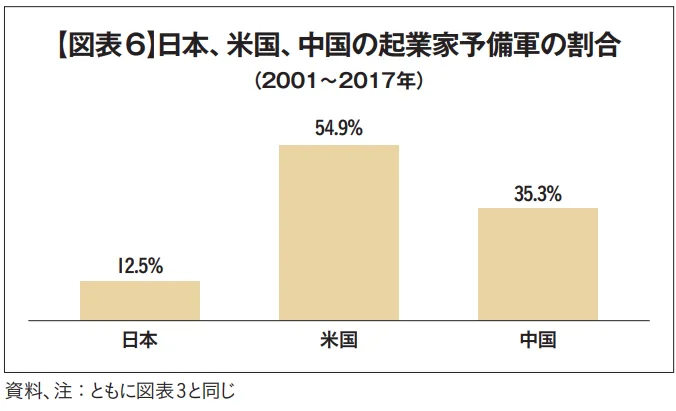
So why is the level of entrepreneurial activity in Japan low? At this point the answer is clear: there are few potential entrepreneurs, and few people with an entrepreneurial attitude. Looking at the proportion of potential entrepreneurs, or people with an entrepreneurial attitude, per 100 adults, it is 54.9% in the United States and 35.3% in China, but only 12.5% in Japan [Figure 6]. No matter how hard that 12.5% tries, it is only natural that it has no chance against countries where 54.9% and 35.3% are potential entrepreneurs.
Is Japan a Difficult Country in Which to Start a Business? https://www.yhmf.jp/as/.assets/vol_66_p8-14.pdf
Earlier in the same document, the following point is also made.
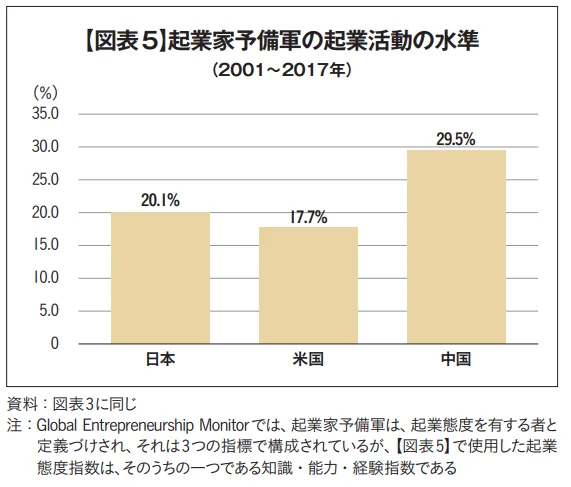
[Figure 5] shows the level of entrepreneurial activity among potential entrepreneurs in three countries: Japan, the United States, and China. According to it, Japan's level falls short of China's but exceeds that of the United States. The rate at which potential entrepreneurs in Japan actually start businesses is by no means low, which shows that Japan is not a country where starting a business is difficult.
Is Japan a Difficult Country in Which to Start a Business? https://www.yhmf.jp/as/.assets/vol_66_p8-14.pdf
Looking in more detail, the percentage of people in Japan who answer that "being an entrepreneur is a desirable career" is quite low.
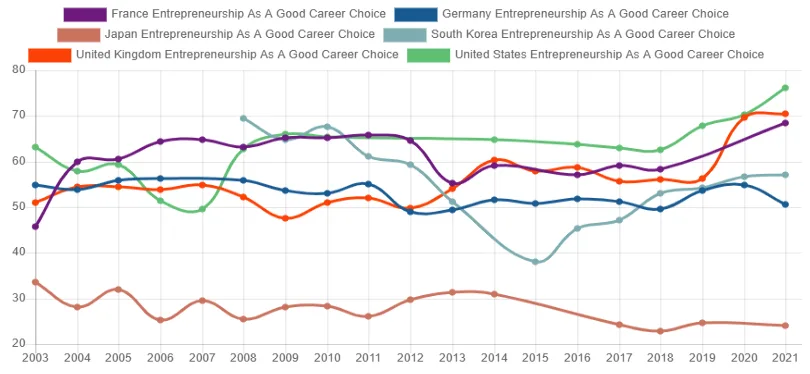
Judging from this data, in Japan, once people become potential entrepreneurs, a fair number of them do engage in entrepreneurial activity, but there are few "potential entrepreneurs" to begin with, before they reach that stage.
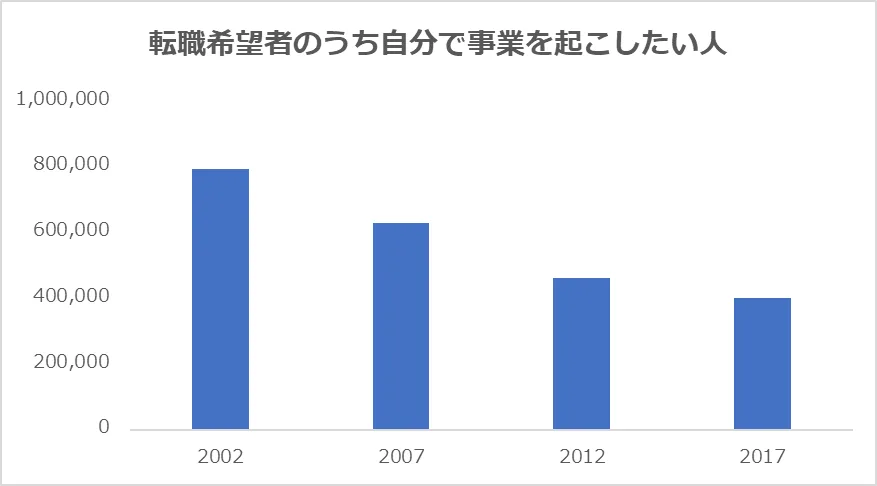
Looking at other data as well, the number of people who aspire to start a business seems to be gradually declining. In the Employment Status Survey, the number of people seeking a job change who want to start their own business is on a downward trend.
Not just more training for potential entrepreneurs, but activities to increase potential entrepreneurs at an earlier stage
Meanwhile, many of the entrepreneur support efforts so far have centered on training and the like "for potential entrepreneurs." Perhaps because of this effect, the "entrepreneurship rate among potential entrepreneurs" is already a sufficiently high 20.1%, even compared with other countries. However, it would be quite difficult to raise this figure further.
If we want to increase the number of entrepreneurs, I think the place to focus more effort from now on is not "supporting people who want to start businesses" but "increasing the number of potential entrepreneurs."
School education should be able to contribute somewhat to that. For example, entrepreneurship education for high school students, started in Sweden in the mid-1990s, is thought to have increased the entrepreneurship rate of its participants.
However, I have doubts about whether the "entrepreneurship education" currently offered in Japan should be expanded.
This is because what many "entrepreneurship education" classes currently do is a "startup version of business education," in which teachers and practitioners teach finance, fundraising, organizational design, business models, and so on. It is an introductory version, adapting content meant for people who are already "potential entrepreneurs" for students who are not yet "potential entrepreneurs." But with that, wouldn't it be hard to increase the number of potential entrepreneurs in the first place?
If the aim is to increase potential entrepreneurs, the content should rather be close to career education.
When people hear "career education with entrepreneurs," many probably think of inviting entrepreneurs to schools to give guest lectures. However, looking at the results of education research and the like, it is unclear whether guest lectures have the effect of increasing potential entrepreneurs (the effect of raising entrepreneurial intention), and I think guest lectures "alone" are not enough for presenting appropriate role models.
Given these several background factors, I am concerned that when entrepreneurship education is rolled out widely as policy in the future, if the current form of entrepreneurship education is simply expanded, it will mean
- Increasing "knowledge-transfer training" for "potential entrepreneurs" (→ the number of potential entrepreneurs themselves may not increase much)
- Increasing guest lectures (→ the effect on increasing potential entrepreneurs is unclear)
and that, as a result, it is likely to become a measure that has little effect on the startup ecosystem relative to the money spent on it.
What is needed to avoid this situation is to refer to existing research on entrepreneurship education. Of course, insights suggested by overseas and past research do not necessarily apply as they are to Japan's current situation. But they should serve as useful hints.
Now that attention is focused on startups and institutions and systems are about to be redesigned, shouldn't entrepreneurship education, which is also the foundation for producing entrepreneurs, be redesigned by making use of the research done so far?