Entrepreneurship Education and Role Models
This article was machine-translated from Japanese by AI (Claude). It may contain errors. Read the original Japanese article.
"Presenting entrepreneurs as role models will increase the number of entrepreneurs"
Quite a few people seem to think so. As a result, a policy like this one gets proposed:
"To increase the number of entrepreneurs, have entrepreneurs give talks at schools"
In reality, though, it does not seem to be as simple as just presenting role models.
Mentoring does not increase the number of people who start businesses
In a study in the United States, entrepreneurs were randomly assigned to some of the university students as mentors, and the students' subsequent careers were tracked over time. The result: although the rate at which students joined early-stage startups rose, no significant change was seen in the rate at which they started businesses themselves.
Perhaps by the time people are university-aged, or when the involvement is as shallow as mentoring, it does not function sufficiently as a way of presenting a role model.
Having a role model give a guest lecture does not raise entrepreneurial intention
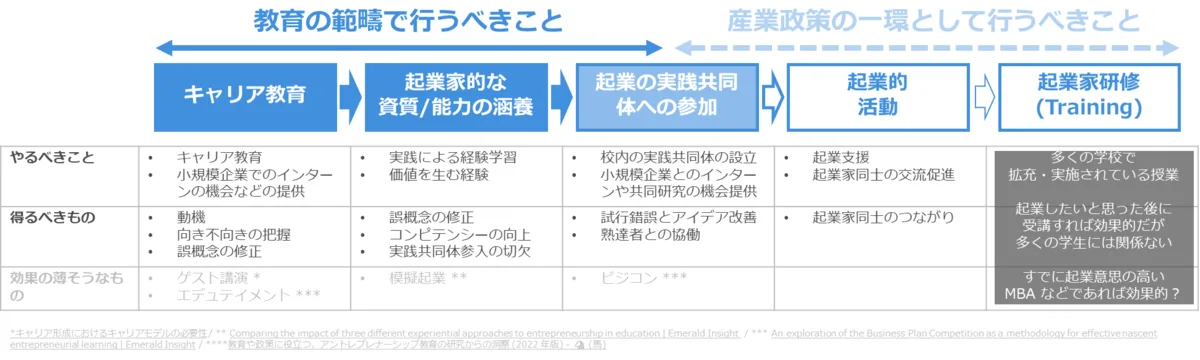
In Japan today, some people are trying to promote guest lectures by entrepreneurs at schools across the country, in the hope that students will see them as "entrepreneurs to look up to." Hearing them speak may certainly raise motivation for a moment. But a lecture is an even shallower form of involvement than mentoring, so I do not think we can expect much of a long-term effect.
In fact, a study examining the effects of an entrepreneurship education program centered on guest lectures by entrepreneurs found that after the guest lectures, the group with high entrepreneurial intention actually saw their intention decline.
Other studies overseas have likewise found entrepreneurial intention declining after entrepreneurship education (though a decline in entrepreneurial intention is not necessarily a bad thing; to a large extent, taking the class lets people find out whether they are suited to starting a business).
The problem is that the term "role model" is too abstract
Of course, it is true that many studies find a positive correlation between having role models and starting businesses.
But on closer inspection, the question mainly used to judge whether a respondent has a role model is "Is there an entrepreneur among your family or friends?" followed by questions such as "Have you ever worked at a new, small company?" and "Do you know many entrepreneurs?"
In other words, while the conclusion of the surveys, taken alone, is that "role models are effective," I think the "role model" referred to there is somewhat different from what we ordinarily mean by the word.
For example, a role model who is close at hand, such as "family or friends," is certainly effective, but a role model presented just once in a guest lecture seems to me qualitatively different from a close one.
Role models of the "mentor" type, not the "idol" type
So let us look at a Japanese survey that classified role models into types. It presents classifications such as the idol-type role model and the mentor-type role model, and examines the effect of each.
For example, "idol-type" role models do not score very high on career development; rather, the "mentor type," whom people strongly take as a model to follow, turns out to be more effective.
Even if students are briefly exposed to an entrepreneur through a guest lecture, that entrepreneur would be an "idol," and unlikely to become a "mentor." On the other hand, "having worked at a new, small company" seems closer to the "mentor type."
Is the closeness of the role model also important?
The closeness of the role models whose effects have been confirmed so far seems to be "much closer" than we tend to imagine. Interning at a small startup with fewer than ten people, watching the entrepreneur up close, may be close enough to have an effect.
In Japan, "there are no entrepreneurs nearby" is sometimes cited as a problem. But if we are aiming for the effect of role models, I wonder whether it would work better to provide opportunities to work right beside an entrepreneur at such a brand-new startup (encouraging entry into a community), rather than creating idolized entrepreneurs through guest lectures and the like.
In any case, if entrepreneurship education as career education is going to be developed with role models at its center, we will need to think up more effective measures and classes based on this kind of research.
I have summarized my own thoughts on the role of classes in the following article.