Company Culture Values: From Beliefs to Actions
This article was machine-translated from Japanese by AI (Claude). It may contain errors. Read the original Japanese article.
Ben Horowitz's "Who You Are: Your True Words and Actions Build a Team That Survives Hard Times" has been released. The original title is "What you do is who you are," so should it be translated as "your actions represent you"?
In this book, Ben Horowitz says that company culture is "the criteria by which employees make decisions," presenting a view of culture centered on "actions." He also places importance on creating a code of conduct rather than a corporate philosophy.
Culture is how people make decisions when the boss isn't in the room. It is the set of assumptions employees use to solve problems every day. It is how you act when no one is watching.
-
The samurai called the principles of the warrior not "values" but "virtues." A virtue is an action, whereas a value is merely a belief. As this book also says, actions are what carry influence (from here on, I will call the ideal form a "code of conduct" and the beliefs most companies put forward a "corporate philosophy").
This emphasis on action seems to me to capture well the recent change in the quality of values at startups in Japan.
In Japan, too, startups have increasingly been publishing their culture and values in recent years to encourage hiring. At traditional large companies, important beliefs were often expressed in single words such as "Trust," "Integrity," "Transparency," and "Honesty," but the values of recent startups tend to run a bit longer.
I think that behind this quantitative change in length lies a qualitative change in the content of the values. They are becoming "values that prompt action." In other words, as in this book, a shift from belief to action in values may lie behind it.
Of course, in the past, too, there were many cases where values included a code of conduct. But recently, it seems to me that more and more companies attach "concrete examples of behavior" to each value, and each company also appears to prepare "rules, processes, and systems" (including evaluation systems) that induce such behavior.
Let's look back a little through some examples.
Cases
Examples from companies overseas are compiled on this page, for instance, and examples from Japanese companies on weare. I would like to pick up a few of them.
Salesforce
Salesforce, which belongs to the relatively older companies, has values that are a list of single words: Trust, Customer Success, Growth, Innovation, Giving Back, Equality for All, Wellbeing, Transparency, and Fun.
Adobe
Adobe is also a relatively old company, and its values are single words: Genuine, Exceptional, Innovative, and Involved.
Airbnb
Airbnb, which can be called a relatively new company, has values that read a little more like sentences: Be a host, Champion the mission, Be a cereal entrepreneur, and Embrace the adventure. It is distinctive in including values that make you pause (and need explaining), such as "Be a cereal entrepreneur."
Twilio
Twilio is also still a relatively new company. What stands out is that it divides its ten values into three categories: "Actions," "Decision-making," and "How to win." Under "Actions" are Be an owner, Empower others, and No shenanigans; under "Decision-making" are Wear the customer's shoes, Write it down, and Ruthlessly prioritize; and under "How to win" are Be bold, Be inclusive, Draw the owl, and Don't settle.
Money Forward
Money Forward, founded by Mr. Tsuji, who contributed an endorsement for this book, renders "values" as "guiding principles for action" and sets them as "User Focus," "Technology driven," and "Fairness" (the page with the CEO's message). Here, values are treated not as values or beliefs but as actions.
Mercari
Mercari and Merpay often have their culture and values written up in articles. Their three values, "Go Bold," "All for One," and "Be Professional," are close to beliefs, but Go Bold is probably a criterion for deciding how to act when you are unsure.
As an aside, I think the three-part composition is easy to understand and easy to imitate: a guideline for action like "Go Bold," a "Be ..." that shows an ideal state, and a value about the team (All for One).
atama+
atama+ is a company about which an article was published saying it is investing in culture. It first places "Wow students" as its value, and then sets "Think beyond," "Speak up," and "Love fun." as the important actions. The fact that it explicitly states them as actions is similar to Money Forward here as well.
SmartHR
SmartHR, which was also a pioneer of recruiting slides, seems to have set values that make it clear what actions to take: "Drive yourself," "Faster is cooler," "Find the best Plan C," "Take care over every single word," "Walk on the wild side," and "Build what people want."
Mirrativ
Mirrativ, whose recruiting slides were also widely featured, lists five values on Mirrativ's company page: "Keep exceeding expectations," "Keep honing your skills," "Keep holding deep love," "Keep going beyond common sense," and "And keep having fun." These, too, are close to values that prompt specific actions.
10X
10X, which operates Taberi, introduces its three values, "Work backward from 10x," "Be autonomous," and "Stand back to back," together with concrete examples (Do's). It is a rare document that, from page 24, also explains the background to how the values were formulated.
CADDi
The values themselves are based on single words: "Bold," "Exceptional," "United," and "Sincere." What seems distinctive is that it has already created a culture book in which it compiles its guiding principles for action.
FoundX
Our values at FoundX are the following three:
- ⭐ Let's be a good role model
- 🪑 Let's sit on the same side of the table, together with HRT💕
- 🧪 Let's experiment with evidence
(We've added emoji, too.)
I feel that values like these are closely tied to execution. For example, the following, though still a work in progress, is our activity system map (explanation), and I feel that each of these values works to strengthen the activities that add value (of course, there are also places where they weaken them, but I think that is a trade-off).
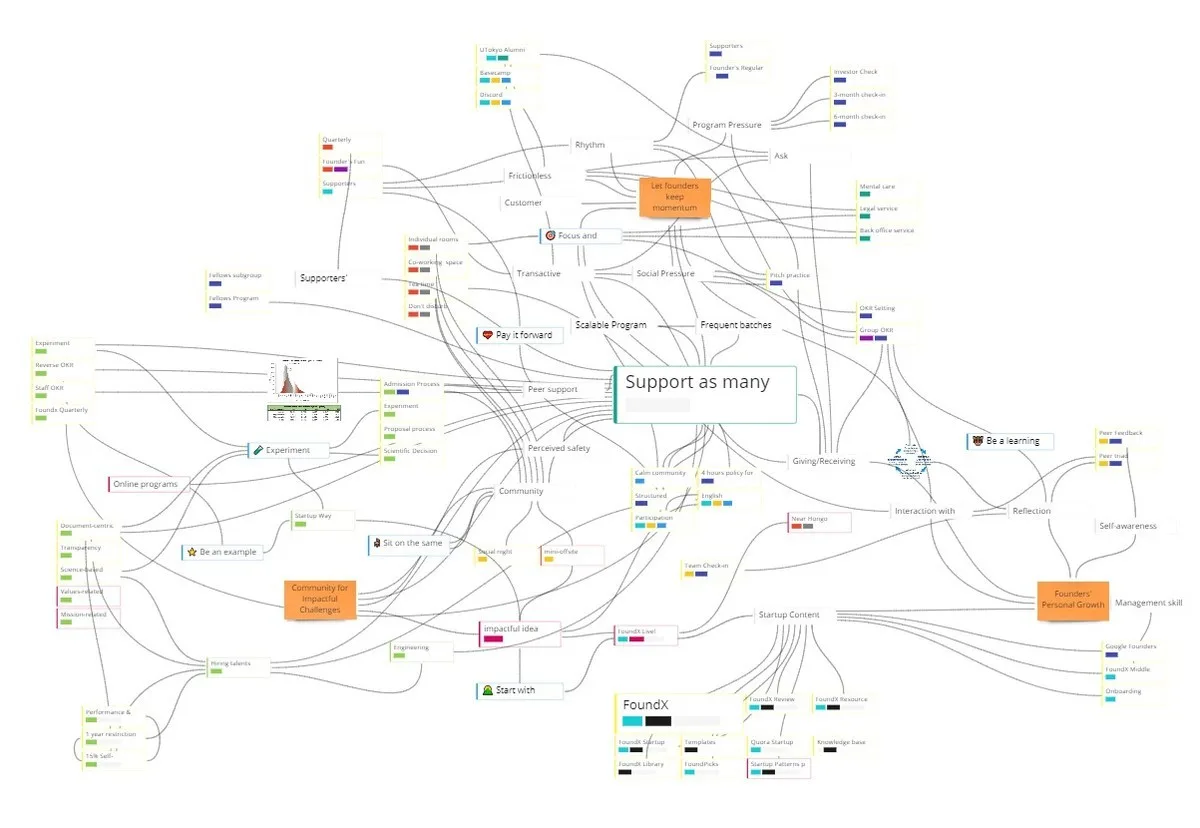
Rules, Processes, and Systems
Rules, processes, and systems are also one way of binding behavior.
One piece of useful advice from this book on that point is probably "create shocking rules."
For example, a16z's rule of paying $10 if you are one minute late to a meeting with an entrepreneur prompts that behavior far more clearly than writing a value like "have respect for entrepreneurs." Amazon's "ban on PowerPoint" also contributes to Amazon's culture of valuing documents. Likewise, it seems that companies are coming to think up memorable values and rules.
Recently there was a good article by Mr. Nishimura of Coral Capital, "Why We Write 'Draw the Owl' in Our Company Values," and it is probably good to include rules and values that need a little explanation. The book also points out that values that are used every day are good, and I thought, indeed...
Summary
I had been thinking about culture just then, so after reading the copy I received as a gift, I also bought it on Kindle and read it.
It is important for leaders to appeal at every opportunity to the "why?" behind the values. This is because the "why?" is what sticks in memory most of all.
-
In designing culture, you can also think of it as a process for deciding whom you want to hire.
-
In fact, it is fair to say that the choice of the first 20 people almost determined what this company would become. What kind of culture you want and whom you want to hire are, in a sense, the same question.
Passages like these prompted me to reflect.
I once wrote the slides below, and this was a good book that took me a step further and set me thinking about various ideas. Especially for delicate matters, such as what to do with borderline cases and how to handle dismissals, it seems worth reading a book like this again.
Don't Destroy the Company Culture / Startup Culture from Takaaki Umada
I have translated related articles on this book at the links below.
スタートアップのマネジメント (Startup School 2014 #15) - FoundX Review - 起業家とスタートアップのためのノウハウ情報review.foundx.jp
So, Ben Horowitz's "Who You Are: Your True Words and Actions Build a Team That Survives Hard Times" is highly recommended.
Recommended Articles
I also recommend the following recently translated articles on culture.
企業文化を作る方法 (Startup School 2014 #10) - FoundX Review - 起業家とスタートアップのためのノウハウ情報review.foundx.jp
スタートアップの採用と企業文化 (Startup School 2014 #11) - FoundX Review - 起業家とスタートアップのためのノウハウ情報review.foundx.jp
企業文化を作る (Startup School 2019 #10) - FoundX Review - 起業家とスタートアップのためのノウハウ情報review.foundx.jp
機能する企業文化を作り上げるために (Peter Levine) - FoundX Review - 起業家とスタートアップのためのノウハウ情報review.foundx.jp
良い企業文化を作るには(そして維持するには) - FoundX Review - 起業家とスタートアップのためのノウハウ情報review.foundx.jp