The Startup and Small Business Ecosystem We Will Need Going Forward
This article was machine-translated from Japanese by AI (Claude). It may contain errors. Read the original Japanese article.
What I keep realizing as I support Climate Tech startups is that companies other than high-growth startups matter too.
Suppose, for example, that a high-growth startup manages to build a solar panel with outstanding performance. To truly get it adopted widely, it has to build its own factory to produce it, or find a partner to build it. To install the panels, it also needs local builders and installers in each region. If those people don't exist, they have to be trained. In some cases, people will also need to be devoted to careful consensus-building in the community.
A single company probably can't do all of this by itself. So a variety of companies are needed around it. NPOs also play a role in building local consensus. If such companies and organizations don't emerge, the growth speed of the high-growth startup will slow down as well.
In fact, in Europe, a startup that trains technicians to install heat pumps has even appeared, and the U.S. Department of Energy is providing support to nonprofits on the scale of 7.5 billion yen.
The Ecosystem
When the startup ecosystem is discussed, universities, investors, large corporations1, governments, and so on are listed. One example is the MIT REAP diagram below.
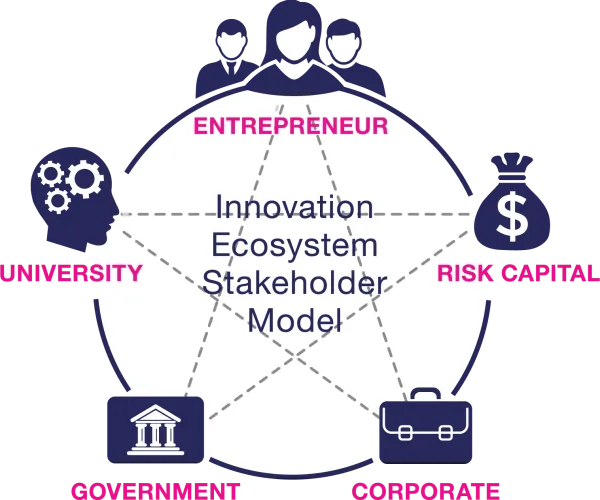
The MIT REAP stakeholder model: https://reap.mit.edu/about/
However, the existence of small and medium-sized companies and NPOs in these surrounding areas is hardly mentioned.
I suspect the reason is that in the IT domain, which has been the center of startups until now, such partners were not needed in great numbers (of course, there are sales agents and the outsourcing of some operations).
But when I look at startups involving hardware, such as Climate Tech, I keep feeling that something big can be done only when many companies are involved. In Japan, too, for example, the precision-instrument companies whose names we often hear around space startups play an important role.
If the startup domain gradually expands from IT into other domains, then how to build an ecosystem that includes these small and medium-sized companies could become a new point of discussion.
The Ecosystem Seen as Concentric Circles
To produce a startup of the kind called a decacorn, a large group of companies is needed around it to support the decacorn. Conversely, this also means that many companies and jobs are created around a company that has grown to the size of a decacorn. That is what it means to build an industry, and I think it is what it means to build an "ecosystem."
If we try to illustrate this ecosystem, I think we can show it with concentric circles by order of magnitude of market capitalization2.
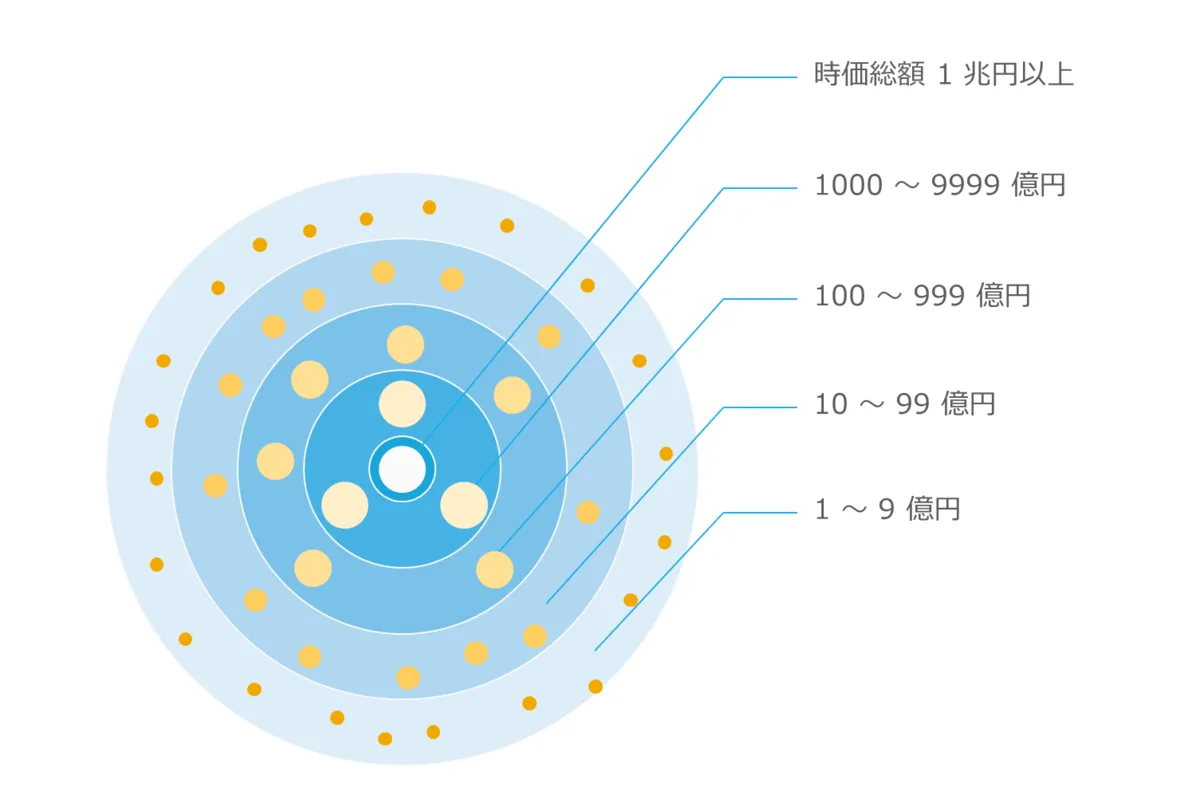
Each orange dot represents a company.
In the center is a business that serves as a great tree, with a market capitalization exceeding roughly 1 trillion yen. Around it are several businesses worth 100 billion to 1 trillion yen, then ones worth 10 billion to 100 billion yen, 1 billion to 10 billion yen, and 100 million to 1 billion yen.
The way to read this diagram is that each fulfills its own role, the whole functions as an ecosystem, and one large industry comes into being.
In fact, it is said that for platform companies such as Salesforce, around the time revenue (ARR) exceeds 100 billion yen and the platform's functions begin to grow complex, surrounding businesses such as consultants start to emerge.
Let's convert revenue of 100 billion yen into market capitalization. As a very simplified calculation, with revenue of 100 billion yen and a profit margin of 50%, profit is 50 billion yen, and with a PER of 20, the market capitalization is about 1 trillion yen. It can indeed be said that when a company of that revenue scale and market capitalization appears, a variety of businesses emerge around it.
For generative AI, which is a hot topic these days, we can organize it like this: a trillion-yen company such as OpenAI suddenly appeared at the center as the great tree of the ecosystem; around it are several fairly large companies (such as Perplexity); further out are AI-based SaaS companies; and further out still, contract businesses doing individual customization, education businesses, and others are emerging one after another. (Perhaps NVIDIA is the center of the circle, though.)
I think it is good to be aware, to some extent, of what kind of business you are trying to build within such an ecosystem, and where in those concentric circles your business would be positioned.
The Concentric Circles Seen from the Side of Policy and Support
In many cases, most of the profit gathers in the company at the center. The reason people end up being called "digital tenant farmers" is probably that countries other than the United States, including Japan, have not been able to take the center in the digital domain.
Also, just as many related companies were born from SpaceX and Tesla, producing a company at the center makes it easier for several new, large startups to emerge around it, and for high-value-added jobs to be created as well. So I think producing a giant high-growth startup that can serve as the center matters for its ripple effects on a country or region. But to make that work, the surrounding businesses are needed.
That said, I also feel that the way to build each of them and the way to support each of them differ greatly.
I myself support high-growth startups that could become the central part, and I do not treat the other parts as targets of my support. This is because the methods of support differ, and my funds and time are not sufficient. But I feel that to produce high-growth startups and build what we call an industry, that kind of group of companies is necessary, and I feel frustrated that I haven't been able to take it on.
Even so, if we cannot produce the high-growth startups at the center, there will be no ripple effects on the surrounding companies. On the other hand, without the surrounding companies, we cannot produce the companies at the center either. Producing this whole series of companies may be what is called industrial policy, but as the domain of high-growth startups gradually expands beyond pure software, I think that those involved with high-growth startups should also think about what kind of ecosystem we should build as a whole.
Appendix: Employment
This is a slight digression from the main argument, but I think we should also pay attention to the quality of the ripple effects.
For example, the following chart shows employment multipliers for each industry in the United States (that is, when employment increases by a certain number, how many times that number the increase ultimately leads to).
There are several industries where large ripple effects are expected in terms of job growth. This page describes more detailed occupations.
In general, the employment multipliers of the tradable sector (manufacturing and high tech) tend to be large3, while those of the non-tradable sector (services and construction) tend to be small.
Newly created jobs also tend to concentrate in particular places. Netflix created jobs in urban areas, but it reduced jobs at video rental stores across the United States and Japan. There is also a debate that, because of advances in automation and the like, manufacturing no longer produces good jobs the way it used to.
On the other hand, in Japan, where labor shortages are already visible, I think it has become difficult to evaluate simply "creating jobs" (although it can be valuable in the short term...).
What has value is "creating a large number of high-value-added jobs." "Creating low-value-added jobs" can rather be seen as having a negative effect in the medium to long term, in that it takes precious labor away into low-value-added work.
In that sense, I think it is better to look, to some extent, at which industries the ripple effects reach. The chart below shows labor productivity by industry and company size in Japan.
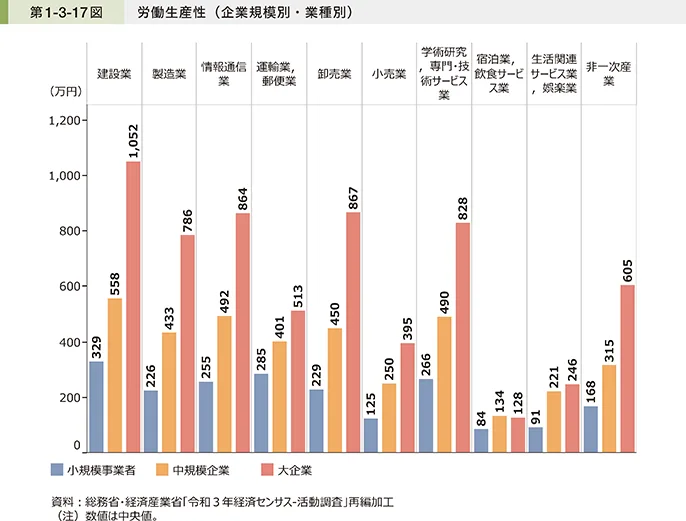
Labor productivity by company size and industry: https://www.chusho.meti.go.jp/pamflet/hakusyo/2024/chusho/b1_3_3.html
What matters is which industries the jobs that arise as ripple effects belong to.
I think that creating jobs of the kind also called the affluent middle class is important for political and social stability as well. For that, it is probably indispensable to have perspectives such as selecting the industries to support so as to create many high-value-added jobs, how to raise the value of jobs whose productivity is currently low (tourism, for example), and how far it can be raised (for example, tourism is labor-intensive and so hard to raise). Green jobs will occupy that position for a time, but probably in about 30 years the appropriate jobs will change again. I think we should look at ripple effects with such points in mind as well.
Footnotes
-
Looking at https://reap.mit.edu/assets/REAP_Ideal_Team.pdf and similar materials, "Corporate" appears to refer to large corporations. ↩
-
I don't think market capitalization is everything, but I use it because it is convenient for looking at ripple effects. ↩
-
Moretti's The New Geography of Jobs is well known, but there is also a debate that the multiplier may be a bit too large. ↩