The Pitfalls of "Supporting the Globalization of Startups"
This article was machine-translated from Japanese by AI (Claude). It may contain errors. Read the original Japanese article.

Summary by NotebookLM
Expectations are rising for startups to go global, or to be nurtured into startups that earn foreign currency.
Personally, I think we should basically push ahead with such efforts and build industries in Japan that earn foreign currency, and I hope startups will contribute greatly to that. It would be good if the "globalization support" that is the subject of this article were made more generous as well.
However, if public funds are going to support globalization, I also think it must not stop at "earning foreign currency." We need to look, as a set, at how much of that value and cash flow is designed to remain in Japan.
To summarize in advance what I want to say in this article:
- "Earning foreign currency" is important. But we need to pay attention to "how it is earned" and "how it is retained."
- The more high-value-added work (R&D, product development, IP, decision-making) remains in Japan, the greater the spillover to the domestic economy.
- With public support in particular, a design for domestic benefit and criteria for evaluating it are all the more necessary.
- Earning foreign currency does not necessarily make the domestic economy richer
- Criteria for evaluation when providing public support
- What kinds of startups are likely to meet the conditions
- Summary: Toward globalization support that maximizes the national interest
- Addendum: Separating "earning foreign currency" from "attracting foreign currency"
Earning foreign currency does not necessarily make the domestic economy richer
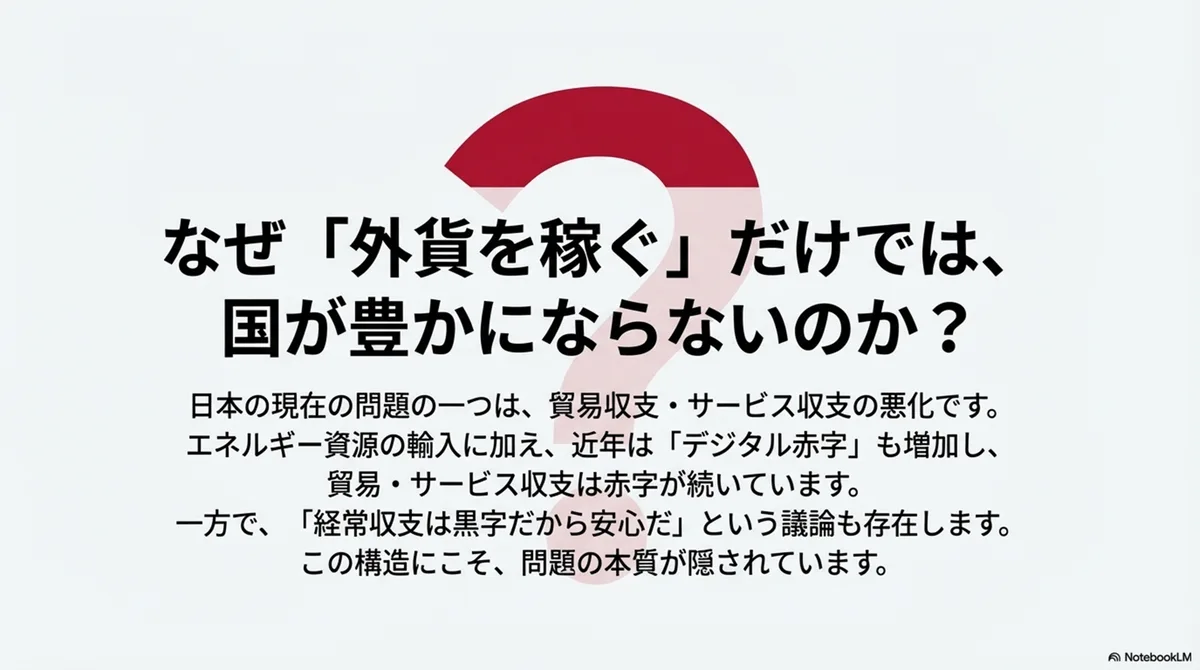
One of Japan's current problems is said to be the deterioration of the trade balance and the services balance.
There are continuing years in which Japan pays more than 25 trillion yen a year to import energy resources, and recently the digital deficit has been growing too, so that the trade balance and services balance combined have been in deficit year after year.
On the other hand, there is also an argument that there is nothing to worry about because Japan's current account is in surplus.
A country's current account is
Current account = trade balance + services balance + primary income balance + secondary income balance
and in fact, Japan's current account has been in surplus for the past decade or so.
This is partly because the primary income balance (interest, dividends, and investment income from overseas investment) has supported the deterioration in trade and services. (The yellow part of the figure below.)
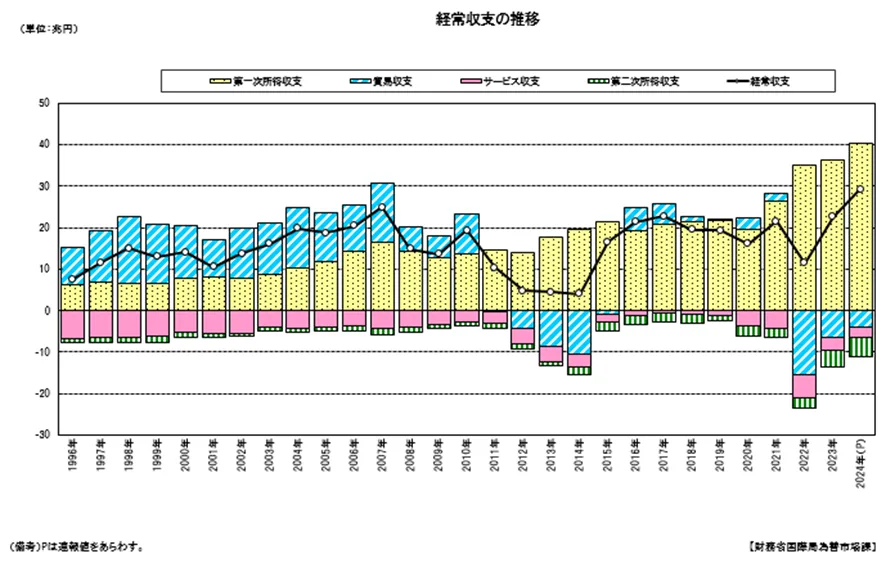
As you can see from this graph, the share of yellow has increased markedly since 2011.
The first few years from 2011 were somewhat exceptional, as nuclear power plants were shut down after the earthquake and imports of energy resources rose. But even after that, the trade balance and services balance remained weak, and in recent years they have been in deficit. It is the primary income balance that has been making up for this.
In a sense, over the decade or so since 2011, a structural change described as "from a trading nation to an investing nation" has been taking place.
A surplus on the books is different from the flow of money
What matters here, however, is that a surplus on the books does not always match the movement of cash that actually comes back into the country.
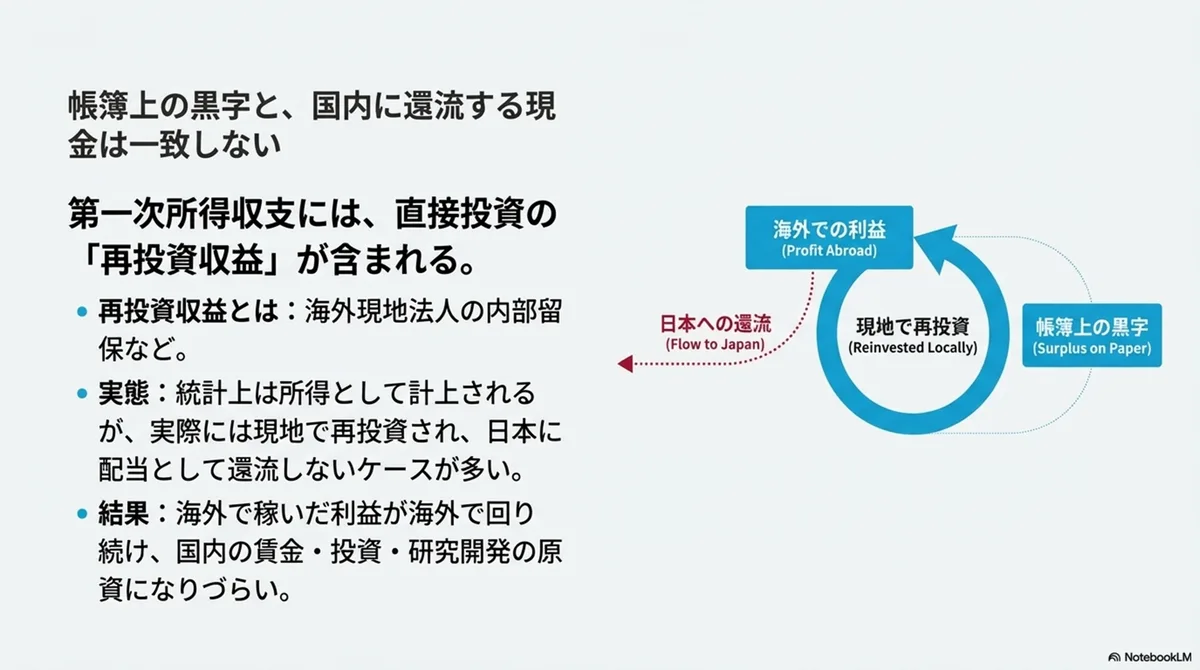
Primary income includes the "reinvested earnings" of direct investment (something like retained earnings). In the statistics these are recorded as income, but in practice they are reinvested locally, and it can happen that they do not flow back to Japan as dividends.
When this happens, the following phenomena become likely:
- Profits earned overseas keep circulating overseas
- They are less likely to become a source of funds for domestic wages, investment, and R&D, which holds down wage increases and investment
Of course, domestic wages and capital investment are also determined by other factors, so this is not the only cause. But at the very least, it is a premise we should keep in mind that "earning abroad" does not directly translate into "making the domestic economy richer."
Another problem caused by money not coming back
Money not coming back to Japan creates another problem.
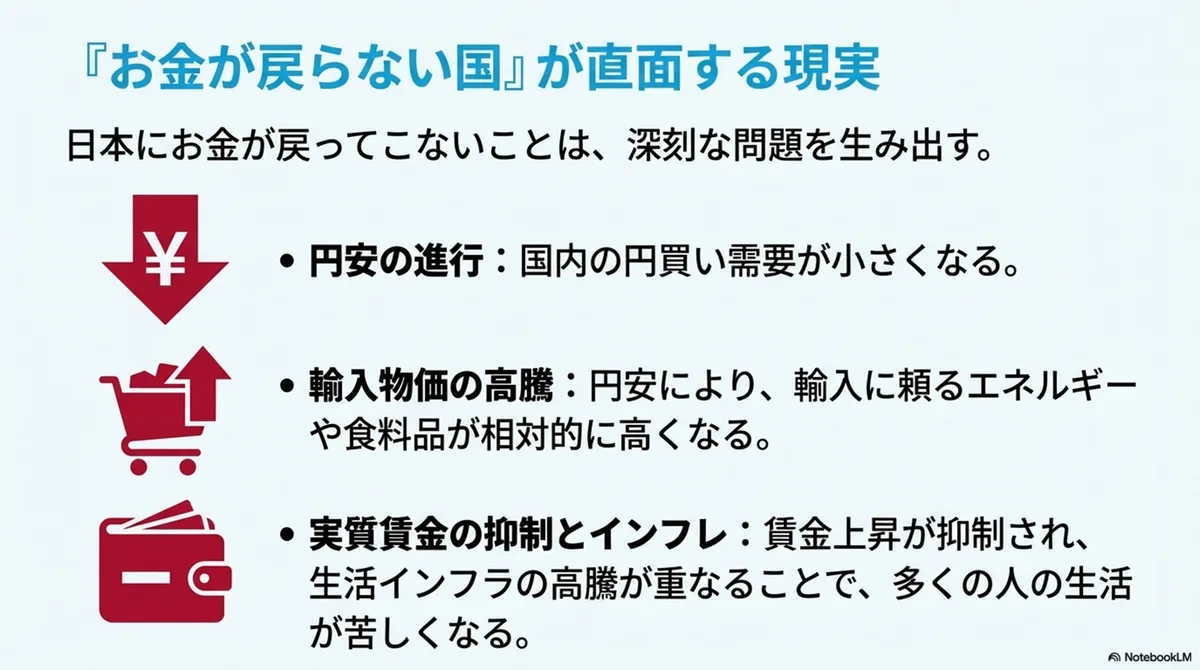
Money not coming back to Japan means that demand for buying yen becomes smaller. If this keeps the yen weak, energy and food, which depend on imports, become relatively more expensive.
In other words, once such a structure takes hold, restrained wage growth combined with soaring costs of the infrastructure of daily life could make life harder for many people.
Of course, corporate share prices rise, so the situation may be different if you hold stocks. But the damage ends up concentrated on those who cannot hold such assets and live on salary income alone.
The possibility of an accelerating digital deficit
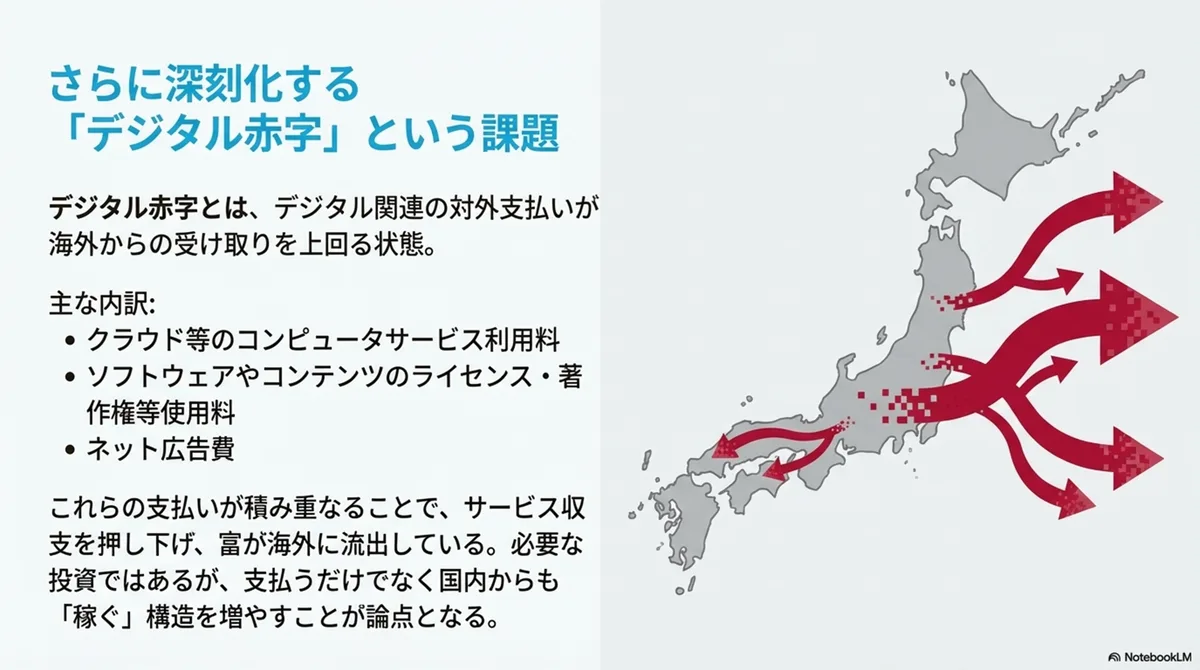
Furthermore, the "digital deficit" has also been frequently discussed recently. The digital deficit here refers to the following:
- Computer services such as the cloud
- License fees and copyright royalties for software and content
- Digital-related payments abroad, including online advertising
As these accumulate, they push down the services balance (that is, foreign currency flows out).
Digital payments are themselves necessary investments, but the issue is increasing structures in which we earn from within Japan as well (exports, IP, products), rather than only paying.
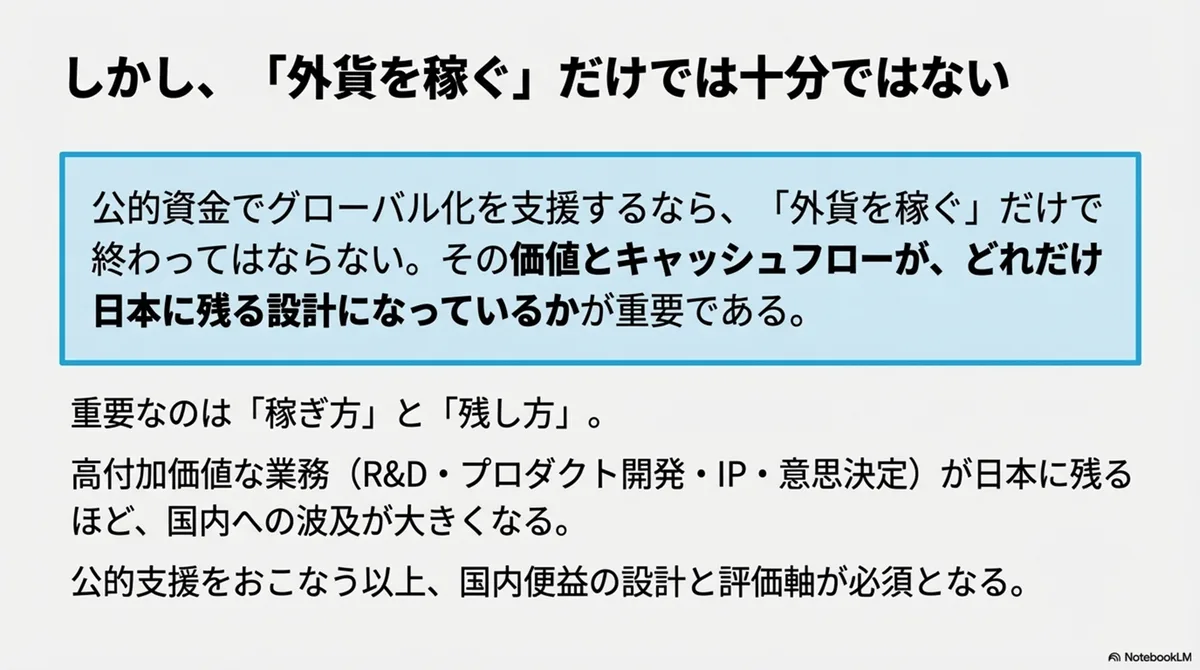
In other words, the direction of "increasing the number of startups that earn foreign currency" is itself reasonable, but how we route that value and cash flow through Japan while earning foreign currency will determine how far Japan benefits.
To make it a step more concrete, even when earning foreign currency, what matters is how much of the following remains in Japan:
- High-value-added work (R&D, product development, design, data and algorithms, PM)
- Ownership of intellectual property (IP)
- Domestic spillover in the form of taxes, social insurance, and employment
Criteria for evaluation when providing public support
What I have said so far merely summarizes Japan's overall economic situation, which has been much discussed recently.
But my point in this article is that unless we bear this in mind, we will not earn trust in support for startups.
Taking this situation into account, when we translate it into the practice of startups, I think the design and screening of support would come to have the following perspectives.
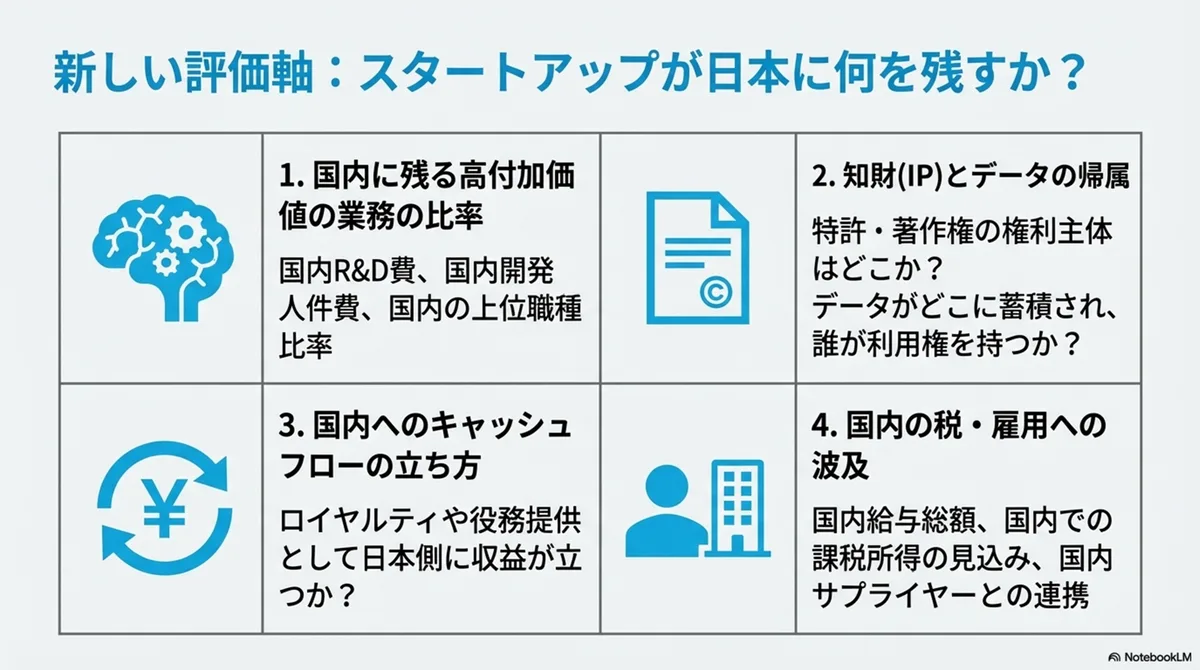
1) The share of high-value-added work that remains in Japan
- Domestic R&D spending, domestic development personnel costs, the share of senior roles in Japan
- Whether the development of the "core functions" is in Japan (not just operations being in Japan)
2) Ownership of intellectual property (IP) and data
- Who holds the rights to patents, copyrights, and core algorithms
- Which party accumulates the data, and who is designed to hold the right to use it
3) How cash flow arises in Japan
- Whether revenue arises on the Japanese side as royalties or the provision of services (service exports)
- Even if the selling entity is overseas, whether the design allows the Japanese side to receive compensation as the source of value
4) Spillover to domestic taxes and employment
- Total domestic payroll (including income tax and social insurance), expected domestic taxable income
- Spillover such as collaboration with domestic suppliers and research institutions, and spin-outs
If we say "we will support it because it earns foreign currency" without evaluation criteria, then even a case where Japan remains merely a sales base or a subcontractor while the core moves abroad could look like a "successful globalization." If we are using public funds, we want to avoid that. That is the point. (※With private funds, I think one can simply aim for the maximum investment return without considering such things.)
This way of organizing things also broadens the range of what we can support.
For example, even for a startup that Japanese people built in the United States, if it keeps its core R&D and product development in Japan and does only its sales in the United States, the benefit to Japan is likely to be large. In that case, it could be a target of support.
On the other hand, even if a company is registered in Japan, if it offshores its core development overseas and sees Japan only as a market, the spillover to Japan is likely to be limited, so whether to make it a target of support should be considered according to the purpose (there are other kinds of value, such as importing labor and efficiency, but it is weaker in terms of high added value remaining in Japan).
What kinds of startups are likely to meet the conditions
Until now, startups in Japan have meant the software industry.
And I think software has played a larger role in filling the gap left by a shrinking labor force (improving productivity) than in earning foreign currency.
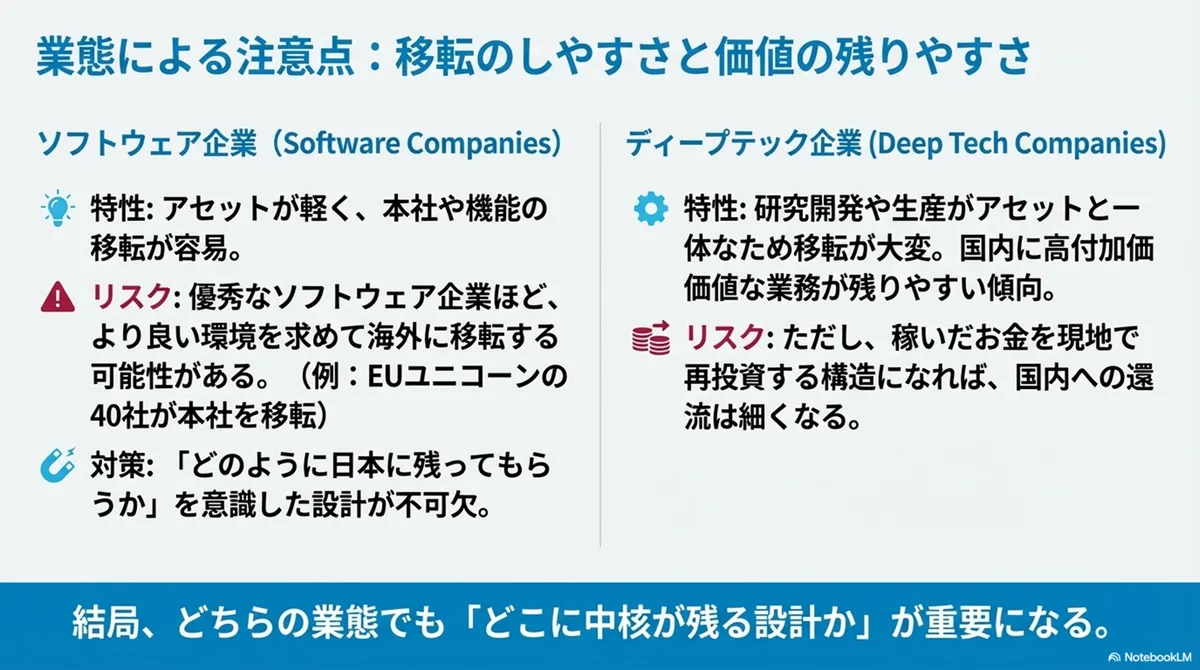
But if we are going to support startups' global earnings with tax money from now on, even software startups should be more strongly conscious of the "design that keeps value in Japan" listed above.
We should also note that software companies, with their light assets, tend to be easy to relocate. The Draghi Report also points out that, of the 147 EU unicorns born between 2008 and 2021, 40 relocated their headquarters, and the same could well happen in Japan.
It is also related to this characteristic that, from the time of founding, people say "if you want to build a global company, you should start in the US." Foreigners who start companies in Japan are in the same context.
In particular, it is not in the early stage but in the scaling stage that startups create large numbers of jobs and the like. Unless we think carefully about "how to get them to stay in Japan," we could end up with "going through the pains of birth in Japan, only to have them taken abroad at just the right moment."
From that perspective, expectations rest on deep tech, whose heavy assets make relocation difficult and in which high-value-added work is likely to remain in Japan.
However, even with deep tech, if research and development or production is localized and the structure is one in which the money earned is reinvested locally, the flow of money back to Japan can become thin. Here too, in the end, what matters is "where the core is designed to remain."
Summary: Toward globalization support that maximizes the national interest
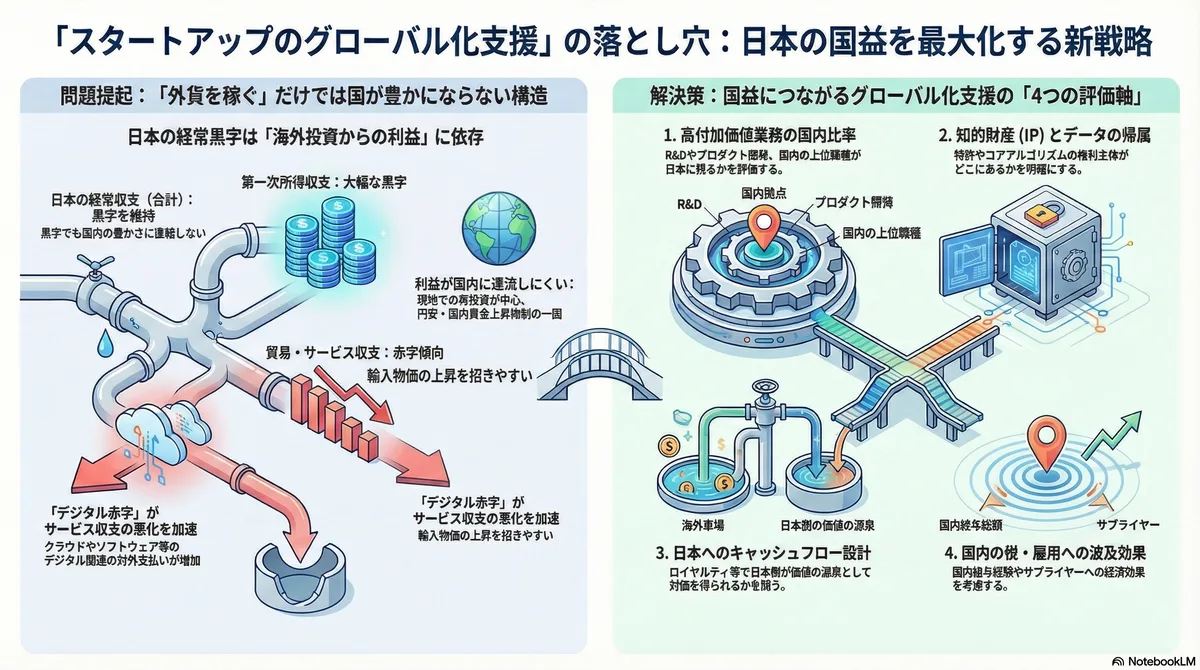
Summary by NotebookLM
The direction of increasing the number of startups that earn foreign currency is important. But simply pushing globalization would bring back the problems that have occurred in Japan so far, so caution is needed.
And if that proceeds through inaction, the foundations of society will be shaken and economic activity will become difficult.
Therefore, if we are going to back startups with public funds, I think it will bring better results in the medium to long term to build into the evaluation from the outset not "global" as a slogan, but how much of "high-value-added work, IP, profit distribution, and the spillover of employment and taxes" is designed to remain in Japan alongside the earning of foreign currency.
Only then will it lead to a meaningful policy discussion of "global startups from Japan," wouldn't it?
Addendum: Separating "earning foreign currency" from "attracting foreign currency"
In discussions about startups, "earning foreign currency" and "attracting foreign currency" also tend to get mixed up, so let me separate them.
- Earning foreign currency (current account side): exports (goods and services), royalties, cross-border provision of services, and so on
- Attracting foreign currency (financial side): investment from overseas VCs, and so on
Both are important, but attracting foreign currency does not equal earning foreign currency. In fact, some investors take the investment strategy that overseas VCs and the like invest in Japanese startups expecting "investment returns from growth in the sufficiently large Japanese market," while investing in local companies in other countries to build a portfolio, so they would rather the startups not expand overseas. If we are to attract foreign investment in order to earn foreign currency, I think we must encourage overseas investment in industries that can earn foreign currency, and it seems we need to read such nuances carefully.