Translating Everyday Language into Policy Language
This article was machine-translated from Japanese by AI (Claude). It may contain errors. Read the original Japanese article.

The rise of emotional discourse, and discourse that carries the pain of lived experience, is an important signal that institutions or distribution are failing somewhere in society, whether through pain, distrust, a sense of unfairness, or damage to dignity.
However, discourse built on pain or hatred can lead to emotional confrontation, and it tends not to turn into concrete policy debate or social analysis. Even if it were reflected in policy as it is, the result might well be a policy that is not very effective.
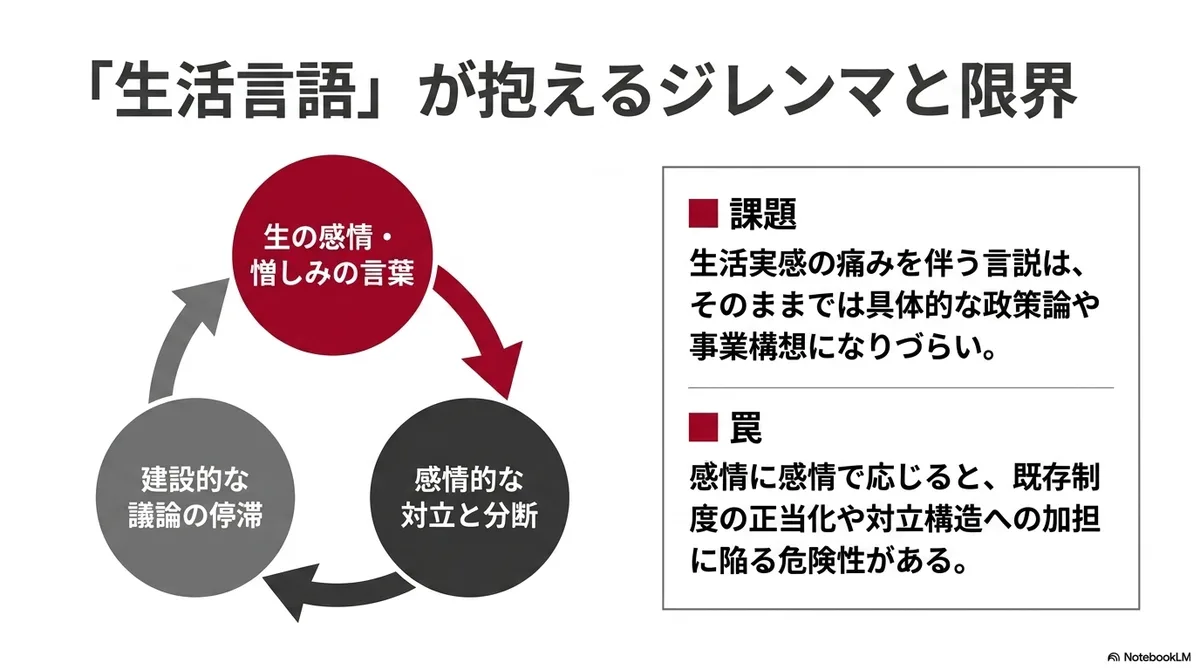
What is needed, then, is to turn the anxieties that emotions point to, and the values behind them, into questions that can be verified and debated.
As an attempt to do this, in this article I used a dialogue with ChatGPT 5.5 Pro to create, as one example, a table that translates "everyday language, including emotion" and "emotional language" into "policy questions and policy language." I suspect that what politicians and civil servants do every day is probably this kind of "translation" of words.
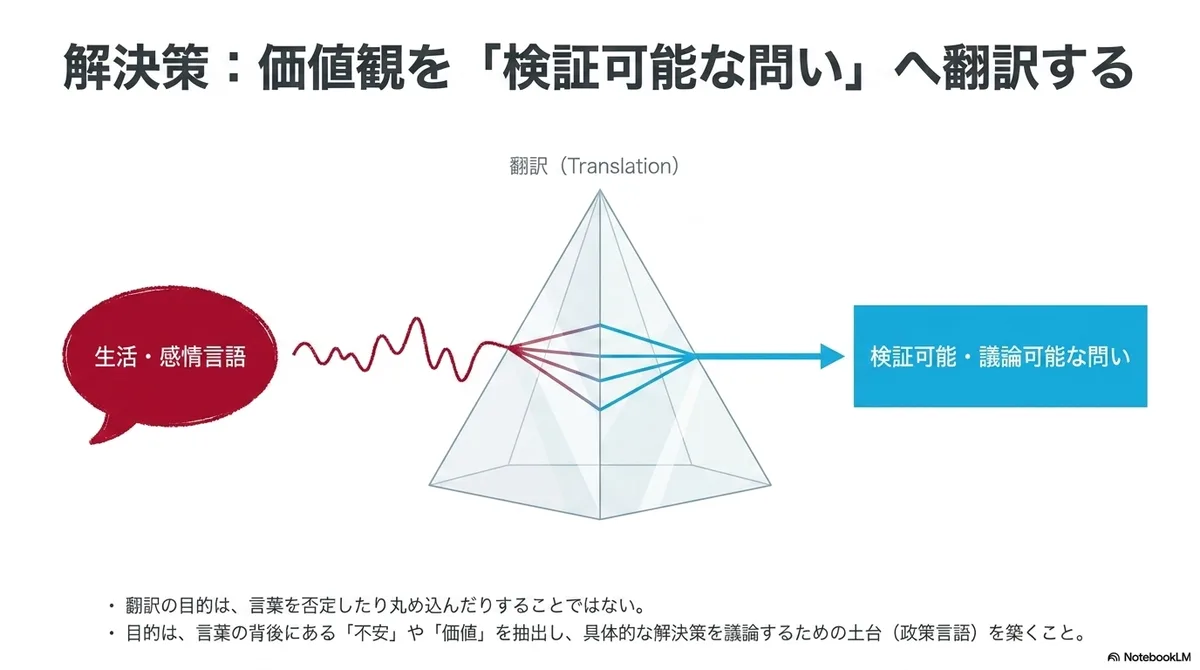
Please note that this translation table is not meant to negate emotional words, nor is it meant to smooth over anger or anxiety in order to justify existing institutions. I hope you will see it as a kind of lens for finding the pain and values behind words, and as an example of translating between "everyday language" and "policy language."
Taxes, Social Security, and Public Finance
| Everyday / emotional language | Underlying anxiety or concern | Translation into policy language | Candidate policy measures | Indicators and facts to check | Rights to protect / biases to avoid | Question to turn into debate |
|---|---|---|---|---|---|---|
| "They take all this tax and we get nothing back" | Sense of burden, lack of a sense of benefit | Making benefits and burdens visible | Visualizing tax and social security burdens, itemized statements of government services, simulations by income bracket | Burden rate by income, benefit amounts, use of public services, disposable income | Do not oversimplify low-income people or the elderly as "people who benefit." Look at the whole life cycle | Can we see who bears how much and what services they receive? |
| "Tax money is being wasted" | Distrust of public finance, distrust of government | Program evaluation and budget transparency | Administrative program reviews, third-party evaluation, outcome-linked budgets, clear criteria for abolition or reduction | Program costs, outcome indicators, audit results, cost-effectiveness, execution rate | Do not assume "public spending = waste." Separate necessary spending from inefficiency | Is the program more effective than the alternatives, and does it have an end condition? |
| "Only people on welfare get a good deal" | Sense of unfairness, suspicion of system abuse | Safety net design, fraud prevention, improving take-up rates | Fraud investigations, application support, employment support, review of benefit design, more caseworkers | Welfare take-up rate, fraudulent receipt rate, poverty rate, rate of transition to employment | Avoid stigma toward people in poverty. Do not confuse a small amount of fraud with the need for the system as a whole | How can we curb fraud and the sense of unfairness while helping those who need it? |
| "Only the middle class is losing out" | Pressure from taxes, insurance premiums, and education costs | Middle-class disposable income, gaps between taxes and benefits | Income tax and resident tax deductions, review of social insurance premiums, education cost support, housing support | Take-home pay by household type, education costs, housing costs, social insurance burden rate | Do not set it against support for low-income people. Make middle-class support and anti-poverty measures compatible | Is the system maintaining the living foundations of the middle class? |
Political Distrust
| Everyday / emotional language | Underlying anxiety or concern | Translation into policy language | Candidate policy measures | Indicators and facts to check | Rights to protect / biases to avoid | Question to turn into debate |
|---|---|---|---|---|---|---|
| "Politicians only think about themselves anyway" | Feeling of not being represented, political distrust | Responsiveness of representation, conflicts of interest, accountability | Disclosure of political funds, lobbying registration, disclosure of meeting records, standardized reporting of legislators' activities | Political fund balances, records of policy requests, legislators' voting behavior, handling of consultations by constituency | Do not treat all politicians uniformly as corrupt. Distinguish legitimate political activity from opaque favor-seeking | Whose interests do representatives speak for, and can citizens verify it? |
| "Everything is decided behind closed doors" | Distrust of closed-door politics | Transparency of the policy-making process | Publication of advisory council minutes, publication of policy requests, obligation to respond to public comments, stronger retention of administrative documents | Advisory council materials, minutes, industry group requests, rate at which public comments are reflected | Avoid sliding into conspiracy theories. Convert suspicion into points for verifiable freedom-of-information requests and audits | Can we trace who asked for what, when, and how it affected policy? |
| "Expert panels have the conclusion decided in advance" | Distrust of expert knowledge, backlash against the use of authority | Transparency of expert selection, institutionalizing dissenting opinions | Disclosure of conflicts of interest, inviting opposing experts, publishing minority opinions, third-party review | Member selection criteria, conflicts of interest, presence of dissenting opinions, meeting materials | Do not let distrust of experts become anti-intellectualism. Examine the selection procedures and evidence, not the experts' character | Are not only the experts' conclusions but also their premises, limitations, and counterarguments made public? |
| "They have no intention of listening to the people" | Declining sense of political efficacy | Institutionalizing citizen participation and government response | Deliberative assemblies, citizen juries, obligation to respond to public comments, citizen briefings for each policy, improved petition system | Number of public comments, response rate, number of deliberative assemblies held, days until government response | Do not treat only the "loudest voices" as representative. Ensure random sampling and demographic balance | Does the government respond to citizens' opinions with reasons? |
Prices, Wages, and Hardship in Daily Life
| Everyday / emotional language | Underlying anxiety or concern | Translation into policy language | Candidate policy measures | Indicators and facts to check | Rights to protect / biases to avoid | Question to turn into debate |
|---|---|---|---|---|---|---|
| "Life isn't getting any easier at all" | Decline in real income, anxiety about the future | Problem of disposable income and cost of living | Tax incentives for wage increases, raising the minimum wage, housing support, benefits to counter high prices | Real wages, CPI, household spending, housing cost burden rate | Do not blame hardship on individuals' lack of effort. Consider differences by region and household composition | Is economic growth reaching household take-home pay? |
| "I work and I'm still poor" | Dissatisfaction with the working poor | Low-wage work, treatment of non-regular workers, employment support | Minimum wage, equal pay for equal work, expanded coverage of social insurance, vocational training | Wages by employment type, poverty rate, social insurance enrollment rate | Do not regard low-wage workers as "lacking ability." Look at the structure of the labor market | Is the wage level high enough to live on when working full-time? |
| "Only big companies are making money" | Distrust of how growth is distributed | Relationship between corporate profits and wages and subcontracting transactions | Regulation of subcontracting transactions, tax incentives for wage increases, measures for passing on prices, disclosure of labor share | Corporate profits, wage growth rate, subcontract unit prices, dividends, retained earnings | Do not treat companies as a whole as enemies. Look separately at the balance of power among large companies, small and medium-sized companies, and workers | How can corporate profits be linked to wages, investment, and fair transactions? |
| "Marriage and raising children are out of the question" | Sense of being unable to plan a life | Income, housing, and childcare costs for young people | Rent subsidies, expanded childcare, child allowances, wage increases for young people, correcting long working hours | Income of young people, rent, childcare capacity, birth rate, working hours | Do not blame the unmarried or those without children. Marriage and childbirth are personal choices, so discuss improving the environment | What is the biggest institutional cost preventing family formation? |
Child-Rearing, Education, and Young People
| Everyday / emotional language | Underlying anxiety or concern | Translation into policy language | Candidate policy measures | Indicators and facts to check | Rights to protect / biases to avoid | Question to turn into debate |
|---|---|---|---|---|---|---|
| "Don't tell me to have kids, I can't" | Economic anxiety, lack of time | Structural costs of childbirth and child-rearing | Developing childcare, child allowances, housing support, parental leave benefits, correcting long working hours | Income, housing costs, childcare capacity, education costs, birth rate | Do not make childbirth an obligation or a moral duty. Protect the freedom to choose whether or not to have children | How can child-rearing be shifted from individual responsibility to social institutions? |
| "Education costs are far too high" | Anxiety about entrenched class divisions | Fairness of educational opportunity | Tuition reductions and exemptions, grant-type scholarships, income-contingent repayment, learning support | Education costs, scholarship repayment, rate of advancing to higher education by income bracket | Do not leave it to parents' responsibility alone. Put guaranteeing children's opportunities at the center | Is children's career path too heavily determined by their parents' income? |
| "Young people's voices don't reach politics" | Lack of generational representation | Youth participation, intergenerational policy evaluation | Youth assemblies, review of the age of eligibility to run for office, generational policy impact assessments, civic education in schools | Youth voter turnout, share of young legislators, benefits and burdens by generation | Do not treat young people as "ignorant" or "immature." Look at the disparity in opportunities for political participation | How can the interests of the young be built into policy-making? |
| "Your life is decided by the parent lottery" | Inequality of opportunity, entrenched class divisions | Child poverty, disparities in educational and cultural capital | Support for infants and toddlers, learning support, measures against disparities in school meals and experiences, child support allowances | Child poverty rate, academic achievement gap, experience gap, advancement rate | Do not blame parents or children. Correct the disadvantages of family circumstances through institutions | How far should policy correct the disadvantage that comes from one's family of origin? |
Aging, Healthcare, and Long-Term Care
| Everyday / emotional language | Underlying anxiety or concern | Translation into policy language | Candidate policy measures | Indicators and facts to check | Rights to protect / biases to avoid | Question to turn into debate |
|---|---|---|---|---|---|---|
| "Caregiving is breaking families apart" | Family burden, isolation, sense of reaching one's limit | Socializing care, support for family caregivers | Securing care workers, respite care, family care leave benefits, community-based integrated care | Caregiving-related job leaving, number of people needing care, facility waiting lists, caregiver burden | Do not confine caregiving to family love alone. Also protect the caregivers' own right to a life | How far should responsibility for care be placed on families? |
| "Medical costs are swelling and I'm worried about the future" | Fiscal anxiety, intergenerational unfairness | Rationalizing medical costs, allocation of burdens, prevention | Preventive medicine, review of medical fee schedules, design of out-of-pocket payments, protection of the high-cost medical expense benefit | Medical costs, spending by age, out-of-pocket payments, healthy life expectancy | Do not treat the elderly only as a fiscal burden. Protect access to necessary medical care | How can quality of care and sustainability be reconciled? |
| "Only the elderly get preferential treatment" | Sense of intergenerational unfairness | Intergenerational redistribution, review of benefits and burdens | Pension reform, review of medical and long-term care burdens, investment in young people, generational accounting | Benefits and burdens by age group, disposable income, asset distribution | Avoid age discrimination. Also look at poverty and asset disparities within the elderly | How can intergenerational fairness and livelihood security for the elderly be reconciled? |
| "I'm far too worried about old age" | Anxiety about the future, distrust of the system | Stability of pensions, healthcare, long-term care, and asset building | Minimum guaranteed pension, home care support, support for continued employment, financial literacy support | Pension level, savings, care costs, rate of living alone | Do not overemphasize self-reliance alone. Protect the dignity of low-income elderly people | At what level should the minimum livelihood guarantee for old age be set? |
Gender, Family, and Ways of Working
| Everyday / emotional language | Underlying anxiety or concern | Translation into policy language | Candidate policy measures | Indicators and facts to check | Rights to protect / biases to avoid | Question to turn into debate |
|---|---|---|---|---|---|---|
| "Women are the ones who get all the burdens pushed onto them" | Care burden, workplace inequality | Unpaid care, wage gaps, promotion gaps | Disclosure of gender pay gaps, childcare and long-term care support, parental leave system, promotion to managerial positions | Gender pay gap, time spent on housework and childcare, share of managers | Do not fix women into the caregiving role. Also institutionalize men's participation in care | Are burdens unevenly distributed across home, workplace, and social security? |
| "Men are suffering too, but we're ignored" | Men's isolation, distress over role expectations | Men's mental health, long working hours, support for fathers | Regulation of working hours, parental leave for men, counseling services, suicide prevention | Suicide rate, working hours, parental leave uptake rate, number of consultations | Do not turn it into a conflict between the sexes. Treat men's difficulties as a problem of gender structure too | How should men's difficulties be treated as a policy issue? |
| "Taking parental leave makes you a nuisance at work" | Gap between the system and the workplace | Replacement staff during parental leave, workplace design, evaluation systems | Subsidies for replacement staff, standardizing work, making parental leave mandatory, corporate evaluation | Parental leave uptake rate, return-to-work rate, turnover rate, assignment of replacement staff | Do not regard those who take parental leave as a "nuisance." See it as a problem of workplace design | Is parental leave designed not only as an individual right but also as part of organizational management? |
| "They talk about diversity, but the front line is exhausted" | Gap between ideals and practical burden | Implementation costs of inclusion policies, staffing and training | Training budgets, consultation systems, support for reasonable accommodation, on-site manuals | On-site burden, number of consultations, training implementation rate | Do not regard diversity as "accommodating troublesome people." Discuss the necessary allocation of resources | Are the staff, funding, and rules needed for diversity policies in place? |
Foreigners, Immigration, and Multicultural Coexistence
| Emotional language | Underlying anxiety or concern | Translation into policy language | Candidate policy measures | Indicators and facts to check | Rights to protect / biases to avoid | Question to turn into debate |
|---|---|---|---|---|---|---|
| "I'm uneasy about the growing number of foreigners" | Anxiety about changes in the living environment, public safety, and cultural friction | Scale of acceptance, regional support, social integration | Japanese language education, grants to local governments, support for community rules, consultation services | Number of foreign residents, burden by region, number of cases of education and medical support | Do not view foreigners as a whole as dangerous. Make the issue institutions and regional burdens, not attributes | Are the scale of acceptance and the regional support system in balance? |
| "Only foreigners get preferential treatment" | Suspicion about fairness | Transparency of support criteria, benefits based on need | Publishing benefit requirements, multilingual explanations, clarifying income and hardship criteria | Benefit requirements, usage records, support by income bracket | Avoid hostility based on nationality. Judge support by degree of hardship and actual residence, not nationality | To whom, and under what criteria, are support programs applied? |
| "Some people don't follow the rules" | Anxiety about order, friction in daily life | Sharing community rules, law enforcement, regional coordination | Multilingual guides, support for neighborhood associations, consultation and mediation systems, response to violations | Number of complaints, number of consultations, response to violations, community satisfaction | Do not extend a few cases to the whole group. Reconcile mutual understanding with fair law enforcement | Is the sharing of rules to prevent friction among residents sufficient? |
| "They're being used and discarded as cheap labor" | Anger at labor exploitation | Protecting the rights of foreign workers, regulating the labor market | Easing restrictions on changing jobs, stronger labor inspections, compliance with minimum wage, consultation services | Wages, work-related accidents, number of disappearances, number of inspections | Do not treat foreigners only as labor. Protect human rights and labor rights | Are the measures against labor shortages turning into labor exploitation? |
Environment, Energy, and Infrastructure
| Everyday / emotional language | Underlying anxiety or concern | Translation into policy language | Candidate policy measures | Indicators and facts to check | Rights to protect / biases to avoid | Question to turn into debate |
|---|---|---|---|---|---|---|
| "Nuclear power is scary" | Fear of accident risk and irreversible harm | Risk management, evacuation plans, regulatory independence | Stronger nuclear regulation, verification of evacuation plans, third-party audits, compensation system | Accident risk, feasibility of evacuation, decommissioning costs, regulatory review | Do not dismiss opponents as unscientific. Protect the rights of local residents who bear the risk | What safety standard would be socially acceptable? |
| "Mountains are being destroyed for renewable energy" | Destruction of nature, regional burden | Siting regulations for renewable energy, local consensus | Environmental impact assessments, siting regulations, return of benefits to the community, procedures for residents' consent | Deforestation, landslide risk, power generation, regional revenue | Do not treat local residents as anti-environment. Reconcile decarbonization with the local environment | How can decarbonization be reconciled with local nature and living environments? |
| "Electricity is far too expensive" | Household burden, distrust of policy | Electricity market, fuel costs, surcharges, subsidies | Electricity bill subsidies, support for low-income people, electricity market reform, energy-saving investment | Breakdown of electricity bills, fuel prices, surcharges, household burden | Protect the right of low-income households to a livelihood. Make the cost burden of environmental policy visible | How should we set the priorities among stable supply, price, and decarbonization? |
| "Infrastructure is aging and dangerous" | Anxiety about the foundations of daily life | Infrastructure renewal, priorities for public investment | Long-life extension plans, allocation of public investment, renewal of water supply and sewerage, wide-area cooperation | Aging rates of bridges, roads, and water systems, renewal costs, number of accidents | Do not neglect areas with few users. At the same time, discuss sustainability | Which infrastructure should be maintained, and where should it be consolidated or converted? |
Media, Social Media, and the Information Space
| Everyday / emotional language | Underlying anxiety or concern | Translation into policy language | Candidate policy measures | Indicators and facts to check | Rights to protect / biases to avoid | Question to turn into debate |
|---|---|---|---|---|---|---|
| "The mainstream media can't be trusted" | Distrust of reporting, suspicion of bias | Media transparency, correction systems | Publishing correction histories, identifying sources, reviews of journalistic ethics, media literacy education | Number of corrections, rate of source identification, comparison of reports | Protect freedom of the press. Do not tie criticism directly to press regulation | Do news organizations correct their errors and show their basis? |
| "Social media tells the real truth" | Distrust of established authority | Verifiability of information sources | Links to primary sources, fact-checking, platform transparency, information literacy | Sources of posts, paths of spread, status of corrections | Do not treat social media users as ignorant. At the same time, address the risk of unverified information spreading | Can we evaluate information by its basis and verifiability rather than by the medium? |
| "Call it a conspiracy theory and they shut you up" | Backlash against the exclusion of questions | Distinguishing legitimate questions from baseless assertions | Information disclosure, third-party verification, appeals, accountability | Public information, verification results, falsifiability | Protect the right to ask questions. But avoid group attacks and baseless assertions | Where does a verifiable question end and a baseless assertion begin? |
| "Nothing moves unless it goes viral in outrage" | Distrust of formal channels | Complaint handling, administrative response, relief systems | Consultation services, ombudsman, response deadlines, publication of complaint handling | Number of consultations, processing time, resolution rate, recurrence rate | Avoid vigilante punishment of targets of online outrage. Build institutional channels for relief | Is there a route for bringing problems to the system without relying on online outrage? |
A Final Note
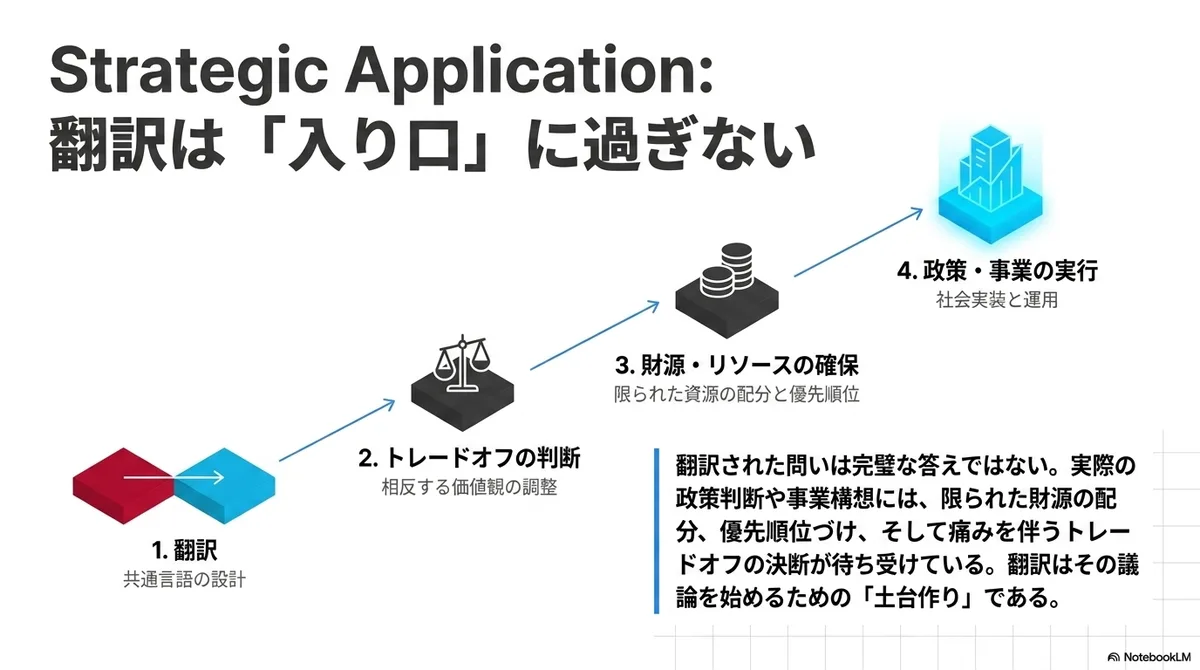
I should also add that this method has its limits.
Emotional words are not necessarily the representative opinion of society as a whole, and voices that stand out on social media may be the result of algorithms or organized posting. Also, taking in the concern behind an emotion does not mean justifying everything that was said. On issues such as foreigners, welfare, gender, and intergenerational conflict, while taking in the anxiety, we need to separate out expressions that lead to discrimination or exclusion.
And translation into policy language is not a final policy judgment; it is only an entry point. Policy also involves funding, priorities, trade-offs, and so on.
Even so, I thought there was some value in recognizing that "it's just that the words are different," so that we can stop for a moment when we see discourse such as complaints, and so I wrote this article.