Exit Quantity and Quality: The Bottleneck in Japan's Startup Ecosystem and the Trillion-Yen Company
This article was machine-translated from Japanese by AI (Claude). It may contain errors. Read the original Japanese article.
- The middle has grown, but the "entrance" and the "exit" have not
- Increase quantity? Raise quality?
- In the medium to long term, raise quality
The medium- to long-term (10-year span) challenge that Japan's startup ecosystem as a whole must address in 2024 is, I believe, the question of how to produce decacorns (companies worth 1 trillion yen) from Japan.
The middle has grown, but the "entrance" and the "exit" have not
The background is that, while VC investment has grown ahead of the rest to about 10 times its level of ten years ago,
- The number of startups, which form the entrance
- The number and value of exits, which form the exit
have not yet increased enough1.
Shown as a diagram, it looks like this.
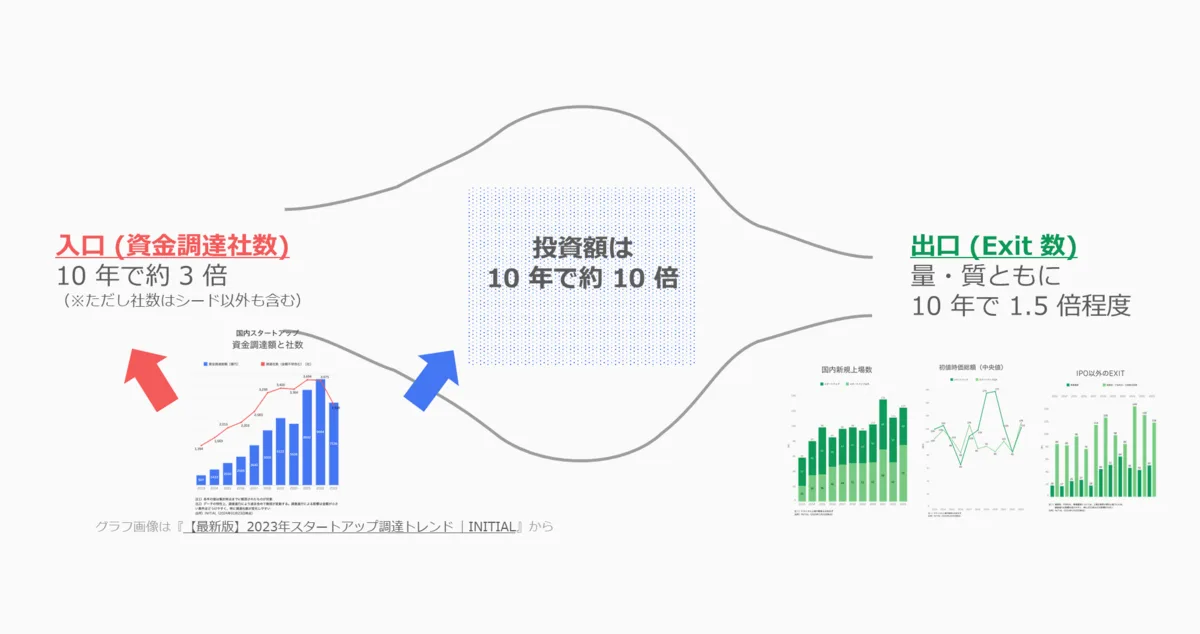
The graph images in the diagram are from [Latest Edition] 2023 Startup Funding Trends | INITIAL
The exit is the bigger challenge
Investment, the middle part, grew about 10 times in ten years, but the number of startups founded at the entrance grew about 3 times in ten years, and the exit grew 1.5 times in both quantity and quality.
The especially serious challenge is probably the Exit (the exit side).
If about 500 billion yen of VC funds are currently being raised in Japan each year, the return expected ten years later is about 3 times that, or 1.5 trillion yen. However, the total return that VCs are earning at present probably does not reach that amount.
If a clog forms at the exit, VC funds will be unable to deliver the expected returns, and money will stop circulating back to LPs. As a result, VCs will be unable to raise their next funds, money will stop flowing into startup investment, the investment amount in the middle, which is now swollen, will shrink, and consequently the number of startups founded will fall.
That sets off a worsening vicious cycle. To prevent that, we need to widen the bottleneck at the exit.
Efforts to increase the "number" of startups founded at the entrance are also important, but if the back end is clogged as it is now, we could end up in a situation like the former "10,000 Postdocs Plan," in which people were produced but had nowhere to go.
Increase quantity? Raise quality?
So, to widen the exit, we need either to
- Increase the number (quantity) of Exits, or
- Increase the unit value (quality) of Exits.
Startup Exits are mainly IPOs or M&A.
That narrows things down to the following four options.
(1) IPO quantity | (2) IPO quality |
(3) M&A quantity | (4) M&A quality |
(1) The number of IPOs is unlikely to increase dramatically. The Growth market is moving toward stricter listing requirements, and given the structural labor shortage at audit firms, I think the number of IPOs will not increase in the short term.
The hope lies in (3) and (4), M&A.
What can be increased in the short term is M&A. If we think on a five-year span, there is no choice but to increase M&A. In fact, it is increasing, if gradually.
However, considering the characteristics of Japanese industry, I also suspect that if startups in Japan continue to be mostly IT-centered, "M&A of domestic startups by large domestic companies" will not increase dramatically.
The relationship between the number of M&A deals in Japan and its industrial structure
To begin with, with what intentions is M&A carried out? For example, McKinsey divides approaches to acquiring startups into four:
- Acquiring technology or intellectual property
- Acquiring talent
- Product expansion
- Geographic expansion
And if large companies were to buy startups "at a high price," it would mainly be for "product expansion."
This is because acqui-hiring often does not amount to a large sum, and ideation, being pre-seed, also does not amount to a large sum. As for "geographic expansion," a large Japanese company buying a Japanese startup does not expand its geography, so it is out of scope.
Then, when the aim is "product expansion," synergy is what is sought, but many of the large companies in Japan that are expected to become buyers of startups are not IT service companies but companies centered on manufacturing and the like. Given that Japanese startups today are almost all IT-based, I think they are not a good match for generating such synergies.
Furthermore, "product expansion" is in many cases an area where not only domestic startups but also overseas startups are compared and considered. That means competing with overseas startups as well.
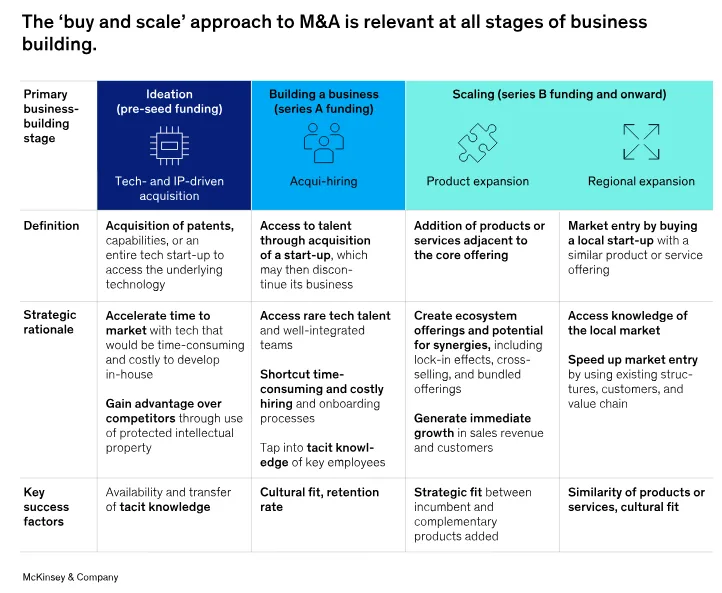
McKinsey's framework of M&A strategies: https://www.mckinsey.com/capabilities/mckinsey-digital/our-insights/buy-and-scale-how-incumbents-can-use-m-and-a-to-grow-new-businesses
Also, the amounts in (4) M&A inevitably tend to be small.
For example, an EY survey for 2021 counted 143 M&A deals a year, but only 18 were worth more than 1 billion yen. Those worth more than 5 billion yen numbered 5.
A 10-billion-yen M&A is quite a large one, and it would take 100 fairly large 5-billion-yen M&A deals a year to reach 500 billion yen.
I think large IT companies and so-called mega-ventures will continue to buy startups, and I think such purchases will increase. However, because those mega-ventures do not have that large a presence in Japan as a whole, I think their contribution to the increase in M&A across Japan will not be that large.
In the medium to long term, raise quality
That being the case, I think we should consider how to grow (2) and (4), quality, that is, aim to produce large Exits in the medium to long term.
Until now, the government has collected the problems startups face right in front of them through bottom-up hearings and has steadily kept solving them with policy, and the startup environment has undoubtedly improved. Precisely because of that, many of the problems visible right in front of us have been solved, or there is a prospect of solving them, and in that sense I think the government is now being asked to take on a policy challenge one size bigger.
One of those is producing decacorns, and I think we should devote more resources to discussing it.
Footnotes
-
I think there is also a debate about whether looking at a ten-year span is right. If new investments are made within 3 to 5 years after a VC fund is formed, fund formation since 2019 has been a little over 500 billion yen a year, and the number of companies raising funds over that period was almost flat. If so, the situation may not be that tight in the short term. Still, the fact that the quantity and quality of Exits are the same as ten years ago means, I believe, that the situation remains severe. ↩