Deep Tech Startups Don't Necessarily Take a Long Time
This article was machine-translated from Japanese by AI (Claude). It may contain errors. Read the original Japanese article.

It is often said that "deep tech startups take a long time to reach an exit," but I want to record here that (at least in the United States) this is not necessarily so.
Life Science is one area of deep tech. Moderna, a representative startup in that area that took the world by storm with its mRNA vaccine, was founded in 2010 and held one of the largest IPOs of its time in 2018. In other words, it went public eight years after its founding. Eight years is not that long a period.
Also, according to a site that compiles U.S. IPO data every year (Jay Ritter's site at the University of Florida), for the 16 Life Science companies that went public in 2022, the median number of years from founding to IPO was 4.
Going back a little further and putting it in a table looks like this.
Number of IPOs | Years since founding (median) | |
2019 | 42 | 4 |
2020 | 76 | 6 |
2021 | 89 | 5 |
2022 | 16 | 4 |
2023 | 13 | 4 |
Data on the median years since founding for so-called "tech (software) companies" over the same period is also posted on Jay Ritter's site, and Life Science companies go public in a far shorter period than those (about half).
Let's check this with some concrete cases. You can see a list of Life Science companies that have gone public at places such as the IPO Tracker.
For example, among the companies that held IPOs in 2023, in descending order of the amount raised in the IPO, ACELYRIN was founded in 2020, RayzeBio was founded in 2020, and Apogee Therapeutics was founded in 2022. Four years does not seem far off.
(Also, regarding Neumora Therapeutics, which went public in 2023, I recommend an article from 2022 by Miyazaki of ANRI and an article about ARCH, the firm behind it, both of which can be read in Japanese.)
Areas Other Than Life Science Aren't That Long Either
One might ask whether a short time to IPO is true only of Life Science, but that does not appear to be the case. Leo Polovets of Humba Ventures (Coding VC) compiled Pitchbook data and analyzed the scale of exits and the number of years to exit by sector.
An excerpt of the comparison table from that article looks like this.
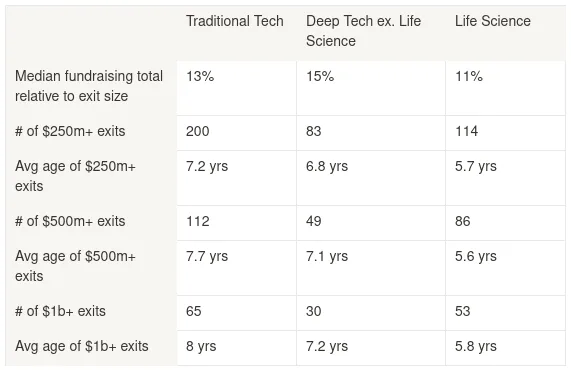
Life Science exits are indeed short, but even when you look at deep tech excluding Life Science, it is shown to be on par with so-called tech companies.
The classification is as follows.
- Traditional Tech: health tech, digital health, supply chain, mobile, e-commerce, SaaS, big data, marketing, artificial intelligence, fintech, insurtech
- Deep Tech: robotics, industrial, manufacturing, 3D printing, cybersecurity, cleantech, space, advanced manufacturing
What I Want to Convey
These are U.S. data, so they do not apply directly to Japan. However, PeptiDream was also founded in 2006 and went public in 2013, so it took seven years, and I think it can be said in Japan as well that it does not necessarily take long.
Of course, it is also true that many businesses overseas, such as SpaceX, take a long time, and there is no doubt that many deep tech startup businesses in Japan take a long time too. In particular, compared with the United States, it has been considerably harder in Japan to go public while running a deficit, which tended to make things take longer (or rather, there have not been many examples of going public outside the Life Science field).
On the other hand, flatly declaring that "deep tech takes a long time" is also a somewhat misleading way to put it.
Moreover, I think that if the "takes a long time" part is overly emphasized and spreads, LPs who invest in VCs might stop investing in deep tech VCs, or policy might go awry. In fact, the academics and policymakers I have spoken with had a vague impression that "deep tech startups take a long time, don't they?", and on several occasions the suggestion came up that "so we should first increase the number of IT startups."
Seeing such cases, I thought it would be good to emphasize the point that "it doesn't necessarily take a long time," and so I wrote this article.
Note that here I have evaluated whether it takes a long time based on the number of years since the company's founding, but whether it "takes a long time" differs depending on where you start counting the years. If you count from the early stage of research, it will of course be longer, so please keep that in mind.