Supporting 'First-Penguin Buyers'
This article was machine-translated from Japanese by AI (Claude). It may contain errors. Read the original Japanese article.
I believe one reason Silicon Valley is strong in the software industry is that it has excellent buyers.
Silicon Valley is home to many people, from large companies to startups, who are at the cutting edge of the software industry. As they go about their business, they are the first to run into the most advanced problems.
If a startup notices those problems and manages to build a product that solves them, that product will sell. The larger the customer company grows, the more sales of the product rise, and the startup can grow together with its customer. It also becomes able to sell the product to other companies, and the startup grows further.
Similarly, the strength and sophistication of the American defense industry probably also comes from having an advanced customer in the U.S. military.
They say "necessity is the mother of invention," which means that creating "high-quality necessity" leads to "high-quality invention." And as I summarized in an earlier article, the fact that customer development and Lean Startup methodologies are effective "especially in the United States" is probably due in large part to the excellence of its customers.
When we think about innovation, our attention tends to turn to the supply side, such as research and development and talent. But at the same time, it is also important to consider how to create demand that is excellent in both quality and quantity.
Policies that create and stabilize demand
I believe that creating demand that is excellent in both quality and quantity is especially important in "the green domain."
However, unlike IT and similar fields, demand in the green domain does not arise naturally if left alone. There is a very strong element of generating it through policy. This is because non-green alternatives are more cost-effective when looking only at economic cost, so most for-profit companies buy non-green products. (That said, this brings social costs such as the advance of climate change, so corrective policy is needed.)
To solve such problems, a variety of demand-stimulating policies, including regulation, are being implemented around the world. In Japan too, policy has already addressed much of the quantity of demand, the monetary value of demand, the predictability of demand, and so on.
More concretely, the following, for example, can be cited as a toolset of demand-side policies in the energy domain.
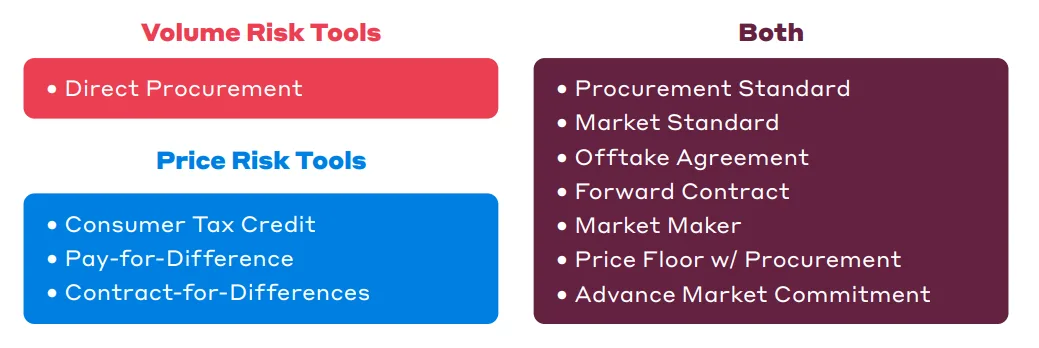
https://bipartisanpolicy.org/report/demand-side-support-for-energy-technologies/
I think these are effective too, and they are undoubtedly necessary.
On the other hand, what I feel from working on the front lines of support, and where I think there could be somewhat more help, is policy that produces first-penguin buyers on the demand side, the ones who buy a startup's product "first."
I think that if we successfully create the first buyers and make them succeed, buyers will appear one after another, and the policies above will also start to be used effectively.
The difficulty of creating "first demand"
Customers have few incentives to try a product "first." The second or third to buy usually face lower risk and lower product costs. And precisely because it is the first of its kind, they are likely to worry about the stability of procurement.
In the IT startup world, people say "find a burning need." But in areas like green, if there is a cheap alternative without a green premium, it is hard for the need to become a burning one.
A demonstration project may be a concept close to first demand, but from an investor's point of view, the quality of demand differs between demand from a demonstration that is no longer used once the trial period ends and demand that continues to be used afterward, even in small quantities. This is because completing a demonstration does not mean there is demand there. In fact, there is even a term, "POC hell," and there are many cases that stop at the demonstration stage.
In other words, to become the first buyer of a brand-new product, the customer needs a considerable sense of the problem or a considerable incentive, or they will not be inclined to move first. Conversely, customers who do move first are also considerable risk-takers.
I think how to handle this is one of the major hurdles in demand policy. In a sense, it is the question of "how to create innovative buyers" and what support is needed for that.
How to create first demand
I would have liked to write up proposed measures as well, but although I looked into policies for creating first demand, I did not find many good ideas, so I will only summarize the problem as I see it.
I do have a few rough ideas, listed below. But I feel they are not very good, so if you know of good examples from overseas, please let me know.
Praise them
First, praise them. Properly praising innovative buyers is unglamorous, but it seems to me to be effective to some degree.
However, whether branding as having been the first buyer works in a given market would need to be discussed separately.
Microsoft, Google, and others have entered purchase agreements with energy startups that cannot yet generate power, in order to procure green energy. I do not know the background or details of those contracts, but in addition to abundant funds, there seems to be the possibility that green energy will be in short supply in the future, as well as a direction as a brand.
Combine it with investment
A mechanism in which buyers also become investors, as with the startups created by Vargas Holding, also seems to be one approach. If it goes well, they not only obtain the product but also earn an investment return. If it fails, they simply do not need to buy, and the contract could be structured so that the downside is limited to the money invested.
Subsidies that can also be used for discounts?
Support for buyers in general differs from support for first penguins. I think it may be possible to hand suppliers a subsidy allocation that lets them offer somewhat discounted prices for first penguins.
In fact, I have heard that some IT companies gave first customers large discounts to build a track record. In the green sector, however, this is difficult. Unlike in IT, producing the product incurs substantial costs. Moreover, a startup has no funds to serve as the source of the discount.
Current subsidies can basically be used only for research and development, but I think that setting up a subsidy allocation that covers the difference, which the startup would otherwise bear out of pocket, might also serve as an incentive for the buyer.
Innovation vouchers?
Overseas innovation vouchers appear to be used mainly as a measure for SMBs to purchase services (R&D and support), and this idea is to see whether they could also be used to purchase green products.
If they were limited to products in specific domains or from specific companies where we want to generate demand ahead of time, and the voucher purchase amount decreased each year, that might create an incentive to buy early.
Summary
I hear that recently, partly because of weak domestic demand in Japan, many Japanese companies are conducting research, development, and production overseas, and reinvesting profits earned abroad further overseas instead of bringing them back to Japan. This is rational behavior for a company, so it should not be condemned, and tax cuts to encourage repatriation and the like may bring some of it back, but without sufficient quantity and quality of demand in Japan, it will not be possible to change the larger flow.
I think a decline in the total amount of demand due to population decrease is unavoidable, so we should at least think about how to create quality demand, especially advanced demand, and how to attract research and development to this land. As a place to try policy innovations toward that end, I think the green domain should see a variety of trials.