The Startup Environment in 2023 and Measures for the Future (Especially from an Accelerator's Perspective)
This article was machine-translated from Japanese by AI (Claude). It may contain errors. Read the original Japanese article.
If you look at the results of prominent American accelerators other than Y Combinator, their performance since 2015 has not been all that strong. In terms of producing unicorns, accelerators other than Y Combinator are no longer producing many unicorns.
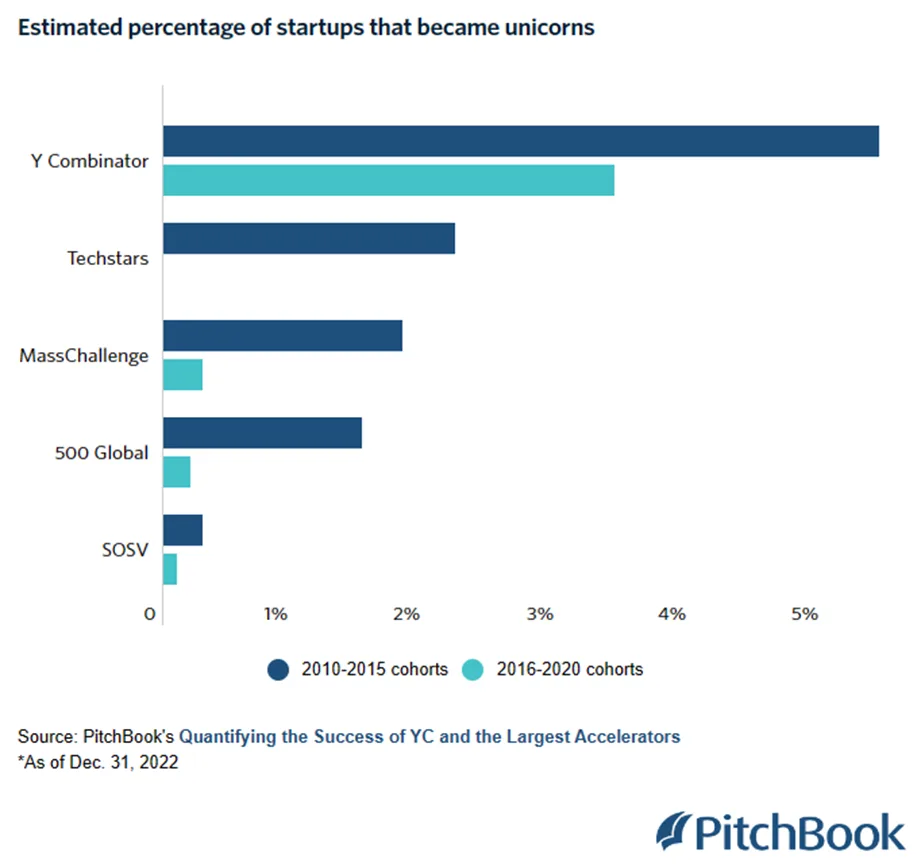
https://pitchbook.com/news/articles/y-combinator-accelerator-success-rate-unicorns
I think this is probably because there have been major changes in the North American startup environment.
The following factors are candidate explanations.
- Y Combinator has expanded the number of companies it accepts, giving it an oligopoly over promising startups
- With more people who have founded companies before, there are more founders who do not need an accelerator
- The areas in which startups can grow have gradually become more limited
So far I have been talking about other countries, but looking at Japan, too, the startup ecosystem has changed a great deal over the past few years. Given those changes, I have started to feel that people on the support side like me need a somewhat different form of support from before.
I wrote an article about the challenges of the ecosystem in 2017, and now, about six years later, I would like to put my understanding into words as the basis for what I will do next.
Please note that this is a personal view of history, and it may differ if you look closely at the data. It is also a story weighted toward accelerators, so it would probably look different from a VC's point of view. It is simply "this is how I see things, and this is how I will act from here on," and I am not claiming that this understanding is correct.
- 1. Up to Now
- 2 Changes That Happened in Japan
- 3 Changes That Did Not Happen (Changes We Could Not Make Happen)
- 4 Japan's Ecosystem from Here
- 5 Accelerators from Here
- Conclusion
1. Up to Now
Let me summarize the broad flow since around 2005, when Y Combinator began.
1.1 Changes in the Technological Environment
As is often said, around 2005 the IT industry saw a series of major changes.
- From 2006, the arrival of cloud environments such as AWS lowered initial investments such as infrastructure costs
- Soon after, smartphones appeared, and later app stores, sharply reducing the cost of distributing apps
- The spread of smartphones and social media also increased the time people spent on the internet
- New, cost-efficient ways of acquiring users appeared, such as social media and search-based advertising
- In the 2010s, the SaaS wave began in earnest, and the B2B market expanded as well
In other words, the 15 years from 2005 were a time when the internet, smartphones, and the cloud (SaaS) kept expanding without pause, while the arrival of services like AWS dramatically lowered the cost of starting and expanding a business.
1.2 The Emergence of Accelerators
In 2005, Y Combinator, said to be the original accelerator, was founded1.
The hypotheses of its founder, Paul Graham, are said to have been these two:
- "Success in starting a company depends mainly on smartness and energy, and age and business experience are not such big factors"
- "You can start a company with less money than most people expect"
These two are what is said to have been the hypotheses2. Put differently, it could be called the hypothesis that "young people can succeed in starting companies with a small amount of money and advice"3.
It would not be an exaggeration to say that, once tested, the hypothesis proved correct. Many young founders emerged from Y Combinator. One of them is Sam Altman, now the head of OpenAI and very much at the center of attention, who was in Y Combinator's first batch and later served as its president.
Efforts imitating Y Combinator were then named "accelerators" one after another, and they spread.
Among the well-known ones, Techstars was founded in 2006, MassChallenge in 2009, and AngelPad in 2010.
1.3 Seed VCs
One reason accelerators worked well, I think, is that after the dot-com bubble, as VCs' focus moved toward later stages, the earlier stages were left open, and there was a need to support startups at the seed and pre-seed stages.
In fact, it was around this time that not only accelerators but also seed VCs emerged: First Round Capital and SoftTech VC (now Uncork Capital) were founded in 2004, and True Ventures and Floodgate in 2005.
I think the reduced cost of starting a company thanks to AWS and the like also played a part in this background. This is because it also mattered a great deal that small investments from accelerators and seed VCs became enough to start a company. For details on this, see Why Has Seed Investing Declined? And What Does this Mean for the Future? .
In this way, I see the flow as one in which, in the space left open by missing support, an environment in which companies could be started at low cost came together, and accelerators and seed VCs were born.
1.4 Angel Investors
Another part of the environment around accelerators that I want to cover is angel investors.
The number of people who had made fortunes from the IPOs of Google, Facebook, and others grew, and when institutional investors pulled back around the 2008 Financial Crisis, angel investors were the ones whose presence grew.
Y Combinator, too, could be said to have originally been started by four angel investors, and AngelPad is something like angel investors plus an accelerator.
Angel investors seem to have had a large presence in the United States until around 2010, but their presence has been shrinking year by year.
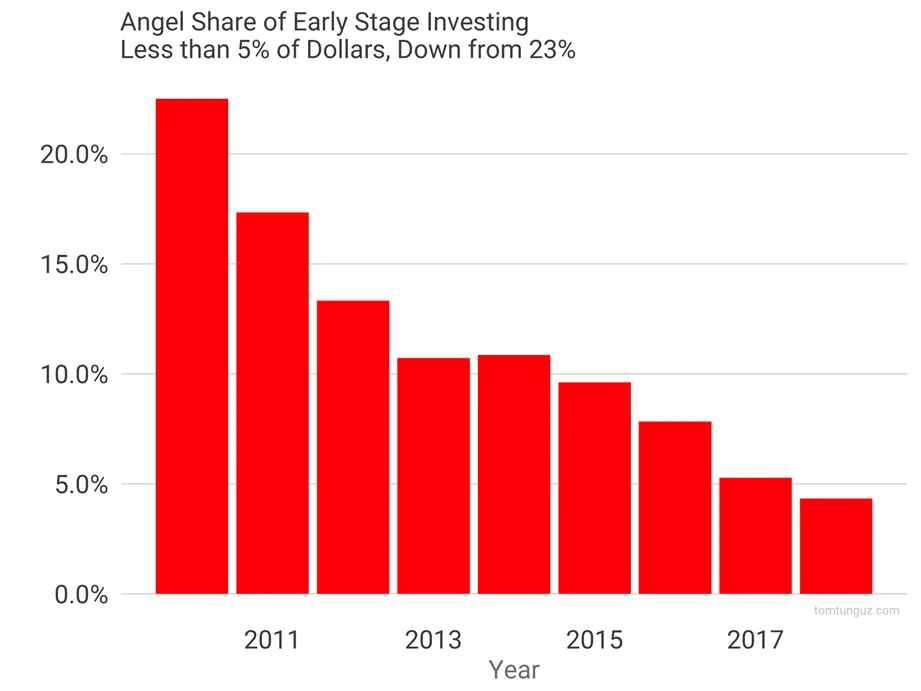
One cause cited for this is that institutional investors came back and began to lead seed rounds. Around 2012, there must have been many people who made some money from acqui-hires, but VCs became more active than angel investing grew.
1.5 The Institutionalization of Accelerators
As institutional investors returned, seed VCs multiplied, and angels had fewer opportunities to step in, accelerators gradually faced more competition. And accelerators, too, seem to have gradually come to operate not as individuals but as organizations and institutions.
Y Combinator and Techstars expanded their organizations and increased the number of companies they accept.
Currently, Y Combinator accepts 400 companies a year (though it plans to cut this in the future). Considering it was around 60 companies in 2010, that is a considerable increase.
Techstars runs accelerators in partnership with companies and others, and likewise accepts more than 400 companies a year, and MassChallenge has also increased its partners and accepts 200 or 300 a year4.
1.6 The Functions of Accelerators
So far we have looked at three similar kinds of players: accelerators, seed VCs, and angel investors.
Let me return to accelerators. What are the functions common to accelerators? I think they are mainly the following four.
- Providing know-how on starting a company
- Design as a program (in many cases, a batch system)
- Access to human networks such as mentors and cohort peers
- Access to funding (initial funding, and introductions to investors through Demo Day and the like)
In other words, the main function of many accelerators is to teach business to (mainly) young engineers through a program and to provide them with human and financial networks.
In doing so, they helped founders gain early traction while avoiding the mistakes that tend to occur in the early days of a startup.
1.7 Looking Back at Accelerators
Looking back like this, the period from 2005 to 2020 can be considered a "special period" in which the accelerator model worked wonderfully.
First, there were some areas of IT that could be started with little money and were also growing rapidly. And it was a time when, with a bit of advice, even young people and engineers could build their abilities as managers while starting and running a company.
In the United States, it was also an environment in which quite a few founders were emerging, and the demand for such programs was a big factor. It also made sense for accelerators to scale up. In the United States, the four large accelerators alone probably support more than 1,000 startups a year, and including smaller accelerators, the number of startups receiving accelerator support must be even larger.
This spread, and several accelerators were born in Japan too, and now many accelerators are active.
2 Changes That Happened in Japan
I have roughly looked back at the period from 2005 to around 2022, and now I would like to dig a little deeper into what kinds of changes happened in Japan.
First, let us look at funding, which is easy to understand in numbers.
2.1 Funding Raised Is 10 Times What It Was 10 Years Ago
According to data from Initial, funding raised across Japan was 87.7 billion yen in 2013 and reached 877.4 billion yen in 20225. This means that funding raised grew tenfold in about 10 years.
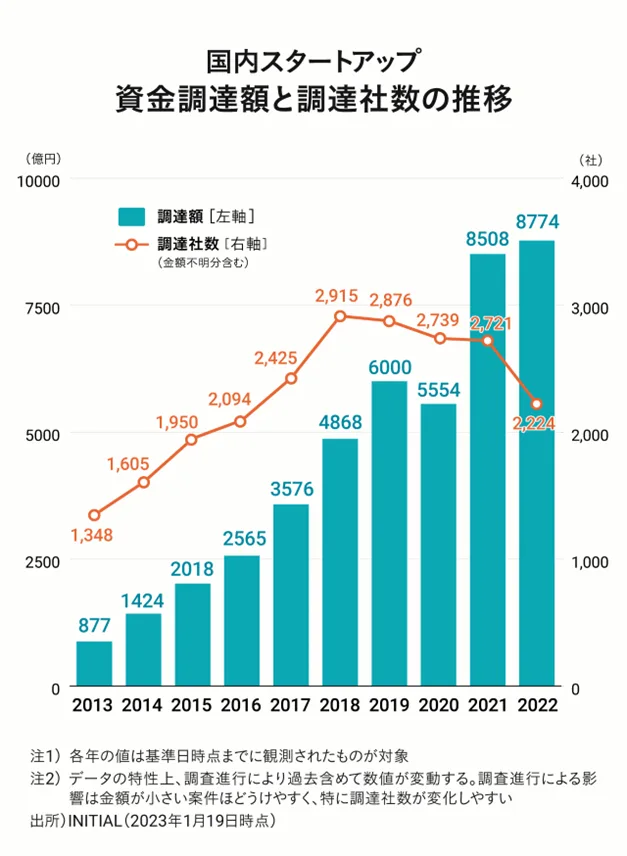
https://initial.inc/enterprise/resources/japanstartupfinance2022
Other countries have also shown considerable growth, so it is not that only Japan grew tenfold and achieved exceptional growth, but I think it was a major change that, at the very least, "Japan, too, went up by an order of magnitude."
2.2 The Increase in Startup Funding Amounts
What we just looked at was the total funding raised across Japan. This total can be calculated as "amount raised per round × number of rounds." Total funding has grown tenfold, but the number of funding rounds is only about double the 2013 level. That means that, on average, the amount per round has grown roughly fivefold.
However, rather than rounds having grown fivefold on average, the main cause of the increase is that large rounds have become more common. Although still an order of magnitude smaller than in the United States, we now see funding rounds of a size that were almost nonexistent 10 years ago.
An increase in the amount that can be raised widens the range of strategies a startup can take. And once startups can raise more money, and faster, than the new-business divisions of large corporations, it also means that the areas they can take on have increased.
2.3 The Growth in Fund Size
The fund sizes of Japanese VCs have also grown rapidly in the past few years. And fund size greatly affects a VC's strategy.
With a fund size of 5 billion yen, if cumulative returns of roughly 15 billion yen come in after 10 years, the IRR is reasonably good6. To get a return of about 15 billion yen, you would need
- one company with a market capitalization of 100 billion yen, of which the VC holds 15% of the shares
- two companies with a market capitalization of 50 billion yen, in each of which the VC holds 15% of the shares
- three companies with a market capitalization of 33.3 billion yen, ...
In other words, a single unicorn is enough to give the fund a sufficient return.
On the other hand, once the fund size becomes 50 billion yen, you need an exit of 150 billion yen after 10 years. To get 150 billion yen, the strategy is to land somewhere between these two:
- produce ten returns of 15 billion yen (= ten companies with a market capitalization of 100 billion yen)
- produce one return of 150 billion yen (= one company with a market capitalization of 1 trillion yen)
That is, whether to produce ten unicorns, one decacorn, or something in between.
However, there is an upper limit to the number of companies a fund can invest in and build relationships with. One investor can handle about 10 companies at most, and since a fund cannot hire ten times as many people, a tenfold larger fund size does not mean it can invest in ten times as many companies.
So the thinking turns to "how can we produce larger exits."
Also, as fund size grows, ticket sizes inevitably grow, and even VCs that had been focused mainly on seed gradually feel a pull toward investing in later stages.
(On the other hand, having money also lets them support the earlier phases, and the range of targets they support tends to widen... but I suspect it will gradually become apparent that this does not match the fund's term.)
I think it was especially in the last few years that this kind of shift in thinking gradually took place on the investors' side.
2.4 More Startup Talent and the Sharing of Know-How
IT is what drives Japanese startups, and most of an IT startup's costs are personnel costs. That funding flowed in means that hiring at startups increased, and the growing number of people working at startups is also a major change.
As a result, the sharing of startup know-how accelerated. Today, many startups publish their know-how on their own blogs and elsewhere.
The number of people involved with startups has also grown, and events are livelier than before.
3 Changes That Did Not Happen (Changes We Could Not Make Happen)
Up to here, these were changes that happened. From here, I would like to briefly touch on changes that did not happen, or that we could not make happen.
3.1 There Was No Surge in the Number of Startup Founders
One prediction I personally held in 2017 to 2018 and that turned out wrong concerns the number of founders working on high-growth startups.
With large exits such as Mercari, I personally hoped that a group of founders called the "so-and-so mafia" would finally emerge in Japan too. I assumed that, if things went well, startups would increase exponentially, or at least linearly. But that does not seem to have happened.
According to Initial's data, the number of companies raising funding grew at a considerable pace until 2018, but growth has stalled since. In terms of the number of companies, it is about double. The number of companies raising funding is not the same as the number of high-growth startups founded, but considering there is a positive correlation to some degree, I believe founding has not increased all that much.
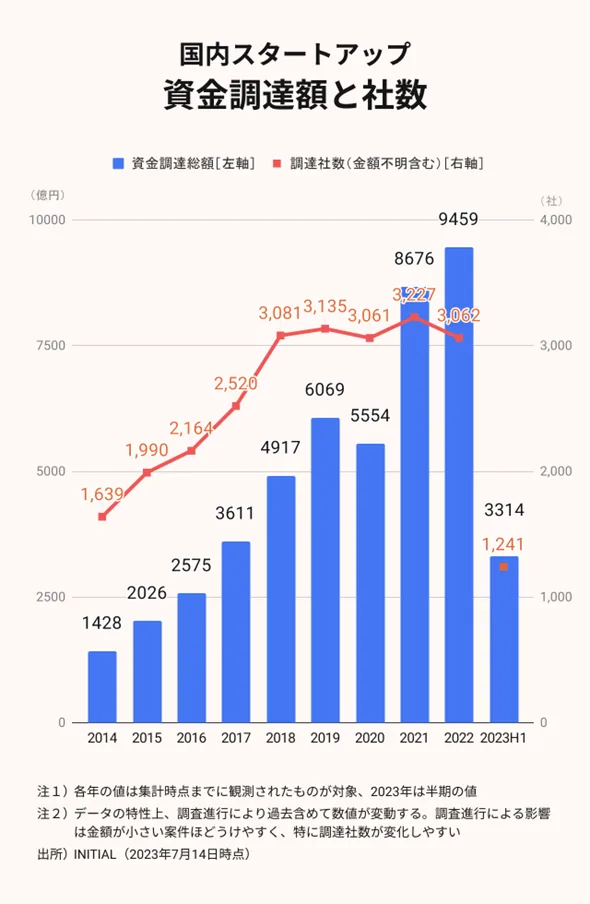
Assuming founding has not increased, there seem to be several reasons.
One is, for example, the growth of other employment. In particular, I think there is a fair chance that people who might in the past have chosen to start a company have flowed into occupations such as
- startup employees and CxOs
- the startup support side
- Big Tech
- strategy consulting
- open innovation divisions of large corporations
I am on the support side myself, so I am in no position to talk about others.
Funding amounts have grown, more people are involved with startups, and events are lively, but on the other hand, I personally do not feel that the number of founders themselves has increased dramatically.
Also, this is only my own impression too, but I have the sense that young people who want to start a company have increased over the past few years. In fact, according to a survey by the Japan Finance Corporation Research Institute, the share of people aged 29 and under who wish to start a business is fairly high.
However, among those starting businesses, I also have the impression that the number of people aiming specifically at startups has not risen all that much. Perhaps many people feel that a small-business way of earning is enough if the goal is to earn a few hundred million yen, and there are also a fair number of people who can earn enough through real estate investment and the like, so financially there may not be much need to deliberately choose the startup path.
In any case, I feel that the number of people aiming to found high-growth startups has not increased as much as funding amounts, which grew tenfold in 10 years.
Incidentally, even though Y Combinator accepts nearly 700 companies a year, its acceptance rate is said to be around 1.5 - 2%. Even if it is 2%, that means there are 35,000 applications a year. That so many founders and prospective founders exist could be called a major difference from Japan.
3.2 M&A Exits Did Not Increase All That Much
It is well known that in the United States, M&A makes up much of the exits. In Japan, by contrast, almost all exits are IPOs.
The existence of M&A in itself increases the strategies available to startups, and investors can recover their principal and take more risk. M&A also has the benefit of letting founders try again sooner.
The scarcity of such M&A exits has long been raised as a problem in Japan, I think, and measures such as the open innovation promotion tax system have been introduced in response.
Behind the scarcity of M&A there is the aversion to Not Invented Here (NIH: technology not developed in-house), and there are also issues such as goodwill, but I think the industrial structure is also part of the background.
Most Japanese startups are IT companies, and the buyers of IT companies are mainly IT companies. In the United States there are many hugely successful IT companies, starting with Big Tech, that can make acquisitions. But in Japan and Europe there are not so many such grown IT companies (IT startups), and because there are few buyers, there are few exits... it is, so to speak, a chicken-and-egg relationship.
That said, this is not a problem that can be solved by forcing large corporations to acquire startups. And to be acquired by a foreign company, a startup would have to be acquired either for world-leading technological strength or as an entry opportunity into the attractive Japanese market. Increasing M&A that makes all stakeholders happy will, I think, continue to be a challenge.
There are also other issues, such as the shortage of backers at the later stage and the problem of growth after listing, but I will leave it here for now.
4 Japan's Ecosystem from Here
Based on these changes, and on what did not change, I would like to think about what kind of development is needed from here.
4.1 How to Create Decacorns
I think many VCs whose fund sizes have grown have come to hold the question "how do we create decacorns"7. And I sense that Japan as a country also wants to produce decacorns.
A decacorn is a company with a market capitalization of 1 trillion yen. In terms of revenue (not profit), 100 billion yen would be necessary. It might need to be 200 billion yen. A unicorn, on the other hand, has revenue of 10 billion yen as one goal.
Reaching 10 billion yen in revenue within Japan alone can somehow be done. But selling 200 billion yen within Japan becomes quite difficult.
So what becomes necessary, I think, is
- taking on the global market
- taking on areas different from pure IT
In both cases, these are areas where no one has the formula.
4.2 Who Will Cover the Early Stage, Which Has Become Harder
As fund size grows, what happens is that the fund's investments gradually shift toward the later stage 8.
That leaves the support for earlier stages open.
On the other hand, if you want decacorns, I think it is becoming impossible to achieve them unless you design for them quite consciously from the early stage. In the past, "if you take enough shots, you'll hit something" may have worked, but I sense that tendency when I look at the declining performance of overseas accelerators.
In other words, intervention from an earlier stage is needed, and the level required of that intervention is rising.
4.3 How to Build Teams That Can Compete at the Global Level
In line with these changes, I think what is demanded of teams in the early days of a company is also increasing.
For example, depending on the business area, it seems increasingly common for teams to be evaluated on points such as
- whether the team can expand globally
- whether the team can raise huge sums of money and also use them well
In other words, whether the management team can compete in the world.
If the bar for founders rises, first-time founders may find it harder to succeed than they did 10 years ago. Fortunately, in the United States the number of serial entrepreneurs has increased, and the number of people with such experience has grown over the past decade. Looking at the profiles of founders of companies that have raised funding, the share of people with prior founding experience is fairly high. Looking at Europe too, about 65% of European unicorn startups are led by serial entrepreneurs.
In Japan, however, people with such experience are still few. In that situation, we need to solve the difficult problem of producing decacorns.
4.4 Which Areas to Dig
In pure IT, the cost of testing a hypothesis is low, and when many opportunities lay dormant, it was possible to keep digging in different places and eventually reach a vein of gold. All the more so if the opportunities were buried near the surface. In that situation, one could say the drive of young people paid off.
But once a place has been dug to some extent, the probability of reaching a good vein inevitably drops.
It is merely that the probability of "digging up a winner" has fallen, not that the possibility is zero. Depending on timing, big waves can come (for example, I think e-commerce may change significantly). Startups in IT, with its low initial investment, will probably continue. Still, with a strategy of digging at random, the chance of hitting a vein of gold will decline year by year compared with the past.
By changing where you dig, for example the business area, you can reach a vein of gold without changing your strategy. There are always things that look like new trends. You need to judge whether a trend will be short-lived or long-lasting, but either way, it is not that there are no chances.
But I feel it will be hard to succeed by digging in the same place as five years ago with the same strategy as five years ago.
4.5 In Summary
Considering all of this, I think the agenda of Japan's startup ecosystem has truly become how to take on challenges an order of magnitude greater than before, even though the ecosystem is not yet as mature as those of other countries9.
5 Accelerators from Here
So far I have been talking about Japan, but I think similar changes are happening overseas as well. As a result, I think the results of overseas accelerators mentioned at the beginning have also changed.
Considering the changes so far, and the changes that have not happened, I feel it is now a phase in which support organizations and accelerators in Japan too must change.
Moreover, if the startups demanded in Japan are now decacorns, a success an order of magnitude larger, I think Japan's support side cannot meet that expectation unless it takes on something discontinuous.
I am considering several directions for that.
5.1 Thinking About Which Variable to Raise
Looking at the whole in terms of numbers, the investment return on startups for the ecosystem as a whole can be thought of as
Return = number of founders of high-growth startups × batting average × size of the home run
While respecting each founder's challenge, please think of this purely in terms of numbers.
When considering which of these elements is easiest to raise, unfortunately I do not think the number of founders is likely to increase sharply in the near term. It can be raised steadily, but people's career preferences do not change dramatically within a few years.
We too have tried many things over the years, and I have a real sense that increasing the number of founders is truly difficult.
That leaves raising either the batting average or the size of the home run, which is what can be done in the short term.
5.2 Intervening at an Earlier Phase
When I think about what is needed to raise the batting average and the size of the home run, I think the need for support from the early stage of company creation grows.
Y Combinator operates in the American market, where decacorns are more likely to emerge, and its model works well, but looking at the performance of other North American accelerators, everyone other than Y Combinator is struggling. From this I think we need to rethink the accelerator "way of doing things" itself.
Furthermore, unfortunately, Japan is not a market where naturally occurring startups become decacorns. In that case, we need to design intentionally from the start to aim for a decacorn. But there are almost no first-time founders who can intentionally aim for that from the start.
Moreover, if the tendency grows that "only teams with decacorn-class ideas and an outstanding team get investment," the bar for teams that get investment becomes quite high. That increases the need to support teaming as well.
If so, while accelerators so far have been mainly about "support" and "investment," I think that unless they move closer to the side of "building" themselves, companies with ideas of sufficient quality will not emerge any time soon.
Of course this is quite difficult, and there is no guarantee it can be done, and since the low quality of the support side in Japan is often pointed out, I do not know whether it is even possible. But considering the variables we can raise, I think this is what we have to do.
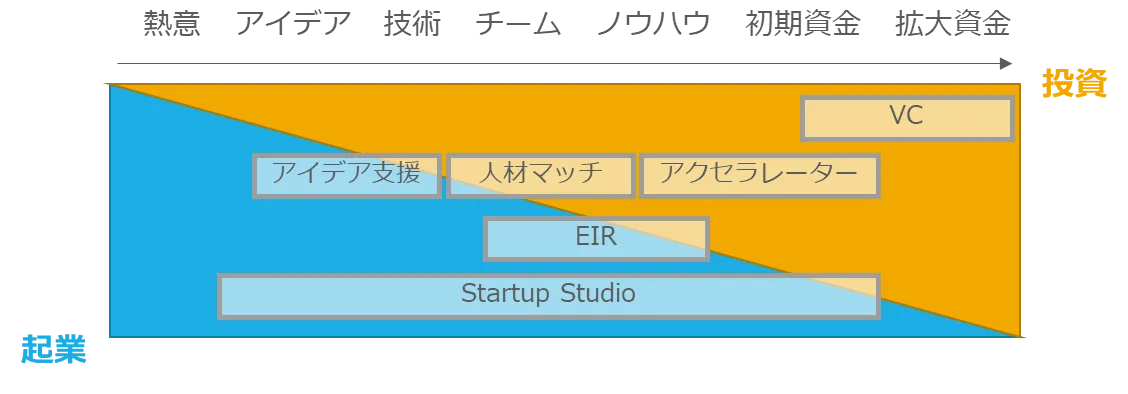
Do we need to expand support for earlier phases?
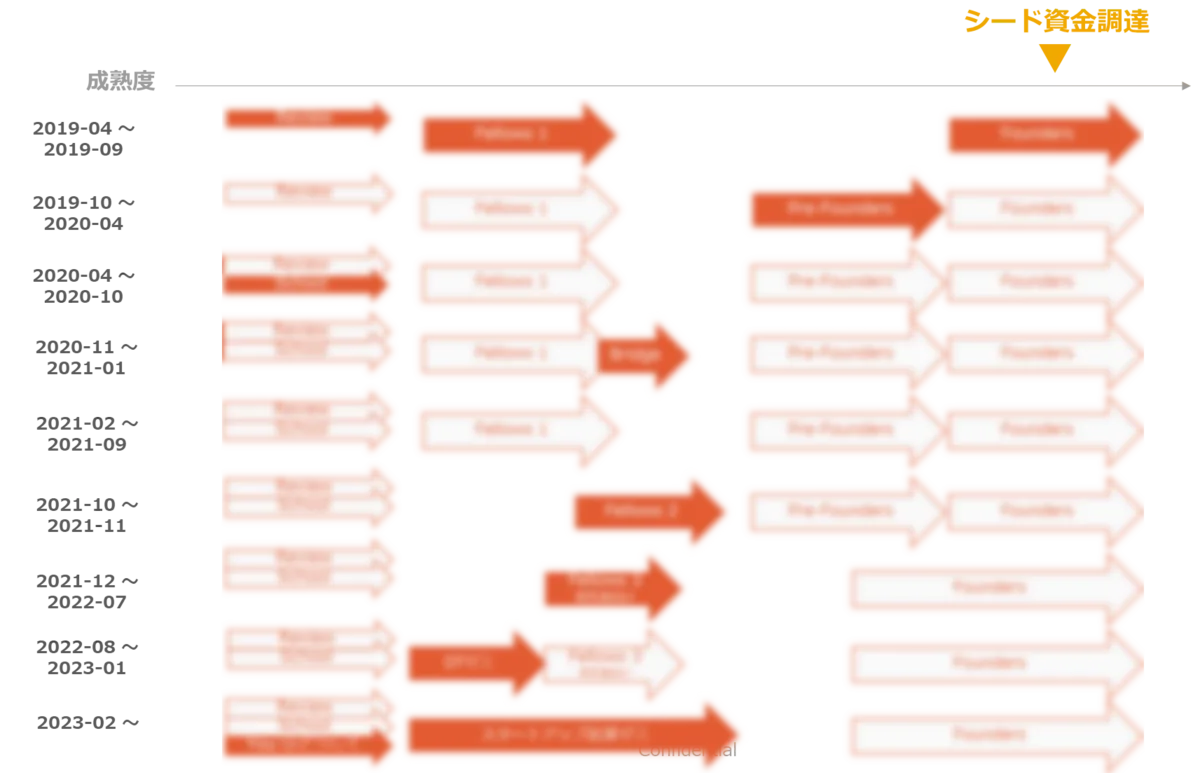
In fact, the support at FoundX, which I am in charge of, has been moving steadily toward earlier and earlier stages. (It is blurred, but we have changed the program content and targets again and again through trial and error. The items filled in red are the new initiatives at the time. You can probably see that we have been steadily strengthening support at the earlier stages.)
More specifically, I think various "pre-accelerator" support measures, such as "idea support," "talent matching," "EIR (Entrepreneur in Residence)," and "Startup Studio," are starting to stand out in the activity of investors, because those on the support side have begun using terms such as Company Creation.
In fact, in Climate Tech, for example, it is difficult for someone with no industry experience to come up with an idea. So I think initiatives are starting in various organizations that provide ideas serving as first hints, even on the premise that the company will eventually pivot, while giving direction toward becoming a decacorn.
And looking at the rise of search funds in Japan, I also think there may be more people than expected who want to start a company if there is a good idea.
There is such a trend worldwide as well. The Global Accelerator Network (now Morrow) recently created the Global Startup Studio Network, and more organizations seem to be exploring the Studio model. The share of the EU in particular seems to be increasing, which I think is due to the smaller number of founders compared with the United States.
The downside of such support from the early stage is that it costs considerably more in-house than an accelerator. And whether the support side even has the capability is still doubtful. But to achieve results an order of magnitude greater, I feel we need to overcome those disadvantages and difficulties and take on something new.
Conclusion
As fund sizes grow and the government's expectations of Japan's startup ecosystem rise, meeting those expectations now requires quite a stretch.
Few people start companies naturally, and compared with North America there are even fewer serial entrepreneurs, so we cannot say we have yet sufficiently achieved even producing unicorns. Under these circumstances, the challenge this time is that the ecosystem as a whole must take on a challenge an order of magnitude greater.
I believe the center of the startup ecosystem should always be the founders. But I thought it was time for the ecosystem as a whole to rethink how to build mechanisms to support their challenge, so I have put it together as an article.
Footnotes
-
See 初期の Y Combinator | by Taka Umada | Medium and Y Combinator はどのようにして始まったのか, among others. ↩
-
I think the background to this hypothesis also included Paul Graham's feelings toward hackers. Around the dot-com bubble of 2000, startups were led mainly by MBAs and people from the business side. Reading his essays and other writing, I think Paul Graham held the idea, as an antithesis to that, that even hackers can learn business and start companies. ↩
-
I have also heard that they take a considerable amount as fees from a single partnership, and I even suspect that they make their money from that instead. ↩
-
The data for the first half of 2023 shows 945.9 billion yen, an even further increase. However, since it cannot be compared with 2013, I am using the graph from the older data. ↩
-
Try searching for "VC 3x fund size" and the like. For example, this article. ↩
-
For example, an article from the long-established VC Globis Capital Partners: デカコーン創出へと続く、日本のスタートアップが変わった10年――テクノベート経営研究所設立記念 特別対談 #1 | GLOBIS 知見録 ↩
-
To avoid this, some VCs adopt a strategy of not making their fund size too large. For example, Benchmark Capital, which specializes in early stage, always keeps its fund size at around $500M. ↩
-
However, I hear that overseas investors' opinions on this agenda are not all that positive. For example, overseas investors sometimes say, "You should just win in Japan, which has a large enough market."
Certainly, if you try to maximize profit over a short period such as five years, concentrating on the domestic market may offer more certainty and allow growth (though for those investors, holding for five years may seem long enough).
But looking at 10 or 20 years, or at the country as a whole, the domestic market will almost certainly shrink, so aiming only at the domestic market seems to me a local optimum that maximizes those overseas investors' profits, and for a single company too, I think the question is whether it is easier to go global before listing or after listing. ↩