Entrepreneur in Residence (EIR) as a Career Opportunity, and Improving the Programs
This article was machine-translated from Japanese by AI (Claude). It may contain errors. Read the original Japanese article.
The "Entrepreneur in Residence (EIR)" model, which you occasionally see overseas, is gradually spreading in Japan as well.
Roughly speaking, an Entrepreneur in Residence is a program, or a person taking part in one, in which "you can prepare to start a company for anywhere from a few months to about two years while receiving a certain level of salary."
The abbreviation is EIR or EiR. Because the position is often filled by people with established careers, it is sometimes called Executive in Residence, which is also abbreviated EIR. In Japan it is sometimes called "visiting entrepreneur" (kyakuin kigyoka).
Efforts around EIR had been explored in Japan for some time, but recently I have started hearing the name again.
I think the background includes subsidy programs such as the Ministry of Economy, Trade and Industry's fiscal 2022 demonstration project on the use of visiting entrepreneurs (EIR) and NEDO's fiscal 2023 MPM project (a project to support securing management talent for university-originated startups). Several VCs and operating companies that received subsidies have begun hiring EIRs (I also hear of some that have started without subsidies).
Japan currently has a broad policy of increasing the number of entrepreneurs, so if government subsidies continue and track records for EIR begin to emerge, EIR initiatives may spread further.
Conversely, I think that the EIR career may become a strong option for aspiring entrepreneurs. It is still at the budding stage, but while government subsidies are available, the VC's risk is lower, so the terms should be relatively favorable for EIRs1. I think experienced people would do well to actively consider an EIR opportunity if one comes along.
That said, if we do not think carefully about how EIR is positioned, the match could turn out unfortunate for both sides, and I suspect that if the early EIR efforts produce no success stories, the EIR system itself will be short-lived. So I will write down a brief overview and my own thoughts.
Where the EIR career sits
When you think "I want to become a business leader," there are various options.
One is management consulting, which is popular with students and others. But a consultant is ultimately an adviser and does not make management decisions himself or herself.
For people who thought "I want to be more involved in management and business," the next careers were things like corporate planning at an operating company, private equity, and starting a company.
From the late 2010s, a new option emerged in Japan as well: the search fund. In this model, a would-be executive called a searcher looks for a small or midsize company to take over as president while raising money from investors; once a good company is found, it is acquired, value is added over 4 to 7 years, and then the searcher exits.
In addition to this, the option of becoming a business leader via EIR is also emerging.
Thinking in terms of risk and return, I believe the careers roughly relate in terms of risk and return as follows.
Risk | Return | Option |
High | High | Starting a company |
Medium | Medium | Search fund, EIR |
Low | Low | Intrapreneurship |
I position EIR as an option with somewhat lower risk than starting a company and somewhat higher risk than an internal new venture.
Even though both are medium risk and medium return, a business leader via a search fund, who mainly takes over an existing business to expand or turn it around, and an EIR, whose purpose is strictly to launch a new business, differ greatly in that one improves a business while the other launches one, and I think the risk is greater for the EIR. Please take this as only a rough classification.
EIR patterns
Even within EIR, there are several patterns.
- VC EIR - Prepares for the next startup while being involved in adding value to portfolio companies (in a sense, an investment in a "person" before there is an idea)
- Corporate EIR – Prepares an internal venture on the premise, to some degree, of a spin-out
- Startup Studio EIR – Prepares to launch a company based on an idea inside the studio
- University EIR - Works on commercializing university technology or on spin-outs (in some cases also involved in business school education)
Even within the single label of EIR, the way of working differs quite a bit depending on which organization the EIR belongs to, and my impression is that the terms differ as well. I think it is worth giving fair thought to which EIR suits you.
Examples of each pattern are also summarized in places such as Beyond Next Ventures' event report.
Who is hired as an EIR
In many cases, EIRs are serial entrepreneurs or people who have served as executives or team leaders at startups or large companies. This is because at the very least, ability as a business leader or manager is required.
However, such people can often find other opportunities with good terms. Also, once you start a company, you go through a period without income, and the savings in your bank account shrink rapidly. One reason EIR is offered is thought to be that guaranteeing a certain level of salary eases that risk and makes the career of starting a company easier to choose.
Because of this background, openings for the EIR role are usually not made public. This is because people are normally hired from existing connections.
That said, there are few such people in Japan, so it seems that people with a decent track record who look like they could become entrepreneurs are also sometimes brought in (on relatively lower terms), and there are also public calls for applicants, so in that sense it can also be seen as easier in Japan for entrepreneur candidates to get a chance.
EIR commitment
How long and how much an EIR is involved in the business varies considerably by program.
In a 2015 survey of overseas EIRs, the duration, the amount of commitment, and the salary all differ a great deal.
Also, when you ask about the details, many EIR programs have nothing that looks much like a "program," and that freedom can be called a feature of EIR.
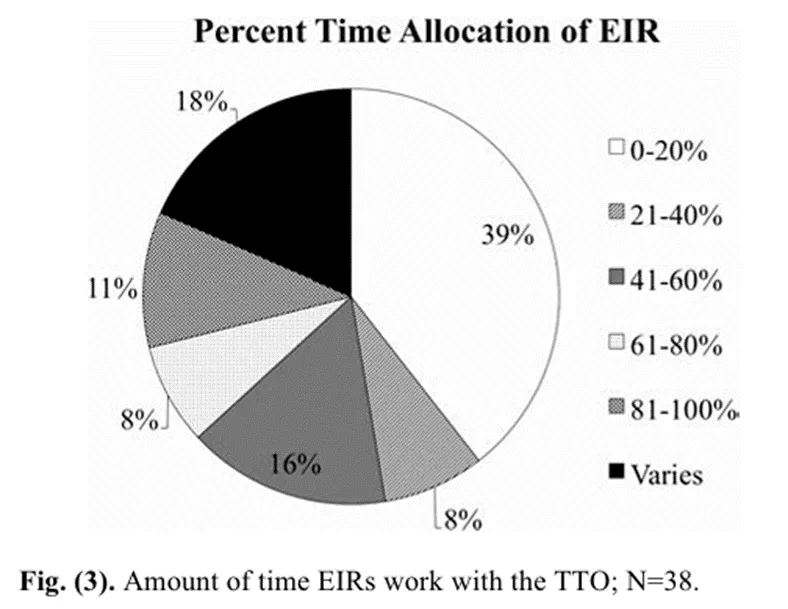
Jessica M. Silvaggi & Orin Herskowitz & Carlton J. Reeves, 2015. "Entrepreneur-in-Residence Programs: One Size Does Not Fit All," Technology Transfer and Entrepreneurship, Bentham Science Publishers, vol. 2(1), pages 37-50, April.
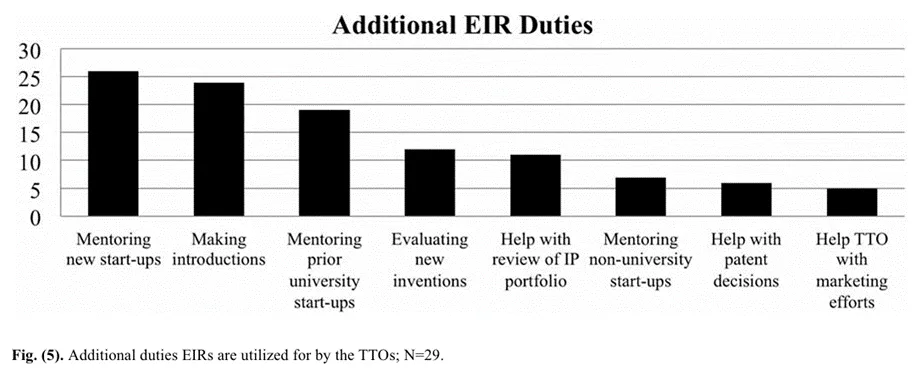
Jessica M. Silvaggi & Orin Herskowitz & Carlton J. Reeves, 2015. "Entrepreneur-in-Residence Programs: One Size Does Not Fit All," Technology Transfer and Entrepreneurship, Bentham Science Publishers, vol. 2(1), pages 37-50, April.
Toward improving EIR programs
EIR is not a new experiment. By one account, it was tried in the early 1980s, and a survey was published as early as 1997, so it is an old approach2.
Yet that it has not spread very far may also mean that EIR has not led to big successes. If it had succeeded, many organizations would have rushed to copy it.
In fact, there are many places that once ran EIR but stopped after a few years or scaled it back3.
On the other hand, it has not failed spectacularly, which is presumably why it is still being tried today.
This probably means there is room for improvement, and also that it will not produce a big success if done in the ordinary way. Especially in Japan, where the number of entrepreneurs is relatively small, I think raising the number of participants in EIR programs and their success rate would be good for the ecosystem as a whole, and that working on improving how the programs are implemented is necessary.
From what I have heard about EIR, there seem to be the following issues.
- EIRs tend to be left to their own devices
- There is little process, and because it is tailor-made, predictability is low and management tends to be costly
- When a VC runs an EIR, investing tends to take priority
- As a result, EIRs tend to be left to their own devices
- If the idea is left entirely to the EIR, it tends to end up small
- Know-how is hard to accumulate
- Each organization has few EIRs, making it hard to find patterns (most have 1 to 3)
- There is little interaction among EIRs
- As noted above, the numbers are small
- EIRs in different contexts have a hard time holding a conversation
- (In countries other than the US) there are no EIR candidates to begin with
- The EIR career is not well known to begin with (is something like a search fund better known?)
- In the US, even where there were many EIR candidates, did it not work out very well?
Many of these are not so much issues with the EIR concept itself as issues with how EIR programs are implemented. I think there is more room for improvement on the implementation side.
For example, if the approach is too hands-off, the only lesson is something like "the EIR succeeded / failed." I think it would lead to the next step if we assigned someone who can observe, to some extent, how the EIR works, and iterated through trial and error in a somewhat structured way.
Personally, I think the following kinds of efforts could bring some improvement.
- Have the host side prepare a bit more in the way of resources (a list of ideas and technology seeds)
- Some organizations already do this
- If possible, build a program instead of leaving EIRs on their own
- Have EIR programs that receive subsidies coordinate with each other (for example, EIRs meeting about once a week)
From what I hear, it seems better for the program side to gently guide the direction of ideas rather than leaving the whole idea to the EIR. In that case, though, the model would be closer to a Startup Studio/Venture Creation than to an EIR... I also think.
I wonder whether it would be better to gather EIRs in one place, but being close to each VC is also a benefit of EIR, so it might be good to start with EIRs getting together about once a week to talk about their challenges...
A "Guide to EIR (working title)" should come out as a deliverable of METI's EIR demonstration project, and it will probably contain various proposals, but I personally hope that some kind of successful EIR model can be built.
Based on the fiscal 2022 EIR demonstration project, "Guidance on the Use of EIR" has been published, and I hope that by continuing to iterate on the basis of guides like this, we can build a model of success.
Summary
For VCs too, as fund sizes grow, the market capitalization at listing that they must aim for is also growing. I suspect VCs will begin considering strategies such as investing overseas or creating larger startups in-house, so I think the trend of EIR, which increases the number of experienced entrepreneurs, is likely to grow.
For the ecosystem as a whole, it will also be necessary to spread the word widely that EIR is an option, and for the industry to encourage excellent candidates for business leadership to look to the EIR career rather than another executive career.
And I hope that aspiring entrepreneurs will make good use of this wave if it comes.
Footnotes
-
Normally, because the company pays a salary, it is understandable that a fair amount of equity would be taken, but with subsidies currently going to VCs, that should be eased to some extent or open to negotiation. ↩
-
I do not subscribe to this journal and have not been able to read it, so I am only mentioning its existence. ↩
-
Among well-known examples, Benchmark Capital did quite a lot of it, but I have not heard much about it recently. Other famous VCs also did various things around 2010, but I have heard almost nothing about them recently. ↩