Tips for Applying to and Preparing for J-Startup Impact, from a Recommendation Committee Member (2023 Edition)
This article was machine-translated from Japanese by AI (Claude). It may contain errors. Read the original Japanese article.
(Note: I wrote this article during and immediately after the recommendation review. I am publishing it now because the J-Startup Impact selected companies were announced on October 6, 2023.)
- 1 Overview
- 2 Key points when applying
- 2.1 Grow your business enough to be selected for J-Startup
- 2.2 Learn the basics of impact investing
- 2.3 Think about the beneficiaries beyond your customers
- 2.4 Show why your evaluation axis matters
- 2.5 Express your impact in numbers as much as possible
- 2.6 Specify the unit
- 2.7 Show the time horizon
- 2.8 Measurement and management
- 2.9 Avoid and mitigate negative impact
- 3 Recommendations for next year
- 4 Summary
I have read through about 500 applications and finished my evaluation.
First of all, I felt great hope in the fact that nearly 500 startups, including both self-nominations and nominations by others, are "oriented toward social impact."
I also know that there were several startups oriented toward social impact that firmly declined to apply, saying "It is still too early for our company to put our hand up for this." In other words, there are even more startups in Japan that are oriented toward social impact. I think this is wonderful.
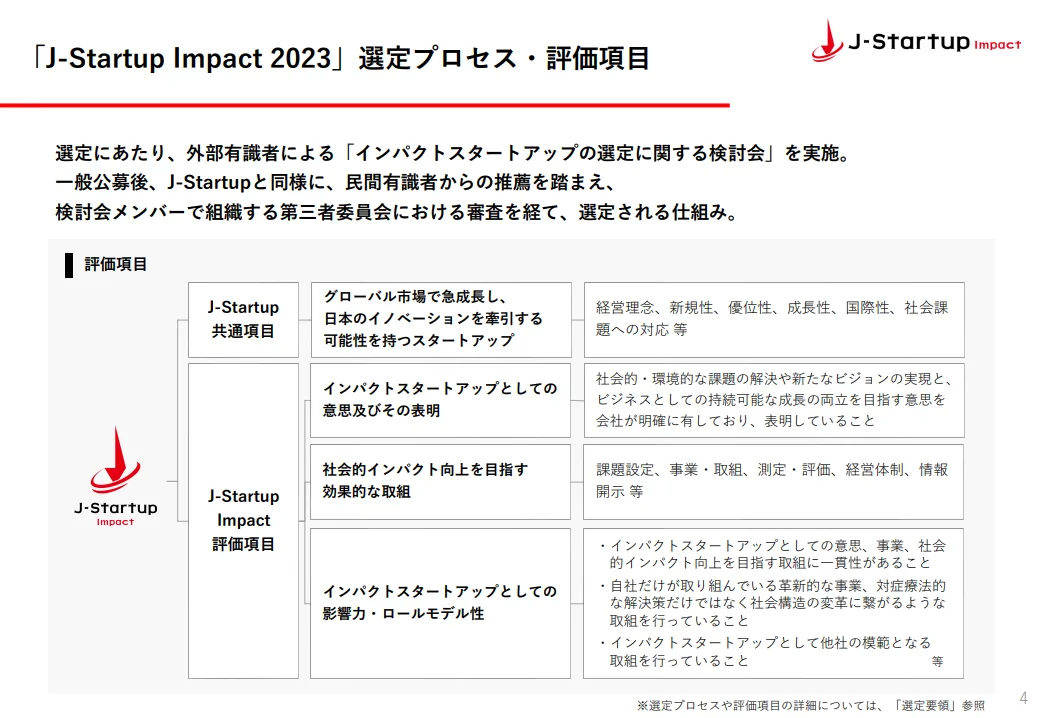
The evaluation criteria and the evaluation process. I was involved in the "recommendation by private-sector experts."
On the other hand, looking at the application documents, the content and the level of detail varied from company to company, and I could sense the confusion of the startups that applied. Frankly, as one of the recommendation committee members, I also evaluated with a fair amount of confusion.
I feel the background to this is, after all, the difficulty of social impact itself, its evaluation axes, and its measurement methods.
Still, saying "the evaluation axes are not settled, so there is no point in doing a selection like this" gets us nowhere. I think what matters is to try it, make use of what we learn, and gradually improve this whole effort from here on.
In that sense, too, I think the coming years are the real start of J-Startup Impact.
So, to make the recommendation process better for both those being recommended and those recommending from next year onward, I would like to summarize the points I noticed and a few things I would recommend from now for next year's applications.
I wrote that the next round onward is the real thing, but for next year, I think the question is whether you can get ready in time, starting now. This is because what decides the outcome is how much preparation and execution you have done by the next application a year from now.
It is not something you can get through by cramming overnight and just writing well, so I recommend starting your preparation now. I am leaving these notes for next year in the hope that they will be of some use.
However, this is only the opinion of one recommendation committee member. I do not know whether I will be chosen as a committee member next year, and even if I am, I do not know whether I will accept (just reading through the applications took more than a day).
So even if you read this and come to pitch me for selection during next year's process, it will probably not be effective, and it would leave a bad impression, so I think it would be best to avoid that...
Also, Mr. Nakamura of GLIN Impact Capital, who specializes in impact investing, has summarized the key points for applying in advance. I strongly recommend reading that as well.
1 Overview
First, I want to emphasize that not being selected for J-Startup Impact does not mean your business has no social impact. Almost every business has a positive social impact. Apart from malicious businesses such as fraud and pyramid schemes, they all solve some problem for their customers, and that should have a positive effect on society.
So what is being asked of companies selected for J-Startup Impact is, I think, the following:
- Quality and evaluation axis: Is the social impact you are aiming for more important than other impacts?
- Quantity and degree: Is the total amount of that social impact large?
- Time and probability: What trajectory will that social impact follow from the present into the future?
What is difficult is the comparative evaluation of the quality and axis of social impact (which social impact is more important?) and the evaluation along the time axis of how large it is likely to become. Let's start by thinking about these two points.
1.1 An example of comparing social impact
Let's consider how difficult it is to compare two things across different axes of social impact and the time axis.
From your perspective, which of the following businesses has the greater social impact?
- A business that "rescues children from poverty"
- A business that "rescues the elderly from poverty"
Because the target is different, the "quality and axis" of the social impact differs. So answering should be fairly difficult.
Next, think about which of the following is greater.
- A business that "rescues 10,000 children from poverty"
- A business that "rescues 20,000 elderly people from poverty"
When "quantity and degree" is added to "quality and axis," comparison becomes even harder.
Next, let's change the axis of social impact.
- A business that "improves the education of 10,000 children"
- A business that "rescues 20,000 elderly people from disasters"
Before, the axes, "child poverty" and "elderly poverty," were in a sense the same axis, poverty. This time, you have to consider "which matters more, education or disasters?", and it has become harder.
Now add the time axis, and it looks like this.
- A business that "(might) improve the education of 10,000 children every year 10 years from now"
- A business that "(might) rescue 20,000 elderly people from disasters 7 years from now"
For a business that is already widespread to some extent, it is enough to evaluate its social impact "now." But for startups, many have not yet launched their business, so you also have to evaluate the possibility that it might become large ten years from now.
What is even more important is the "might." Once the time variable enters, you also have to estimate the probability that the social impact will be realized.
That said, if you rate things whose probability is low at present too low, you can only recommend businesses whose effects are "already proven," and companies taking on new challenges will be rated low (in energy, for example, the mass installation of solar panels would be rated rather than nuclear fusion. That is fine in its own way).
If that happens, no innovation will occur as a result, and it would run counter to the purpose of J-Startup Impact, which is to nurture startups.
Therefore, information that raises the probability also needs to be taken into account. For example, if we add the team's experience, it becomes as follows.
- A business that "(might) improve the education of 10,000 children every year 10 years from now, by a team that has not been involved in education so far"
- A business that "(might) rescue 20,000 elderly people from disasters 5 years from now, by a team that has so far engaged in disaster-preparedness activities as an NPO"
Weighing all the information up to this point comprehensively to rank the options is what it means to rank and recommend startups in consideration of their social impact.
If I could understand a business's social impact more deeply through dialogue, I might be able to evaluate with somewhat higher precision, but that is not possible for every company, so I have to make these judgments strictly from the materials submitted.
So I think it would be easier to understand if you wrote out your assumptions: what the axis of your business's social impact is, what impact it could ultimately have, how long it will take to get there, and how high the probability is.
2 Key points when applying
From here, I would like to think about practical tips for actually being selected for J-Startup Impact.
First and foremost, what matters is to read the application guidelines carefully. When I review or recommend, I check the purpose of the subsidy or program and the application guidelines quite thoroughly, and then select companies that fit that purpose (at least I do). Also, most of what you should write is already stated in the guidelines (the 2023 edition is here). Please read them first and write content that fits that format.
Also, this time, detailed selection guidelines were published at the same time as the announcement, so please be sure to refer to those as well.
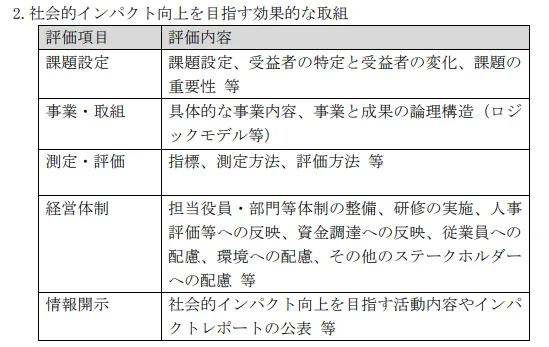
https://www.meti.go.jp/policy/newbusiness/J-Startup-Impact_Guideline.pdf
A certain proportion of startups had not done this and stopped at copying and pasting from their own website. It may be effective in lowering the cost of applying, but inevitably it looks inferior compared with other applications.
With those basics covered, I think the differences between the startups I rated highly this time and those I could not rate so highly lie in the following.
2.1 Grow your business enough to be selected for J-Startup
Companies selected for J-Startup Impact become members of "J-Startup."
For companies already selected for J-Startup, the main work is to make their impact evaluation explicit, but for other companies, you first have to aim to be selected for J-Startup. In other words, your business needs to have grown that much.
When the business is still small, it seems hard to be selected for J-Startup. In terms of funding scale, I think it would be good to aim for around Series A.
Also, if you state what the market size is and how much revenue your company aims for, it saves the reviewers the trouble of estimating it. Personally, I would appreciate it if you gave figures looking about 10 years ahead.
2.2 Learn the basics of impact investing
I recommend learning terms such as Intentionality, Additionality, and Measurability, as well as the basic ideas of impact investing and impact evaluation.
These are a kind of cognitive framework, and for readers they also work as a framing that helps understanding (provided the reviewers reading them have that kind of background...).
Showing Additionality is probably difficult, but I find that anything that makes me think "without this business, this social impact would not occur" tends to get a high rating.
2.3 Think about the beneficiaries beyond your customers
It goes without saying that customers are beneficiaries, and I think whether you could show what social impact you bring beyond them was a major fork in the road.
When doing so, I recommend identifying beneficiaries by considering both so-called direct beneficiaries and indirect beneficiaries.
There were quite a few applications that simply wrote the customer's problem in the "Problem" field and stopped. That is also a social problem, but my impression is that the evaluation changed greatly depending on whether the applicant had thought about what social problems lie beyond it and how much social impact it would bring.
For example, with SaaS, the immediate outcome is usually greater efficiency in the customer's operations, but please think about what social impact that results in. For construction SaaS, that means considering a line of reasoning such as: construction time is cut by 10% and costs fall, so the number of people who own homes rises by X%, and as a result Well-being improves by X%.
You cannot avoid thinking about this when you draw a logic model, so I think applicants who had drawn a logic model tended to be rated highly and those who had not tended to be rated low.
2.4 Show why your evaluation axis matters
If you can explain that your social impact is more important than other social impacts, I would very much like you to do so. This will be qualitative information.
Because it is qualitative information, compatibility with the reviewers and recommenders also comes into play. Whether that evaluation axis is valued also depends on timing. There is the timing of whether it has become a social issue, and there is also timing at the individual level, such as how the problems of child-rearing and babysitting are first felt as problems when you have a child.
Conversely, this means that it is important to get people to regard this social issue as a problem in their everyday lives, to the point that it is not affected by timing, and to communicate the significance of tackling this social issue day after day and build allies on a regular basis.
2.5 Express your impact in numbers as much as possible
It would be good if you could show your impact in numbers as much as possible.
The environment, especially climate change countermeasures, is easy to understand. In this case, the figure for how much GHG is reduced makes comparison possible even across different businesses.
Medicine and drugs seem easy to understand at first glance, but it is hard to compare them unless you know how many people at home and abroad have that disease or health condition, how much suffering they currently bear, and how many people's suffering is reduced or lifespans extended each year as a result of the business.
If there are existing indicators such as IRIS+ or the 169 SDG targets (the breakdown of the 17 goals), I think it is fine to state and use them, and as Impact Frontiers suggests, expressing impact through three points, "scale, depth, and duration," is also an option.
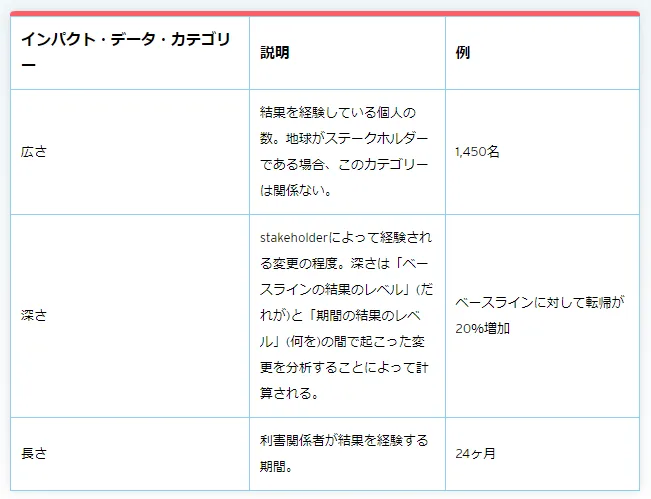
https://impactfrontiers.org/norms/five-dimensions-of-impact/how-much/
2.6 Specify the unit
Related to numbers, it is easier to understand if it is clear what unit you measure in. For example, for environmental issues, there are units such as how much GHG or CO2e has been reduced.
On the other hand, with abstract wording like "creating new value," unless it is clear what kind of value that is and how it is measured, evaluation and comparison become difficult. In fact, I saw many cases that described abstract social impact.
Also, even if an applicant says "QOL improved by X points" or "Well-being improved by X points," it is hard to evaluate unless the meaning of the unit for QOL or Well-being is understood. In such cases, I think it is important to be resourceful, for example by using existing indicators such as QALY or WALY.
2.7 Show the time horizon
I am well aware that, being startups, you are still partway along the road.
That is why I think it would be good if you wrote what social impact you intend to realize, and in how many years.
In doing so, it is fine to have several scenarios, but it is also fine to simply show "the maximum impact would be this." The probability will probably be judged on the recommendation committee's side...
2.8 Measurement and management
If you write how you measure continuously, the evaluation becomes higher. For example, publishing and tracking impact reports showed a high awareness of measurement and management, and looked very favorable.
Also, if you carry out organizational management, such as "we manage social impact indicators internally on a regular basis, not just sales," I think describing that would lead to a high rating as well.
2.9 Avoid and mitigate negative impact
Almost every business can also have a downside. For example, manufacturing can put a burden on the environment, and even an education service that causes no harm at all may contribute to the reproduction of inequality if it provides education at high fees.
Rather than simply touting positive impact, a description showing that you properly address and mitigate such negative impact leaves a good impression. Examples include making products with renewable energy, or, in education, providing scholarships.
I would like you to introduce such efforts by individual companies.
3 Recommendations for next year
From here, I will introduce recommendations for those preparing for next year.
3.1 Research what J-Startup Impact companies are doing
Companies selected for J-Startup Impact should be practicing excellent impact management. So first, please research what the selected companies are doing.
For example, if a selected company is engaged in efforts such as an impact report, you may want to begin preparing for something similar for next year while using it as a reference.
I think it is fine to start by imitating good companies and gradually find your own way, and looking at what other companies are doing will probably also make the other recommendations below easier to understand.
3.2 Learn and practice impact management
There is a considerable body of knowledge on impact management. I think it is good to refer to that body of knowledge first and begin learning.
Much of it is available in Japanese too, so please start from there. I recommend searching for terms such as "impact management." Looking at the case examples mentioned above is also one way.
However, if you demand too much perfection from the start, you will not be able to begin anything, so I recommend starting with what you can do.
Also, I think impact management will be more useful for your business if you make sure that business progress and the realization of social impact are aligned.
3.3 Draw a logic model
For those among the companies that were not selected this time who have never drawn a logic model, I recommend that you "try drawing a logic model or a Theory of Change." Doing so will let you satisfy, to some extent automatically, many of the points on which you are evaluated. I dislike that this sounds like an advertisement, but I also introduce it in "Implementing the Future," so please take a look.
That said, quite a few people write their logic models a bit oddly at first, so it would be good to show what you made to someone and have it graded.
Also, there were quite a few applicants who said "we have a logic model." But it was a pity that in many cases it was not posted on their website either. If possible, I would appreciate it if you published it on your own site, as it makes things easier for us, so please...
There were also some who said "the VC that invests in us has one." I think that is a wonderful effort as an investor. On the other hand, a logic model from the investor's perspective and one from the company's own perspective will differ, and since it is the company itself that is evaluated in impact startups, I think it is best to post it on your own site even if it was created together with your investors.
3.4 Make your business plan bigger
Even if a business produces social impact, if it does not grow rapidly it cannot be called a high-growth startup.
I have heard from the secretariat that J-Startup Impact is not necessarily limited to high-growth-type startups, but even so, if the business is too small, the social impact it can generate becomes small as a result, so that is not right either.
So, at least when applying to something bearing the name "startup," it is reasonable to expect that Intentionality regarding growth will be looked at. Growth here would mean growth accompanied by revenue for a for-profit company, and for those with a strongly nonprofit character, it would be Intentionality regarding business growth itself, regardless of profitability.
If you are carrying out various activities related to outward-facing social impact, such as a logic model, impact reports, or B Corp certification, and yet were not selected, please draw a business plan for a business that can become big and reflect it in your application.
3.5 Promote yourselves again and again
Please promote what you are doing and its social significance again and again. Through repeated promotion, it may come to be recognized as a social issue, and I think many people finally become aware of something only after it has come across their social media feeds a few times.
For example, Mercari puts out various activities at different times, such as correcting the gender pay gap, Planet Positive, its impact report, and Mercari donations, so its actions toward society seem easy to notice and easy to take in.
A single promotion by your company will almost never get the information across to everyone, so if you are doing good things, it would be good to communicate them each time.
4 Summary
I felt that applications from companies that properly do the things that are commonly said to be "worth doing," such as logic models and impact reports, were written in a way that made me think they had reached their conclusions after thinking deeply.
In that sense, too, I felt that it would lead to better results in the end to first fit yourselves into the "forms" described in contexts such as impact investing, following the order of shu-ha-ri, and then find your own way afterward.
If you are thinking of applying next year, please take this opportunity to become familiar with the ideas of impact evaluation and impact investing, organize your company's social impact, and consider applying next year.
That is all. Since I spent a whole day on the evaluation, I thought that sharing the trends and implications I felt there would have some meaning and would let me leverage the time I spent, so I took additional time to write this.
This is just the opinion of one recommendation committee member, but I hope that what I felt during the review and my recommendations will be of some help to you.
(Also, I will note as my personal opinion that selecting a company that was founded about 20 years ago as a "startup" is surely not right...)