Promote Recurrent Education to Increase Entrepreneurship
This article was machine-translated from Japanese by AI (Claude). It may contain errors. Read the original Japanese article.
- School as a place to build personal learning and, at the same time, human connections
- School as a community where people spend long hours together
- Full-time recurrent education, not training or lifelong learning
- Recurrent education to start driving the two wheels of developing advanced talent and advanced industries
When you look into Climate Tech startups, a certain pattern emerges. Two typical examples are the following:
- A high proportion have a co-founder who has earned an MBA
- A high proportion have a co-founder who holds a Ph.D.
Unlike IT entrepreneurs, those taking on Climate Tech and Deep Tech seem to work for a while after graduating from university, then go back to university to earn a degree and relearn. The same tendency appears among Climate Tech startups outside the United States.
One reason behind this may be that a labor market that values expertise has taken shape. Because earning a degree leads to career advancement, the incentive to go back to university and study grows. As a result, people with deep expertise in business and science are produced, and I suspect this works as a mechanism that turns out the CTO and CEO talent able to take on difficult fields like Climate Tech, and also develops the employees who work at such startups.
School as a place to build personal learning and, at the same time, human connections
However, going back to school seems to do more than just cultivate an individual's knowledge and abilities. Looking at the connections between co-founders, you can see that a fairly high proportion of them attended the same university.
In other words, I think that new human connections are also formed at the time of relearning at school, and these have a positive effect on starting a company.
To produce entrepreneurs, some kind of community is needed. This is because human connections are effective when looking for co-founders or thinking up ideas.
To gain new connections, you have to go out to communities different from your usual ones. But such activity demands considerable extroversion, and I suspect that not many people are good at it.
For example, even if you created a networking community such as a "community for finding co-founders," most people would not come. And even if they did, it would likely be a group with an imbalance in the supply and demand of talent.
What I have felt through my involvement in community-related activities is that most people do not really have a strong desire to join a community in itself.
That is only natural. Seen from the outside, a community is something where you cannot tell who is there or what you will get. Many people also know from experience that the chance of meeting good people is low. And with a community, it is unclear what return you will get on the time and money you invest.
That is exactly why actively joining a community tends to be a high-risk gamble, and it is understandable that many people avoid it.
What is needed then is a community with "a mechanism that lets you take part somewhat passively, yet also take part actively." A community with "a mechanism where, just by being there, you easily get pulled in by someone who is active" may be good as well.
School seems to be exactly that kind of place.
The main purpose of the people who take part in school is, after all, knowledge and abilities, and the degrees and certificates that result from them. Opportunities to learn are given passively through classes and the like, and there are people you meet regularly. By working together on homework or in class, you may make friends.
By being there, you can build connections with new people, and because people come and go every year, a fixed community like a group of regulars tends not to form.
Also, you cannot graduate without doing something active, namely research. School is a place where, through such learning activities, human connections are formed in a semi-compulsory way. I think that by making good use of school as a community, new human connections that become the seeds of entrepreneurship can be born.
And going through school also has the original benefit of producing advanced talent.
School as a community where people spend long hours together
Still, there may be an argument that if the goal is to "make new connections" or "learn," it need not be school. For example, a study group where you share a place and time for about an hour is sometimes called a community, and it is a place of learning too. It is quite conceivable to argue that creating that kind of community would be enough.
Certainly, if the aim is merely to make acquaintances, a short event may do. But to turn people into co-founders or people with whom you exchange ideas, you need to build a fairly deep relationship.
For example, according to Hall's research, it takes an average of 75 hours to call someone a "casual friend" and about 112 hours to call them a "friend."
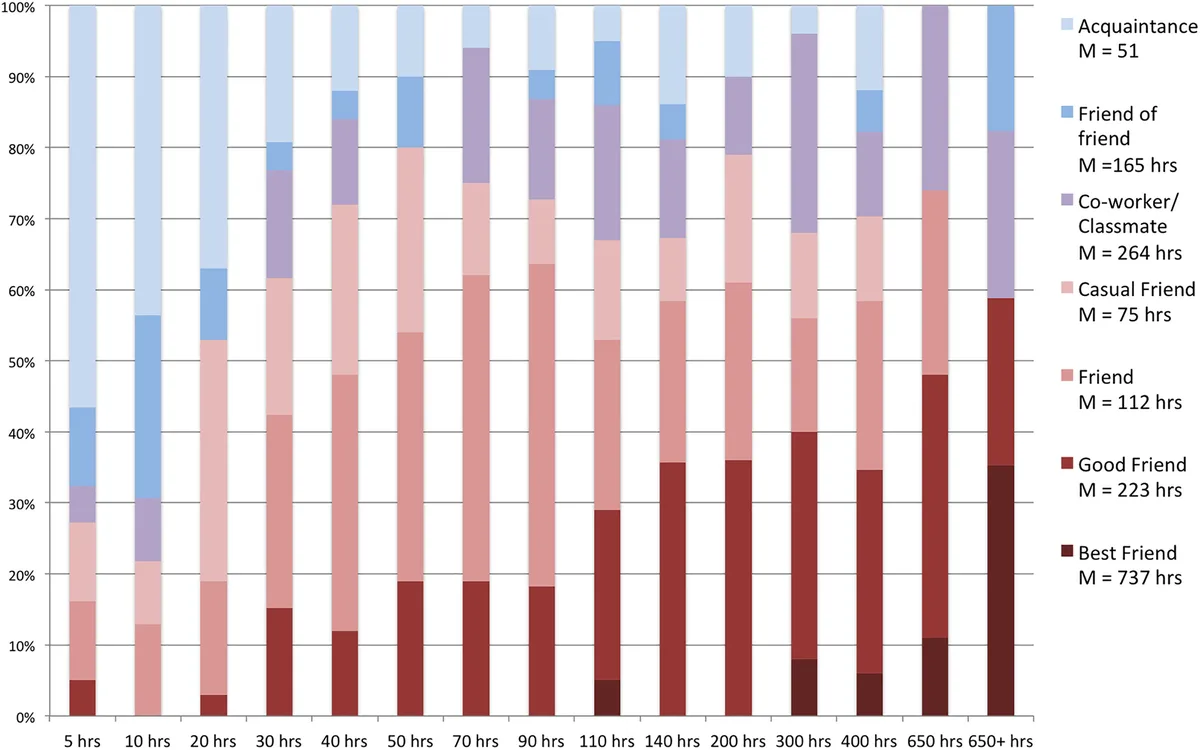
https://journals.sagepub.com/doi/full/10.1177/0265407518761225
A community where people spend this much time together is hard to build just by piling up small networking events or study groups. Moreover, participants do not work together at such events.
In fact, training that people take while employed somewhere is almost never conducted over a long period, and I hardly hear of cases where people who met in training went on to start a company.
It is precisely because people take part in a school's series of curricula and spend long hours there that this kind of network forms, isn't it?
Full-time recurrent education, not training or lifelong learning
Furthermore, immersing and concentrating in a place of learning like school over the long term seems to have the effect of changing one's perspective significantly.
Although the argument in this paper does not apply directly, it points out that "if you want to change something significantly, you must address it at the stage of training, not through in-service training."
In fact, learning new things often requires correcting misconceptions or unlearning existing ideas. When working at the same time, you end up trying to learn new things on the basis of your current environment, and it is easy to imagine that a person's perspective and schemas are hard to change.
That is why I think that, rather than temporary training, stepping away from work a little to receive recurrent education can be expected to be highly effective in changing perspectives and ways of thinking.
However, the discussion of recurrent education in Japan is somewhat muddled. To begin with, recurrent education is
"The idea of recurrent education is a cyclical concept that looks at an individual's whole life and alternates between periods focused on work and periods focused on receiving education"
The Significance and Issues of "Recurrent Education" as Policy
and it is pointed out that it is not temporary training.
Yet the discussion of recurrent education in Japan
"tends to be treated in Japan as including not only full-time re-education conducted away from work but also part-time education conducted while working, and the difference from lifelong learning (the lifelong model) is not clear"
Same as above
and it is pointed out that it has come to include a wide range of learning.
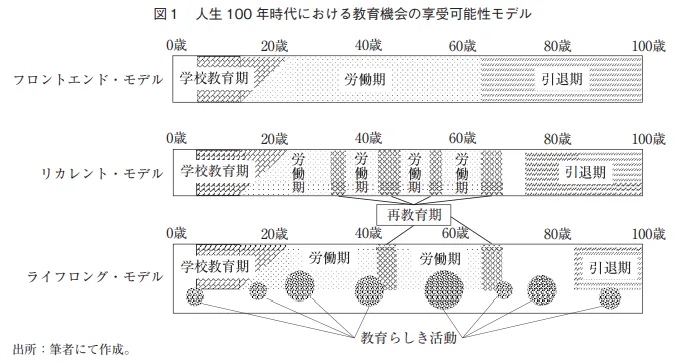
https://www.jil.go.jp/institute/zassi/backnumber/2020/08/pdf/026-040.pdf
From the standpoint of properly learning new perspectives and of building new human connections, I think it is important to create an environment where people can temporarily step away from work and immerse themselves in learning for a long period, that is, an environment for recurrent education in its original sense.1
Recurrent education to start driving the two wheels of developing advanced talent and advanced industries
To create a situation in which people can leave their companies, discussion about how to handle social security will also become necessary. As in Sweden, the birthplace of recurrent education, something like an educational leave act (a law establishing the right to receive education and training) may also become necessary.
Universities, which will probably play the leading role as places of learning, must also prepare to accept new kinds of students (it is hard work, but it would also be a new business opportunity for Japanese universities). As I said at the beginning, unless the labor market comes to value expertise, no incentive to relearn arises.
This applies only to fields close to industry, but in order to create the incentive that "if you earn a doctorate you can get a high salary," it is also necessary to develop high-value-added industries that can make use of such doctorate holders. Support that gives rise to startups that put such advanced knowledge to use, for example promoting Deep Tech startups, will also become important.
Given that increasing startups is currently a policy goal, combining startup promotion with the promotion of recurrent education seems like a good fit, and I think it could contribute to bringing about labor mobility toward growth industries and to raising the mobility of talent.
And by also providing entrepreneurship education within such recurrent education, or by preparing business schools for entrepreneurs, couldn't we build, in each region, a mechanism through which startups are born?
Footnotes
-
However, Sweden, which promotes recurrent education, also faces various problems such as high youth unemployment, so I think it needs to be promoted with such side effects in mind. ↩