What Kind of Game Are We Playing?
This article was machine-translated from Japanese by AI (Claude). It may contain errors. Read the original Japanese article.
I have been reminded once again how important it is, when starting a startup, to understand what kind of game we are playing.
More specifically, I am talking about fighting the battle with an understanding of:
- What kind of battle or contest we are in
- What conditions we need to meet in order to win
- Within what time frame we need to meet those winning conditions
This could also be described as thinking about "what are the rules of the game we are playing?"
For example, a startup and an ordinary business venture can be said to be fighting different kinds of battles, because the scale of the revenue they aim for, among other things, is different.
Moreover, even among startups, the type of game differs. For example, in a business where network effects apply, it is a game in which you win by maximizing your own users first and crossing the threshold first. In that case, you need to look at your own product and competitors' moves, determine by when you should cross that threshold, think about when to hit the accelerator, and deploy your resources accordingly. Sometimes, like Mercari and Uber, you may even run at a loss in order to reach that threshold (because if you can then secure a monopoly, you can recover that loss).
Understanding the rules of the game like this is extremely important, so I have also added a corresponding page to the pitch slide template that I released the other day.
The Case of Climate Tech
Regarding these types of games, in the field of climate tech, a European VC has compiled a resource called Climate Brick.
This resource makes the following classification:
- Battles of scale (cost reduction through scaling up)
- Battles of deployment capability
- Battles of service
- Battles of product strength
- Battles of disruptive technology
- Battles of game-changing science and technology
- Battles of software-enabled hardware
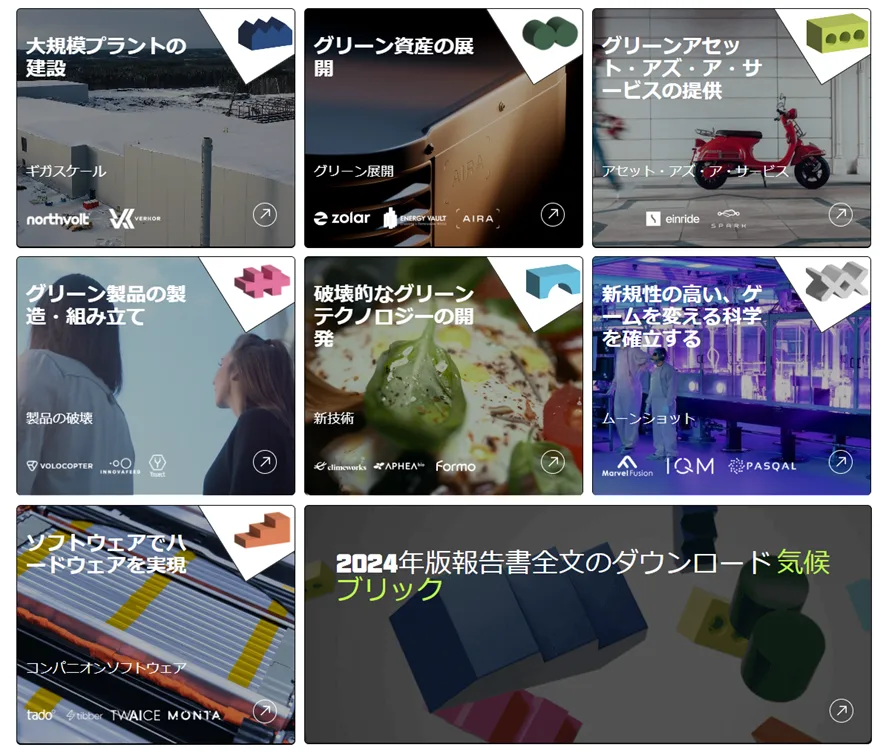
It also summarizes what funding patterns startups fighting each type of battle have gone through. It can be said to be an example of organizing what type of game each one is.
Which Hypotheses Must Be Right for Us to Win?
Looking at this from another angle, it also means understanding "which hypotheses must be correct for us to win this game."
Our product and our business are a mass of hypotheses. The strategies and tactics for reaching the winning conditions mentioned at the beginning are hypotheses, and for that matter, the winning conditions we have set are hypotheses too. And a startup can be said to be playing a game in which, if these hypotheses are correct, it will achieve great success.
Conversely, proceeding without such hypotheses could also be described as acting blindly without any goal.
So, I think it would be good to break down the large hypothesis that is a business idea, view it as a tree structure, identify "which hypotheses in that tree must be correct for this idea to hold up," and move forward while keeping in mind verifying those hypotheses and spending or raising funds to make those hypotheses come true.
I have summarized how to think about and organize such hypotheses in Hypothesis-Driven Action, but it seems to me that being somewhat conscious of such hypotheses and winning conditions from an early stage is required of those running startups more than ever.
仮説行動――マップ・ループ・リープで学びを最大化し、大胆な未来を実現する
So, from time to time, I think it would be good to look back on "what kind of game are we playing?", "what are the rules of the game we are playing?", and "which hypotheses must be right for us to win?"
Addendum
Sometimes the rules of the game themselves are "not fair." In such cases, what is needed is not to comply with the rules but to work on changing the rules themselves. Please take this article as being only about thinking through business, especially startup business.