Startups should not hand out equity to advisors easily (if you do, start from around 0.1%)
This article was machine-translated from Japanese by AI (Claude). It may contain errors. Read the original Japanese article.
The number of people becoming startup advisors seems to be growing lately, which I think is a good thing in itself, but some founders (especially first-time founders) end up giving advisors a lot of shares or stock options.
Before deciding on an allocation: consider asking them to invest instead
Personally, though, my basic recommendation is not to give advisors equity as a rule. Someone with good intentions should be willing to support you to some extent for free, and someone who truly sees potential in the business would join full-time. If someone sees potential but can't get involved because of time constraints, try asking them to make an angel investment (Venture Hacks also recommends this first).
I also recommend judging whether someone is the right advisor not by criteria such as whether they set aside time for consultations, give input, or lend prestige, but by whether they reliably bring results and outcomes (hires, business meetings, introductions, and so on). As far as I know, giving equity to a prominent person just to add prestige has almost no effect (they don't move).
Criteria for allocation
If, after that, you judge that the person will continue to provide value to the startup, I recommend allocating equity according to the company's current stage and the advisor's level of commitment.
For example, the Founders Institute offers an advisor agreement template called FAST (Founder / Advisor Standard Template). FAST proposes the following allocations.
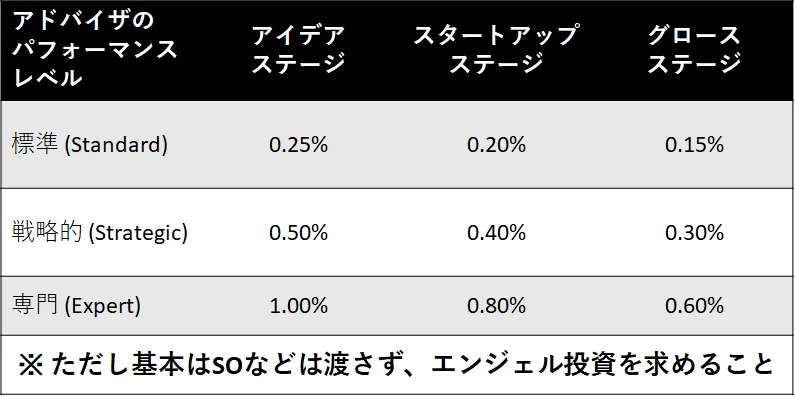
Translation of the FAST v2 table
As for the stages, the guidelines in the contract template describe the idea stage as "everyone is part-time," the startup stage as "finding the first employees," and the growth stage as "traction has started to appear to some extent."
FAST also sets a 3-month cliff and monthly vesting over 2 years, which limits the damage if it turns out early on that the advisor isn't effective. Personally, I feel a cliff and vesting of about this length are reasonable.
From another source, a 2008 Venture Hacks article proposes a benchmark of 0.1–0.25% in common stock for a standard advisor post-Series A, and 1–2% for a super advisor who helps substantially with the company's progress, and says that before Series A these figures should be raised by about 30–50%.
Another source, Silicon Hills Lawyer, says that 0.25–0.50% is typical at the pre-equity round, and that 1% is for an advisor you are acquiring very strategically.
In any case, if employees hold only a small number of stock options while a so-called advisor who doesn't show up even once a week holds a large amount of equity, it becomes hard for the employees who create value every day to stay motivated. I recommend keeping this in mind when thinking about allocating equity to advisors.
(Addendum) I received the comment that these are guidelines for the US and English-speaking world, for when serial entrepreneurs or industry legends join as advisors, and that since it is hard to find advisors who can contribute at this level in Japan, they may not be correct as guidelines for Japan. I, too, basically recommend not giving equity to advisors. As stated above, please understand that this is only a reference case for when there is someone worth giving equity to. In Japan, for example, a case where a professor-level person who has spent many years developing a relevant technology joins as an advisor could serve as one reference. When calculating, please also refer to the thinking in Paul Graham's Equity Equation.
The value of advisors
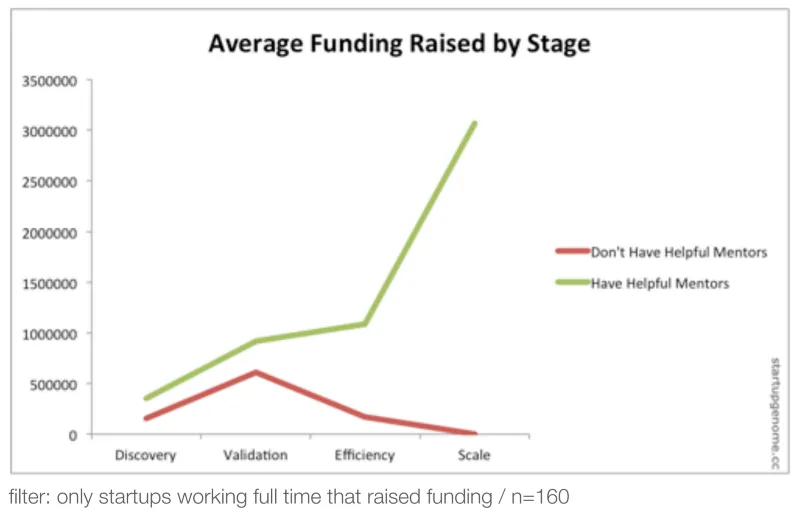
That said, it's not that advisors and mentors are unnecessary. According to Stanford's Startup Genome Report, startups with good mentors raise more funding. There is also a story that Spotify's early growth came from making good use of Facebook's Open Graph, and that this may have been influenced by Facebook's Sean Parker being on Spotify's advisory board. For people who contribute to growth like this, it's probably better to be prepared to pay them properly.
For technical advisory boards, I recommend the following podcast, among others.
https://a16z.com/2015/09/21/building-the-right-technical-advisory-board/
Note: This article is a revised version of an article I posted in 2018. I think it's important to build a sense of market norms in Japan as well.