How to Build a Startup Differs by the Scale You Aim For
This article was machine-translated from Japanese by AI (Claude). It may contain errors. Read the original Japanese article.
When you think about starting a company, how you build it differs quite a lot depending on the "market capitalization" and the "time frame" you aim for as the result.
Looking only at the numbers, a market capitalization from 100 million yen to 100 billion yen seems continuous, and it seems that a business can grow continuously. For example, once sales reach 1 billion yen, you might think you can achieve 10 billion yen at the same pace.
However, depending on the field you choose, a business's growth often "plateaus," so I feel that in practice, what you should think about when starting a company differs for each order of magnitude of the business scale you are aiming for.
Example: Common plateaus in D2C, Vertical SaaS, and contract development
For a D2C business, annual sales of several hundred million yen with a single brand tend to be relatively easy to achieve, and the business appears to get off the ground quickly (of course, it still takes a great deal of hard work).
On the other hand, building a brand that reaches several billion or tens of billions of yen is quite difficult, and sales tend to plateau early. D2C also has relatively low profit margins, so it is quite difficult for a single brand alone to push market capitalization above 10 billion yen, and reaching 100 billion yen beyond that is extremely difficult, by this calculation.
So in this case, if you want to grow the company, you need to think from the start about how to build the business on the premise of multiple brands, and you need to make those preparations from the early stage.
Vertical SaaS for the domestic market is similar: when you consider the target market and the share you can capture (in B2B, probably at most around 20-30%), you can see the limit of sales, and the upper bound of the market capitalization you can reach also becomes visible. To aim for a larger scale, you need to think from the start about creating multiple businesses and products, or about becoming a platform.
For that reason, what you should think about and work on from the early stage differs. You consider whether the business you are entering first is really the right one (for example, whether the first product leads to the next business or product), or you assume that a second product will need one to two years of experimentation to succeed and begin laying the groundwork early.
Contract software development is also a business that gets off the ground quickly. However, the market capitalization of contract software development companies is only about 1 to 2 times sales, so it is quite difficult to build a company with a market capitalization above 10 billion yen. Even if you manage to turn what you learned from contract work into a product, a single product alone will hit a plateau, just like the Vertical SaaS above.
That being the case, even if you start with contract work, if you want to grow big, you need to change how you build and launch from the early stage, for example by thinking about "the one after next" before starting that business.
Of course, there is also value in a business that grows steadily with a single product or a single line of business. But if you aim to be a company that lists on the Tokyo Stock Exchange Growth Market and keeps growing further, then it would be better to keep in mind that how you build a company differs discontinuously with each order of magnitude of the market capitalization you aim for, and to change your startup policy and so on accordingly.
A different order of magnitude means a different way of building
On Japan's Tokyo Stock Exchange Growth Market, it is said that a company with a market capitalization of around 30 billion yen comes under consideration for investment by institutional investors.
So if we organize things by taking 30 billion yen as the center and say that the way of building a business differs for each order of magnitude, I think the methodology of starting a company also becomes clearer.
- 300 billion yen and above
- 30 billion yen to 300 billion yen
- 3 billion yen to 30 billion yen
- 300 million yen to 3 billion yen
- Up to 300 million yen
In a sense, when distinguishing whether a startup is a high-growth startup, treating whether it is trying to build a company with a market capitalization above 30 billion yen as one watershed seems to fit well with the current Japanese startup ecosystem.
(The result may end up being a smaller market capitalization, but the point is, at the very least, whether you are aiming for it.)
It also differs by industry
So far, this has been a discussion about scale. Meanwhile, what you should think about from the early stage also differs depending on the industry you take on.
For example, IT and deep tech are different. And within deep tech, medical and drug discovery differs greatly from the rest, so I think it is better to consider them separately.
- IT
- Deep tech (medical and drug discovery)
- Deep tech (other than medical and drug discovery)
And with the discussion so far, if we classify by crossing target market capitalization with industry, we can make the following table.
Target market capitalization | IT | Deep tech (medical and drug discovery) | Deep tech (other than medical and drug discovery) |
300 billion yen and above | |||
30 billion yen to 300 billion yen | |||
3 billion yen to 30 billion yen | |||
300 million yen to 3 billion yen | |||
Up to 300 million yen |
It also differs by whether growth is accidental or intentional
One more distinction I want to make is whether you bet on chance for the business's growth or pursue it deliberately. Each is a gradient, but I think a venture leans toward one or the other.
For example, when there is a major change in platforms or technology and "no one knows what will hit," betting on chance and taking on a large number of challenges, in the spirit of "if you take enough shots, one will hit," will be the optimal answer. In fact, I think that in some respects startups are expected to take on such challenges.
Even so, a contract business in software or R&D has an upper limit (for example, the number of people becomes the rate-limiting factor), so you need to look beyond that, or aim to take many shots with products.
On the other hand, for a deliberate startup, I think you need to think carefully about which market capitalization you are building toward, and only then take the first step.
If we add this axis to the table above, we get the following table.
Target market capitalization | IT | Deep tech (medical and drug discovery) | Deep tech (other than medical and drug discovery) | |||
Accidental | Intentional | Accidental | Intentional | Accidental | Intentional | |
300 billion yen and above | Take many shots | Take many shots | Take many shots | |||
30 billion yen to 300 billion yen | ||||||
3 billion yen to 30 billion yen | ||||||
300 million yen to 3 billion yen | ||||||
Up to 300 million yen | ||||||
Support also differs
Over the course of thinking through the methodology of starting a company, we have made several distinctions.
I believe these distinctions are also important for those who provide support. What a founder is aiming for changes the methodology of starting the company and what should be considered early on, and as a result, the way support should work changes too.
What we should be careful about is that no matter what scale of business you are launching, the early stage of getting a business off the ground looks roughly the same in terms of objectively visible actions. This is because what you do is hypothesis testing and product development.
But the thinking behind those actions differs considerably.
Moreover, if the supporting side is not clear about what scale of company it is trying to support, I think the support or advice given along the way may end up lowering the order of magnitude of the business scale the founder is aiming for (for example, "It's better to start by earning steadily").
Also, even when aiming to grow big by chance, the support needs to consider whether that form of startup "can truly grow big."
Where to increase support, and where to increase startups
The topic shifts a little. When we look at Japan's startup ecosystem as a whole, I think the scarcest resource is founders willing to take on challenges.
It is said that about 150,000 businesses are opened in Japan each year, but most of them are not startups aiming for rapid growth.
The number of seed investments per year has hovered at a little under 1,000 each year. Considering the cases that did not result in investment and the companies that chose a path of rapid growth without taking investment, we can estimate that there are roughly 2,000 startup-style new ventures per year.
How to allocate these 2,000 challenges a year across the boxes in the table above is, I think, what it means to build a portfolio of innovation for all of Japan in high-risk business domains.
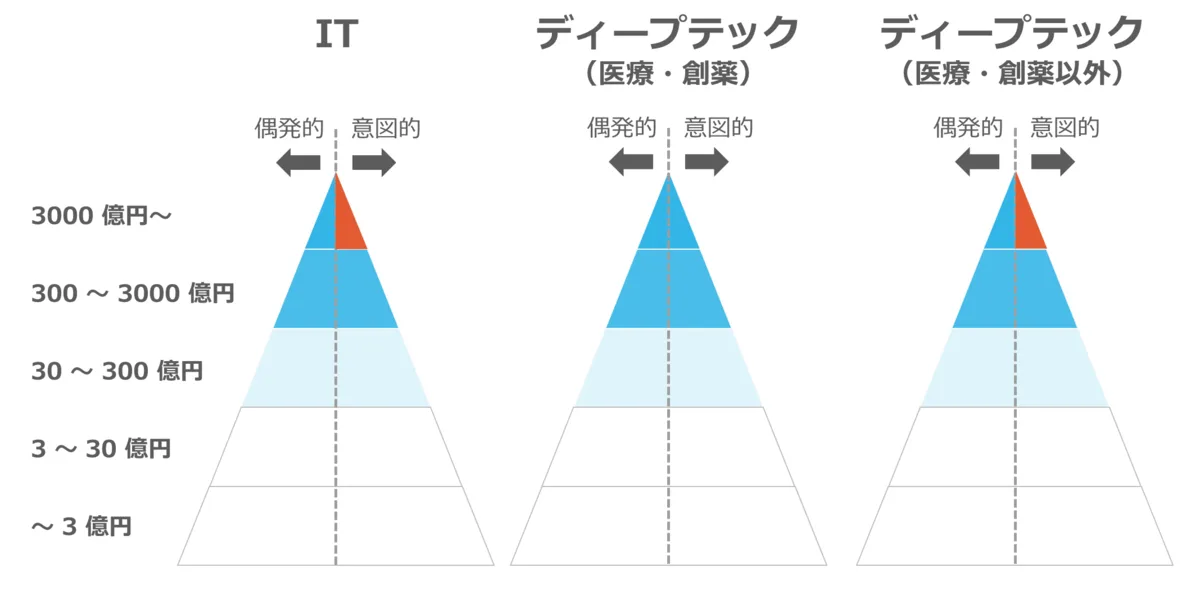
For example, the top box, 300 billion yen and above, probably has a low probability of success, so we would like to allocate 200 challenges to it, and the question is whether that is being done.
In reality, you cannot allocate them deliberately, so the ecosystem as a whole will have to optimize which boxes to attach incentives to in order to attract founders.
Moreover, the return to the ecosystem as a whole is roughly determined by
number of startups × probability of success × size of success
The number of startups and the probability of success might be raised by 10 to 20% with effort, but going beyond that seems quite difficult. In fact, even in these past few years when market conditions were good, the number of seed investments did not increase dramatically. If so, we should assume it will be quite difficult to dramatically increase the number of startups in the future.
In the United States, founders appear like bamboo shoots after the rain, and an ecosystem suited to taking many shots seems to have formed, where companies that do not work out are quickly shut down so founders can move on to the next challenge. But in Japan, the number of founders taking on high-growth startups is not that large, and they tend to continue a single challenge for a long time. Considering this, I think a strategy that relies on "taking many shots" is not suited to Japan.
The probability of success might also be raised by 20%, but I think that even if it were raised as much as possible, it would not reach the return that is currently demanded of the startup ecosystem.
That leaves us needing to make efforts to raise the size of success. In other words, the top row of the boxes.
And whether a company can get into that domain seems to be decided quite early in the company's life, such as at the idea stage.
With all that in mind, I personally would like to explore the methodology through very early-stage support for founders who deliberately aim for 300 billion yen and above (the red area in the figure below).