"Indie Startups" and Small Businesses
This article was machine-translated from Japanese by AI (Claude). It may contain errors. Read the original Japanese article.
At a social gathering, the topic came up of calling ventures built on contract development or self-funding "indie startups" or "indie businesses."
Startups and small businesses are often compared, but the term "small business" seems to inevitably carry the nuance that small means not good (that is certainly not the case, and I think choosing to be proudly small is a perfectly valid option).
While dispelling that negative nuance, I feel that "indie" may be a word that can stand in contrast to high-growth startups.
The "indie" in "indies," a word used in music, games and so on, comes from "independent," and it has gained a fair amount of recognition. So when the term indie startup is used as a form of entrepreneurship, that background works well, and
- independence
- a deliberate orientation toward staying small
- coolness
and other positive nuances can be included, so I think it may have the potential to be more widely accepted than the term small business.
I think this topic originally arose from a discussion on Off Topic.
インディーズVC・スタートアップの時代 #205 | オフトピックyoutube.com
I was talking while also recalling ventures that shut down, such as indie.vc.
(Incidentally, the indie.vc site has a video of a unicorn being burned.)
Classification of entrepreneurship
Now that every kind of venture is sometimes called a "startup," there are more and more situations where we need to raise the resolution and align on which kind of venture we mean. As ways of organizing this, I have already introduced things such as the four types of entrepreneurial ventures and high-growth startups.
In addition to those, by adding an axis of what kind of independence the company is trying to maintain, that is, "whether it is indie or not,"
- no external funding ⇔ external funding (indie or not)
- growth ⇔ stability
it seems we can organize things along these two axes.
(However, as I will explain a little later, I think the axes are not orthogonal to each other.)
Organizing along two axes
If we represent the presence or absence of external funding on the horizontal axis and the orientation toward growth on the vertical axis, we get the following two axes.
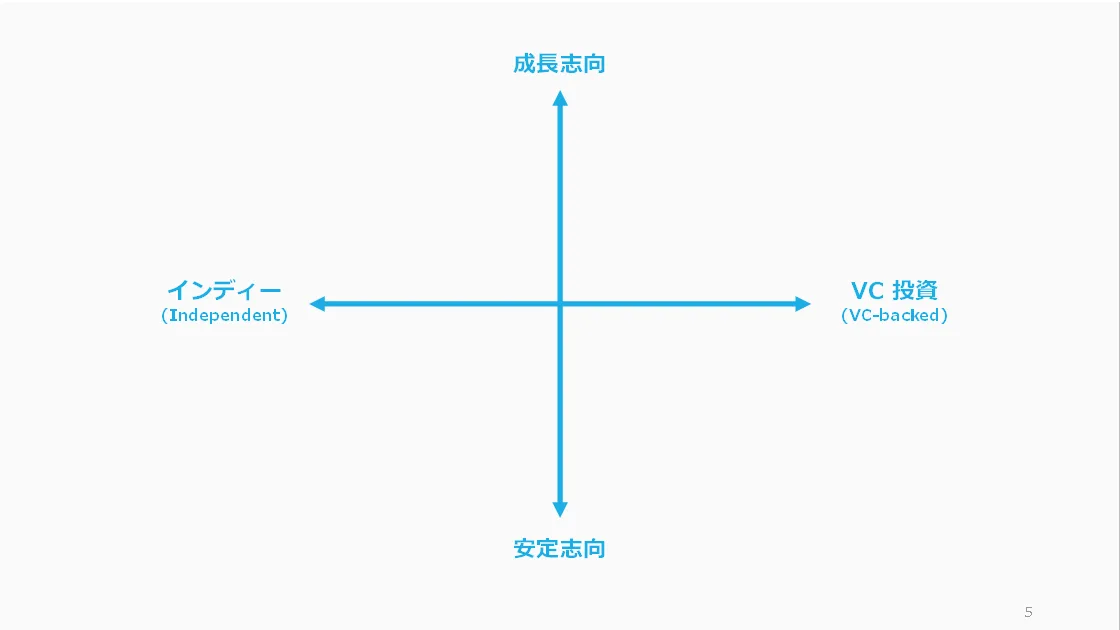
I think organizing along these two axes makes the vague term "startup" somewhat easier to sort out.
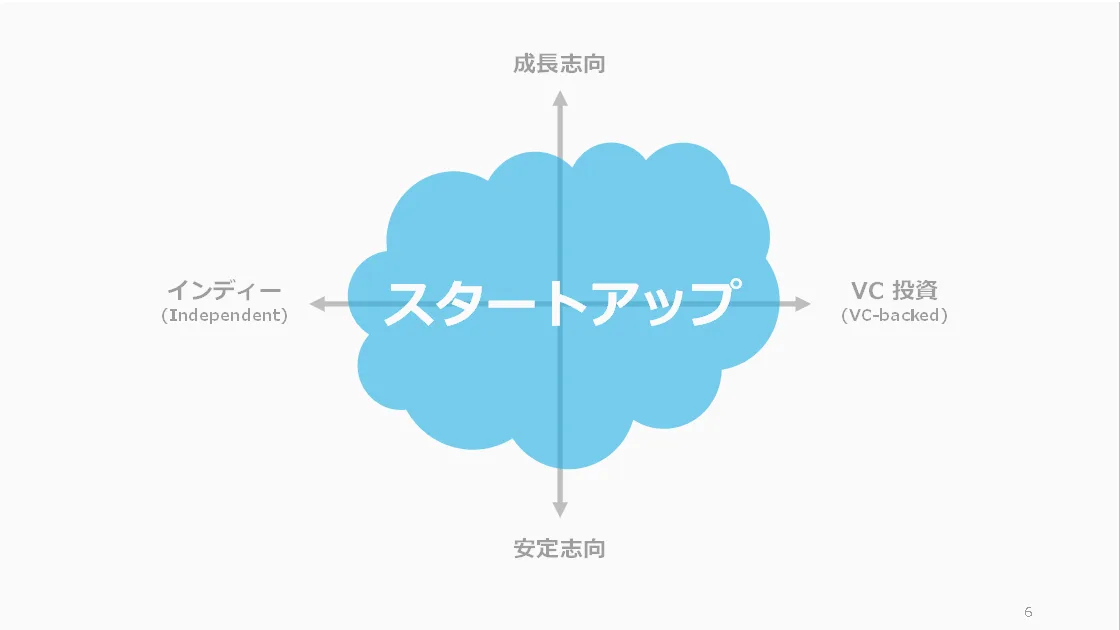
A diagram of the vague term "startup"
Horizontal axis: independence
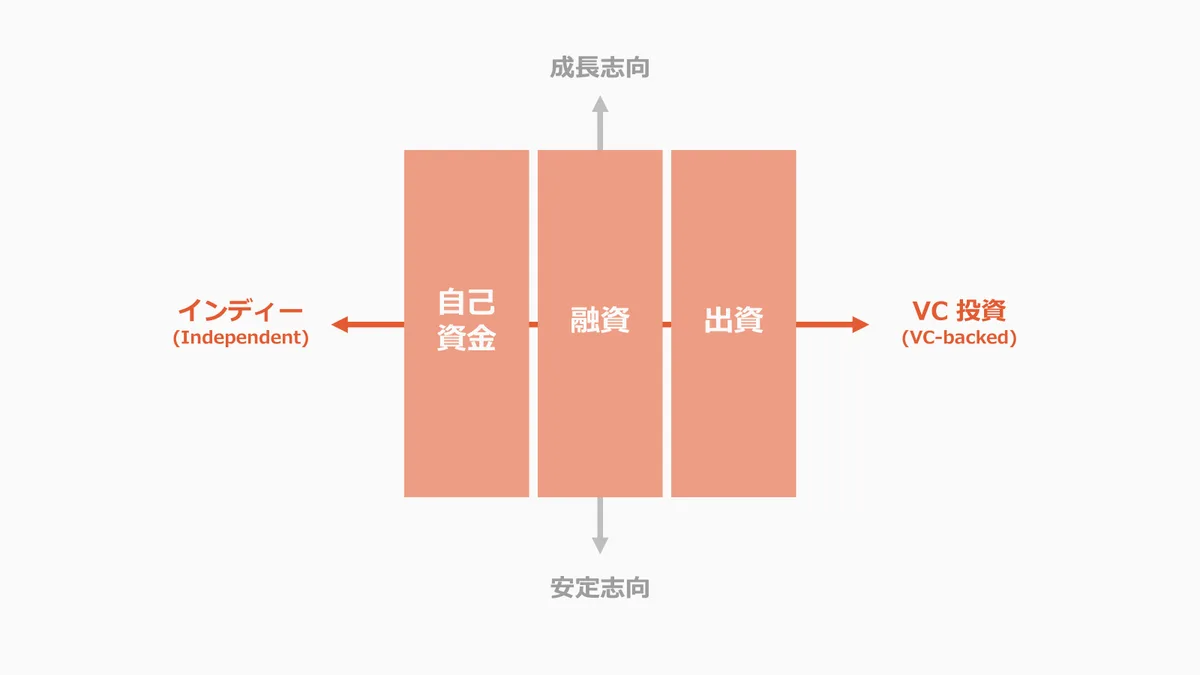
First, on the horizontal axis, from the viewpoint of independence, I divide by self-funding, loans, and equity investment, placing indie on the left and those receiving VC investment on the right.
Vertical axis: growth ⇔ stability
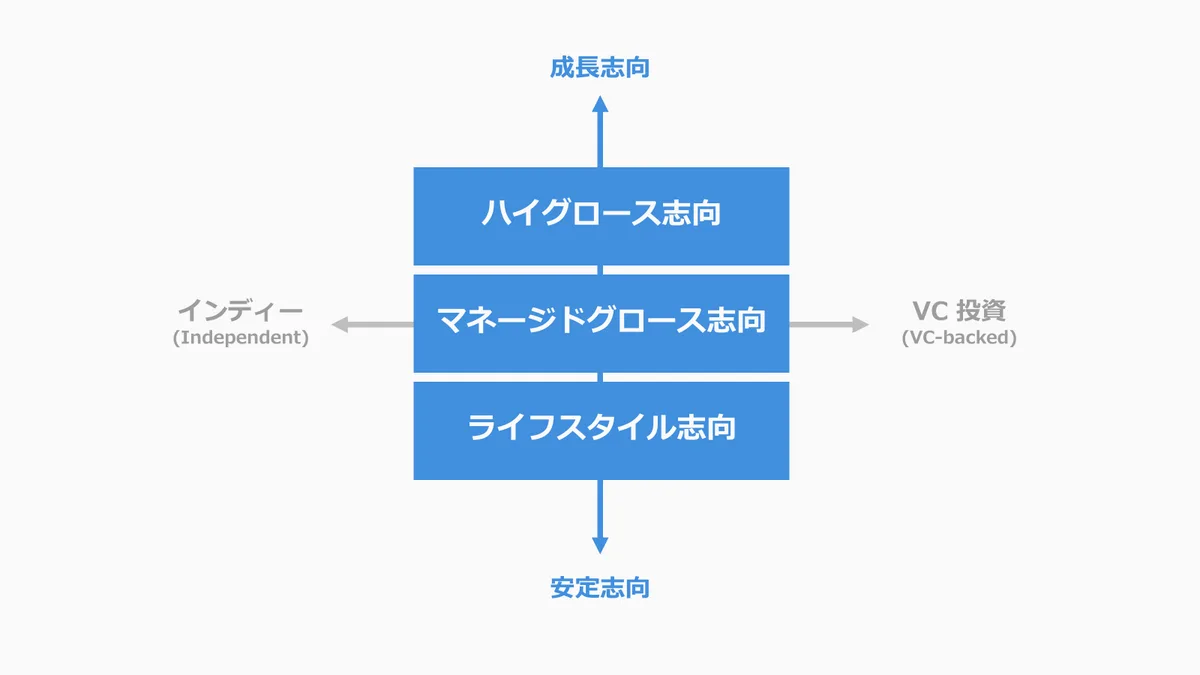
On top of that, on the vertical axis I map which of growth and stability is emphasized. This time, from the four forms of entrepreneurship, I take up the following three1.
- High-growth orientation
- Managed-growth orientation
- Lifestyle orientation
Four quadrants
Finally, my image is to cross these with each other and classify them in more detail.
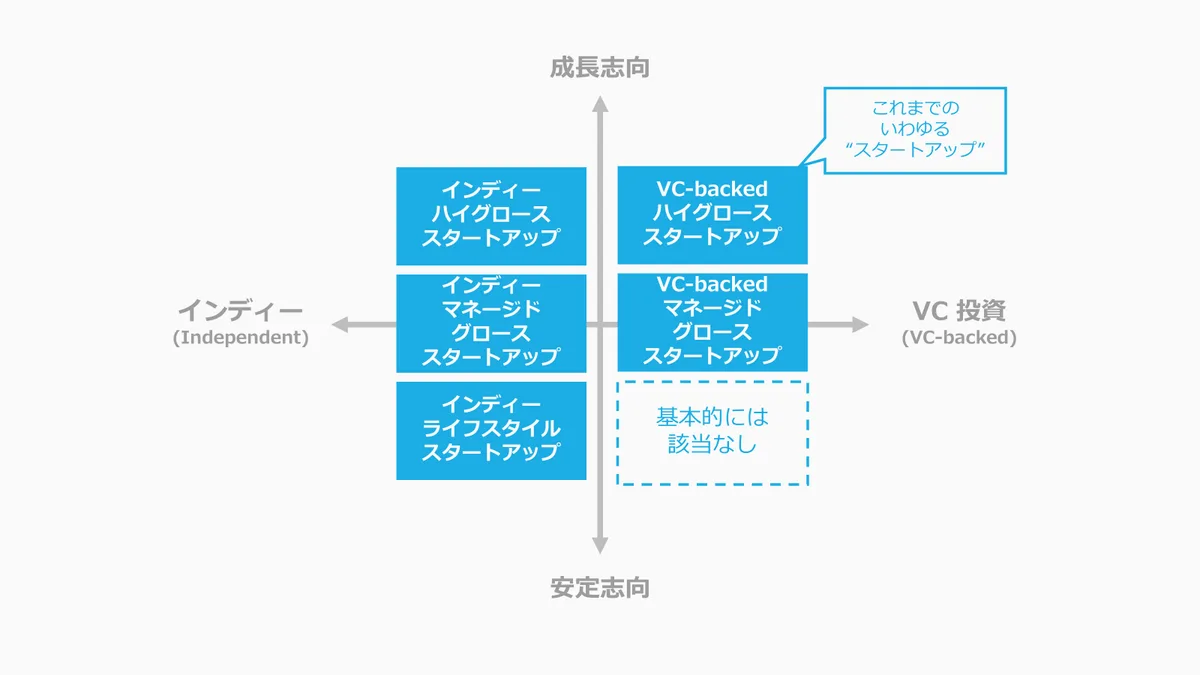
Even with an indie orientation, rapid growth is possible. However, in terms of numbers, I think many high-growth startups will be VC-backed.
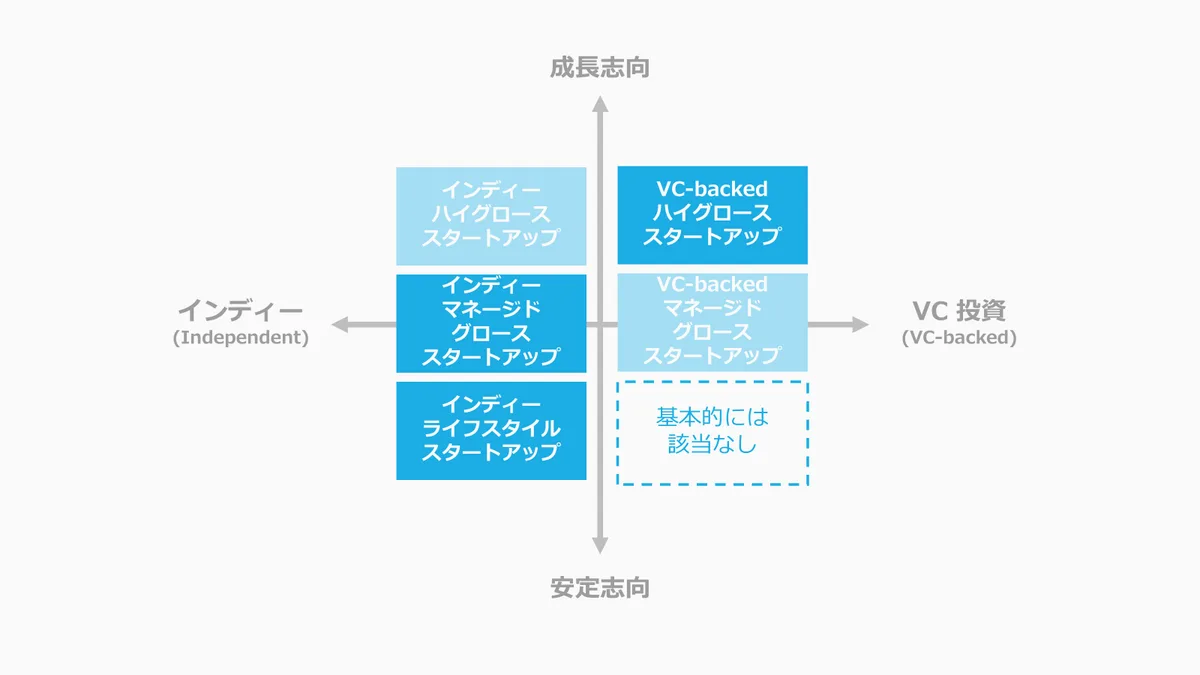
For example, I think the contract software development companies I mentioned at the beginning would fall under indie lifestyle startups, or indie managed-growth startups.
Summary
As I wrote in a previous article, I am concerned that the word "startup" has come to refer to entrepreneurship in general, and that unless we organize things, discussions will not mesh well and policy may even go in a strange direction.
At the same time, using the term "small business" in contrast to startups can invite some misunderstanding or resistance because of its nuance, so I think that if terms such as indie startup and indie business emerge, things may settle more comfortably.
Looking back, it seems that the separate word "startup" emerged because "venture company" had come to refer to "emerging companies" in general, and there was confusion over terminology at that time as well.
It is odd in the first place that "venture company" came to refer to "emerging companies" in general; the word "venture" originally means "adventurous," so it should not mean stable entrepreneurship. (Perhaps starting a business itself was an adventure, though.)
In any case, the nouns "venture company" and "startup" seem to be steadily broadening in the range they cover.
So I suspect that unless we attach adjectives such as "indie" and "high-growth," we can no longer properly recognize the forms of entrepreneurship in Japan today, and discussions will not mesh. In that sense, I thought the word "indie," which can express an orientation, may be useful.
Addendum: There has been the word "bootstrap" until now, but I feel that bootstrap strongly carries the sense of "how you start" and is not a state or an orientation, so this time I have prepared a slightly different word.
Footnotes
-
Survival-type ventures are almost nonexistent in Japan, so I have left them out. ↩